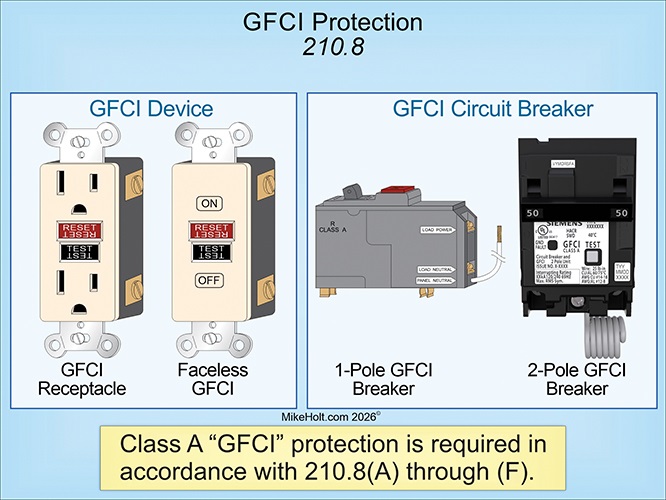
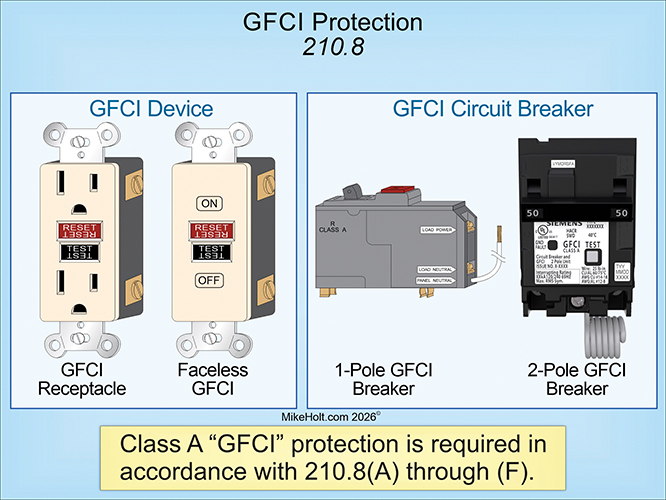
Article 100 Defines a Ground-Fault Circuit Interrupter (GFCI) as a device intended to protect people by de-energizing a circuit when ground-fault current is 6 milliamps (mA) or higher, and it does not open when the ground-fault current is less than 4 mA. It monitors current flow in the circuit conductors supplying the load and opens the circuit if there’s an imbalance.
An arc-fault circuit interrupter (AFCI) is defined in Article 100 as a device intended to de-energize the circuit when it detects the current waveform characteristics unique to an arcing fault. It monitors the circuit, and if it detects a parallel or arcing fault, the AFCI de-energizes it.
The difference is simple: a GFCI primarily protects people from electric shock, while an AFCI helps protect people and property from fires caused by arcing faults.
GFCI general requirements
GFCI protection as required in 210.8(A) through (F) must comply with the following: the GFCI device must be in a readily accessible location [210.8]. This is important for monthly testing as recommended by the manufacturer’s instructions.
Note: “readily accessible” is defined in Article 100 as capable of being reached quickly for operation, renewal or inspection without those requiring ready access to take actions, such as the use of tools (other than keys), climbing over or under obstructions, removing obstacles or requiring the use of portable ladders.
GFCI protection can be provided by a GFCI circuit breaker or a GFCI receptacle.
GFCI protection of receptacles in dwelling units
Receptacles rated 125V or 250V in the dwelling unit locations specified in 210.8(A)(1) through (A)(14) must be GFCI-protected.
Those locations are:
- Bathrooms [210.8(A)(1)] or garages [210.8(A)(2)]
- Areas of accessory buildings limited to storage, work and similar uses [210.8(A)(3)]
- Outdoors [210.8(A)(4)]
- Crawl spaces at or below grade [210.8(A)(5)] or in basements [210.8(A)(6)]
- Kitchens [210.8(A)(7)]
- Areas with sinks and permanent provisions for food preparation, beverage preparation or cooking [210.8(A)(8)]
- Within 6 feet* of the top inside edge of the bowl of a sink [210.8(A)(9)]
- Boathouses [210.8(A)(10)]
- Within 6 feet* of the outside edge of a bathtub or shower stall [210.8(A)(11)]
- Laundry area [210.8(A)(12)]
- Indoor damp locations [210.8(A)(13)]
- Indoor wet locations [210.8(A)(14)]
*Measured as the shortest path the power supply cord connected to the receptacle will follow without piercing a floor, wall, ceiling or fixed barrier [210.8].
GFCI protection of receptacles in other occupancies
GFCI protection is required for 125V through 250V receptacles supplied by single-phase branch circuits 50A or less or three-phase branch circuits 100A or less rated 150V or less (to ground) in other than dwelling locations listed in 210.8(B)(1) through (16). These locations are:
- Bathrooms [210.8(B)(1)]
- Kitchens [210.8(B)(2)]
- Areas that contain sinks with permanent provisions for food preparation, beverage preparation or cooking [210.8(B)(3)]
- Areas that have permanent provisions for food serving, beverage serving or cooking [210.8(B)(4)]
- Rooftops [210.8(B)(5)]
- Outdoors [210.8(B)(6)]
- Receptacles and cord-and-plug-connected fixed or stationary appliances within 6 feet* from the top inside edge of the bowl of a sink [210.8(B)(7)]
- Indoor damp locations [210.8(B)(8)]
- Indoor wet locations [210.8(B)(9)]
- Locker rooms with showers [210.8(B)(10)]
- Garages and similar areas [210.8(B)(11)]
- Crawl spaces [210.8(B)(12)]
- Unfinished basement areas [210.8(B)(13)]
- Within 6 feet* from the top inside edge, rim or conductive support framing of an open aquatic vessel or container, bait wells and similar tanks or bowls for aquariums [210.8(B)(14)]
- Laundry areas [210.8(B)(15)]
- Within 6 feet* of the outside edge of a bathtub or shower stall [210.8(B)(16)]
*Measured as the shortest path the power-supply cord connected to the receptacle will follow without piercing a floor, wall, ceiling or fixed barrier [210.8].
GFCI protection for appliances
GFCI protection is required for hardwired or cord-and-plug-connected appliances rated 150V or less to ground (120V, 208V, 240V, 120/240V, 208Y/120V), 60A or less [210.8(D)]. These are:
- Automotive vacuum machines [210.8(D)(1)]
- Drinking water coolers and bottle-fill stations [210.8(D)(2)]
- High-pressure spray-washing machines [210.8(D)(3)]
- Tire inflation machines [210.8(D)(4)]
- Vending machines [210.8(D)(5)]
- Sump pumps [210.8(D)(6)]
- Dishwashers [210.8(D)(7)]
- Electric ranges [210.8(D)(8)]
- Wall-mounted electric ovens [210.8(D)(9)]
- Counter-mounted electric cooking units [210.8(D)(10)]
- Clothes dryers [210.8(D)(11)]
- Microwave ovens [210.8(D)(12)]
Electric shock hazards exist whether appliances are hardwired or cord-and-plug-connected.
GFCI protection for receptacles for equipment requiring servicing
GFCI protection is required for 15A or 20A, 125V receptacles within 25 feet of the air conditioning equipment as required in 210.63(A) and in the same room as the indoor switchboards, panelboards and service equipment as required by 210.63(B) [210.8(E)].
GFCI protection for dwelling outdoor equipment
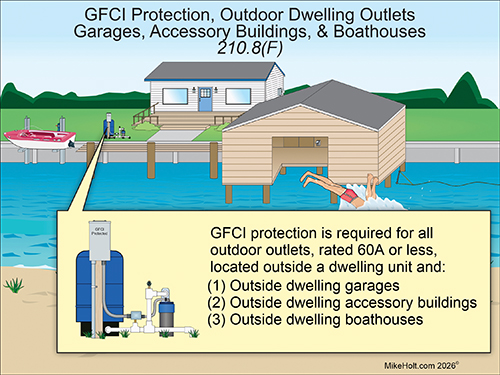
GFCI protection is required for all outlets for electrical equipment, such as HVAC, pumps, etc., rated 60A or less, outside dwelling units, dwelling garages, dwelling accessory buildings and dwelling boathouses [210.8(F)].
Note: Class A GFCIs marked “HF” are evaluated for use with loads having high-frequency leakage currents from power conversion components such as variable-speed drives and inverters. See UL 943, Ground-Fault Circuit-Interrupters, for further information [210.8 Note 2].
If equipment connected to any dwelling outdoor outlets is replaced, the circuit to the outlet must be GFCI-protected.
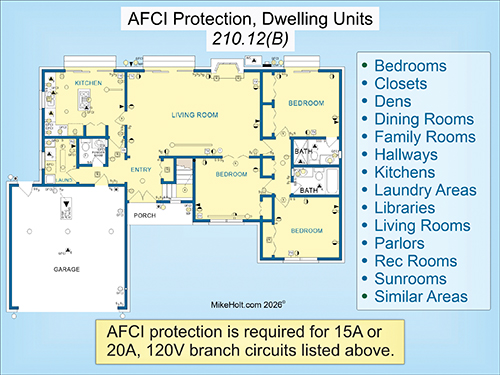
AFCI requirements
AFCI protection as required in 210.12(B) through (E) must be in a readily accessible location and comply with the following: AFCI Protection for Dwelling Units. AFCI protection is required for 15A or 20A, 120V branch circuits in the following dwelling unit locations [210.12(B)]: kitchens, family rooms, dining rooms, living rooms, parlors, libraries, dens, bedrooms, sunrooms, recreation rooms, closets, hallways, laundry areas and similar areas.
AFCI protection for dormitories
AFCI protection is required for 15A or 20A, 120V branch circuits in these dormitory unit locations [210.12(C)]: bedrooms, living rooms, hallways, closets, bathrooms and similar rooms.
AFCI protection for other occupancies.
AFCI protection is required for 15A or 20A, 120V branch circuits in these locations [210.12(D)]: guest rooms and guest suites of hotels and motels; areas in nursing homes and limited-care facilities that are used exclusively as patient sleeping rooms; and areas designed for use exclusively as sleeping quarters in fire stations, police stations, ambulance stations, ranger stations and similar locations.
AFCI protection for wiring extensions or replacements
If the wiring is extended or replaced in areas where AFCI protection is required, the branch circuits must be provided with AFCI protection as follows [210.12(E)]: 1) AFCI circuit breaker, and 2) AFCI receptacle or AFCI-protected switch at the first outlet of the existing branch circuit.
AFCI protection is not required for extension wiring less than 6 feet long if no outlets are added. This measurement does not include the conductors inside an enclosure, cabinet or junction box [210.12(E) Exception].
GFCI and AFCI rules summary
Many dwelling unit locations have overlapping GFCI and AFCI requirements. In these areas, a dual-function GFCI/AFCI circuit breaker can be a practical solution. Remember, GFCI and AFCI devices must be readily accessible. Don’t install them where they can’t be reached without removing obstacles or using a portable ladder.
Missing a GFCI or AFCI requirement can result in a failed inspection and costly rework. Learn the rules, apply them correctly and become the go-to person others trust.
mike holt enterprises
About The Author

HOLT is a National Electrical Code expert, author and educator with more than 50 years of experience in the electrical industry. He started his career as an apprentice and became a master electrician, electrical inspector, contractor, instructor and publisher. He has written hundreds of electrical training books used nationwide through MikeHolt.com. He can be reached at [email protected].