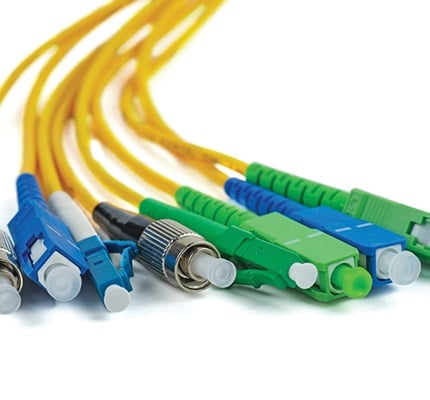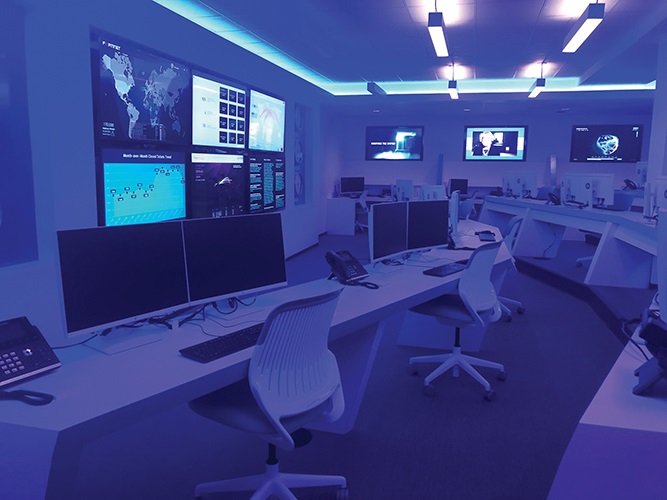
Mercyhurst University in Erie, Pa., boasts a lab for teaching students about cybersecurity. Supporting the lab’s state-of-the-art technology is a robust fiber communications network installed by Dagostino Electronic Services Inc., a systems integrator
in Pittsburgh. That network was made possible with the application of the latest fiber enhancement technologies and best practices related to industry standards and customer relations.
Preparing for the future
Dagostino Electronic Services helps clients tap the potential of new fiber technologies for serving mission-critical functions. It also prepares those fiber networks for future service.
Bob Dagostino, president, started the company in 1973. In addition to Mercyhurst University, Dagostino Electronic Services has developed and maintained fiber networks for NASA, the U.S. military, hospitals, school districts, universities and commercial enterprises.
“Our value is in installing fiber, testing fiber, the splicing and commissioning the fiber—essentially verifying that it meets standards and will support the equipment being plugged into it,” Dagostino said. “It can be challenging. We’re working with glass the thickness of a human hair.”
Even so, for rapid communication of data and information supporting mission-critical activities, fiber continues to evolve, gain capacity and offer unlimited possibilities.
“We are moving beyond multiplex fiber and more to single-mode fiber, which supports higher bandwidth and uses lasers rather than LED to pulse light,” Dagostino said.
Like other contractors, Dagostino Electronic Services has encountered customers that need help meeting their current needs and preparing for the future. In that mix are some who believe their fiber networks are already equipped for the future, when in reality they’re not even meeting current needs.
“The biggest problem is that most people don’t interrogate their network performance on a regular basis,” Dagostino said. “They haven’t made the effort to quantify the inefficiencies.”
To maintain high performance, it’s necessary to examine the components of source and destination to find opportunities for further optimization.
“We collect statistics related to the packets of data that traverse the network from source to destination and identify the bottlenecks,” Dagostino said.
With older systems, data packets become corrupted, causing the network to resend data—a sure sign of poor performance and wasted bandwidth.
Because cable operates at different frequencies, new and existing networks working side by side can produce cross-talk and resistance, Dagostino said. Network performance should be tested according to IEEE and ANSI standards prior to turning any system over to the customer.
But key to ensuring performance is working with customers early on to learn their needs, Dagostino said. “We have to have a seat at the table when our customers are planning for their network needs.”
Analog systems of the past—security systems, multimedia, audiovisual—are crossing into the IT network.
“All of this information is being transmitted over the backbone of cable,” Dagostino said. “Fiber is still the closest thing you can do that is future-proofing. We have to stress to our customers that fiber is not just needed to support their immediate needs but also future needs for the next three to five years.”
Dagostino predicts that quantum computing is poised to take off in the next five years for research in the university setting.
“We’ve got to build solid infrastructure to support high-performing networks,” he said. “But to do that, we must continue to understand their changing priorities, their markets and their business models.”
Maximizing capacity
Zach Magid, chief operating officer for Millennium Communications Group Inc., East Hanover, N.J., agrees. Millennium serves the U.S. military, hospitals, universities and businesses, and works with large local telecom networks such as Comcast, Verizon, Crown Castle, Lumen and Zayo.
Magid was early to identify the critical misconception among some clients that their fiber networks are inherently future-proofed. He said this usually results from forgoing essential practices such as regular audits, maintaining detailed geographic information system (GIS) mapping of fiber infrastructure and implementing a robust fiber use program or management strategy.
“Some clients rely on their building and grounds teams or IT teams for managing fiber infrastructure,” Magid said. “But those approaches don’t always align with the specialized technical priorities and strategic planning required to ensure the network’s long-term performance and scalability.”
Millennium helps customers to better use existing networks and to see fiber “almost like pathways between buildings that you can reuse, repurpose and reallocate,” he said.
Millennium’s system designers and engineers anticipate how networks and supporting infrastructure must evolve to meet future customer objectives.
“Future-proofing is really about optimizing functionality and building in flexibility to accommodate cost-effective changes down the line,” Magid said.
Proper documentation and inventory management are critical first steps to achieving these goals.
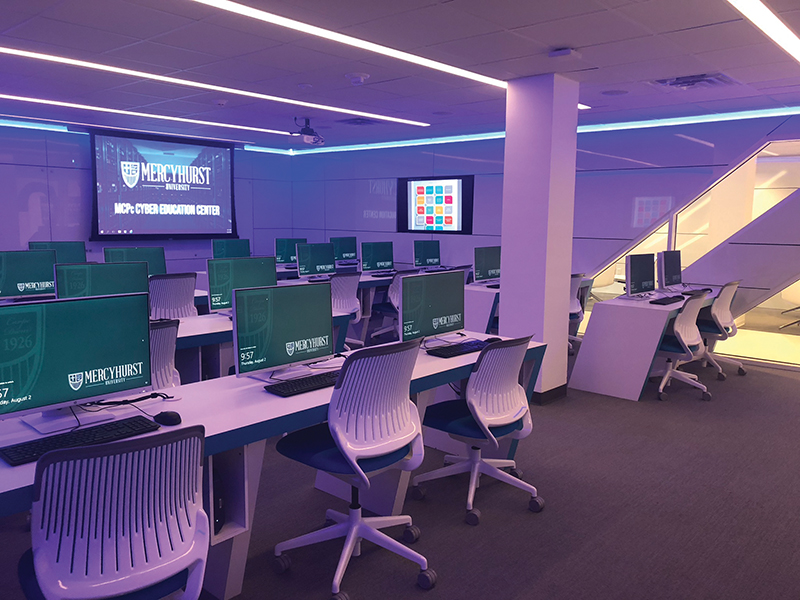
State-of-the-art fiber optic technology supports the cybersecurity lab at Mercyhurst University.
“For instance, a fiber system in a ring configuration with spokes running to campus buildings can involve simple modifications but only if you know what’s already there and have an accurate knowledge base of the utilization,” he said.
Using GIS as an online mapping tool reveals how many strands are in each cable but the information must be updated.
“We often help our customers generate their own fiber inventories if they don’t already have these,” Magid said.
He also noted technologies that enhance network capacity while minimizing unnecessary construction and expense. Multiplexing, for example, allows a single fiber to function like 10 or 20, using lasers to send multiple channel signals and effectively increasing capacity tenfold or more. High-density terminations and multifiber push-on connectors further support efficient use of fiber resources.
“The majority of carrier networks had access to these more advanced technologies decades ago,” Magid said. “Fortunately, these have become more affordable, allowing us to integrate them into our customers’ legacy systems.”
Like Dagostino Electronic Services, Millennium avoids costly retrenching by using MaxCell fabric innerduct to insert and protect new fiber pathways inside existing conduit. This product saves time and avoids having to submit permitting for working beneath railroads and other public rights-of-way. With every network modification or update, Millennium provides detailed “as built” documentation, which is integrated into the client’s existing GIS mapping.
“This is one of the most critical aspects of future-proofing,” Magid said. “It lays the groundwork for adapting to evolving needs and supports efficient, cost-effective expansion.”
An example for others
The U.S. military’s future-proofing efforts offer a great example for others to follow, said John Adams, owner of Adams Telecomm, The Villages, Fla. He’s also a veteran, a registered communications distribution designer (RCDD) outside plant (OSP) specialist who teaches BICSI-certified RCDD classes in the OSP and inside plant for fiber network designers, and a consultant for MaxCell.
“In the past, it seemed like the military was focused on getting projects completed quickly so troops could be moved in and/or out of bases,” Adams said. “However, in the last 25 years, I’ve seen dramatic movement toward planning, future-proofing, cost effectiveness and reliability, along with the military seeking advice from the private sector.”
Providing training and inspections worldwide, Adams has taught increasing numbers of military personnel about “best practices” and industry-recommended methodologies. The most gratifying aspect of this work, he said, is the attitude attendees bring to class.
“They genuinely want to learn, and they are starting to set an example for the industry,” Adams said.
Gaining capacity and providing room to grow in the OSP world “is not that big of a chore at the start of a project,” he said.
Building out larger infrastructure—for example, going from four to six conduits—saves having to redo and retrench years later, especially when conduits run beneath railroad tracks, roads and other paved surfaces.
“For both new and existing infrastructure,” Adams said, “I believe the military has found the answer by identifying pathways rendered unusable, requiring subdivision of conduits, repairing existing conduits, allowing room in trenches for new conduits if required, and protecting underground structures with concrete encasement. Add controlling the use of available conduits to that list and you have a much better chance of managing future needs.”
To optimize use of existing conduit, subdivide conduit spaces with fabric mesh innerduct, he said. Replace old fiber with single-mode fiber that can handle more channels of communication. It also makes sense to assign fiber pathways and networks to conduit, not just allow different groups to claim interest, he said.
Above all, employ or work with experienced system designers who possess RCDD credentials as required by the military, Adams said.
Sustainable, accessible, flexible
Constructing fiber network infrastructure that will serve future generations in an increasingly interconnected world is an overarching goal of Sean Adam, vice president of market strategy and innovation at AFL, Duncan, S.C., a manufacturer of fiber optic cable and connectivity conductor accessories, fusion splicers, and testing and inspection equipment.
He touts modular design principles and the company’s trademark recommended approach for customers, SAFER. The term stands for constructing systems that are:
- Sustainable and long-lived to reduce the need for replacement and disposal
- Accessible, to allow technicians to go into the field and easily make network changes
- Flexible, for adapting to new demands and technologies
- Expandable
- Reliable
“We’re nowhere near reaching the transmission capacity of fiber technology that’s available now,” Adam said. “We can develop systems that will serve generations to come.”
He and Manja Thessin, enterprise market manager at AFL, also suggested that electrical contractors performing fiber work employ or partner with BICSI RCDD-certified system designers.
Dagostino Electronic Services and Millennium Communications Group employ and partner with RCDD-certified designers.
DAGOSTINO ELECTRONIC SERVICES INC. | EXENTIA / STOCK.ADOBE.COM
About The Author
.jpg?sfvrsn=a64b988b_1)
DeGrane is a Chicago-based freelance writer. She has covered electrical contracting, renewable energy, senior living and other industries with articles published in the Chicago Tribune, New York Times and trade publications. Reach her at [email protected].