Millard County, Utah, seems an unlikely place for innovation in data center power design. With a population around 13,500, it’s an agricultural center best known for its alfalfa seed production. However, artificial intelligence (A.I.) developer Joule Capital Partners has targeted a 4,000-acre farm in the county as a site for a new data center campus with a power demand that could eventually total 4 gigawatts (GW), and it has some creative ideas for meeting that need.
The company plans to provide its own on-site power, a common strategy as utilities struggle to upgrade their own generation. But the resource it is turning to—a fleet of industrial natural gas generator sets, or gensets—is unique and illustrative. With utilities and A.I. operators now competing for more commonly used turbine generators, Joule is opting for equipment designed for backup applications to keep its servers running 24/7. As turbine manufacturers are backed up through 2029, such approaches could become more common in this rapidly developing market.
A.I. supercharged turbine demand
Today’s tight turbine market represents a significant turnaround for equipment manufacturers’ fortunes in just a few years. For almost two decades, sales of utility-scale generators were essentially flat. With electricity demand rising a mere 1% to 2% annually, utilities saw little need for new generation. Yes, coal plants were retiring, but solar and wind, backed up by battery-based storage, grew quickly to make up for any shortfall.
In November 2022, OpenAI launched ChatGPT, and everything related to power generation changed. A.I. wasn’t a new concept—versions of it have been around for years. But ChatGPT’s conversational interface and wide-ranging expertise brought a new understanding of the effects of large language models on daily life.
The ensuing competition among tech companies to carry those advances further has created a data center building boom that shows no sign of abating. To power these new facilities, utilities and independent power producers have turned their attention back to natural gas turbines. These machines can rapidly ramp up or down to meet A.I.’s irregular demand patterns and can be more easily located at the scale needed than solar and wind generation.
The generation scramble
For utilities, generation is just one piece of the puzzle in speeding delivery to new hyperscale data centers that can require 20–100 megawatts (MW) each. There’s also the need for substations, transformers, power lines and other equipment, all of which is currently in short supply. This is why developers are now encouraged to develop their own on-site power sources. This also means that utilities and their customers are competing for the same limited turbine supply.
Because market growth was so slow for so long, production capacity declined over the last 20 years. Today, just three companies—GE Vernova, Boston; Mitsubishi Heavy Industries (MHI), Houston; and Siemens Energy, Orlando, Fla.—manufacture about 75% of all gas turbine generators, according to figures from energy consulting firm Wood Mackenzie. Those three leaders face their own shortages from their suppliers.
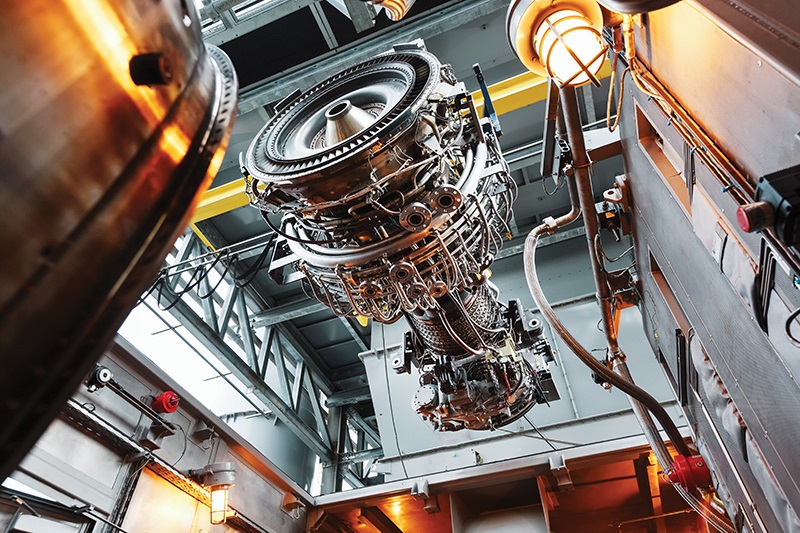
Beyond that, these are bespoke products—they can’t be mass-produced. Given their demanding operating conditions, with blades spinning at up to 3,000 revolutions per minute, many components need to be hand-machined.
Manufacturers have begun expanding their operations to meet data center demand. GE Vernova is in the midst of a $160 million expansion at its Greenville, S.C., plant, where it expects to add more than 650 new employees. Similarly, Siemens Energy is adding 61,000 square feet to its Gibsonton, Fla., turbine operation. In August, MHI announced plans to double its production capacity within two years.
Breaking through bottlenecks
While this added capacity could ease data center developers’ concerns in the long term, today’s project leaders face urgent deadlines. So, like Joule Capital Partners, they’re increasingly using backup power gensets as prime power providers, recognizing the tradeoffs in this move. Gensets are less efficient and top out at around 2.5 MW, so multiples are needed to reach the output of a single turbine unit. But buyers have a broader range of manufacturers to choose from and parts aren’t as specialized. Transportation and installation also are easier, so facilities can be up and running more quickly.
Another option gaining traction is adapting jet engines for power generation, either by retrofitting units that formerly flew the friendly skies or purpose-building engines for data center applications. Boom Supersonic, Englewood, Colo., a startup founded to enable supersonic air travel without the “boom,” now is marketing its Symphony jet engine for on-site data center generation in a packaged 42-MW design called Superpower. In December, data center developer Crusoe announced a purchase of 29 Superpower units, indicating this market, too, is ready for takeoff.
STOCK.ADOBE.COM/Alexander
About The Author

ROSS has covered building and energy technologies and electric-utility business issues for more than 25 years. Contact him at [email protected].
.tmb-art-li-th.png?Culture=en&sfvrsn=9278ce2b_1)