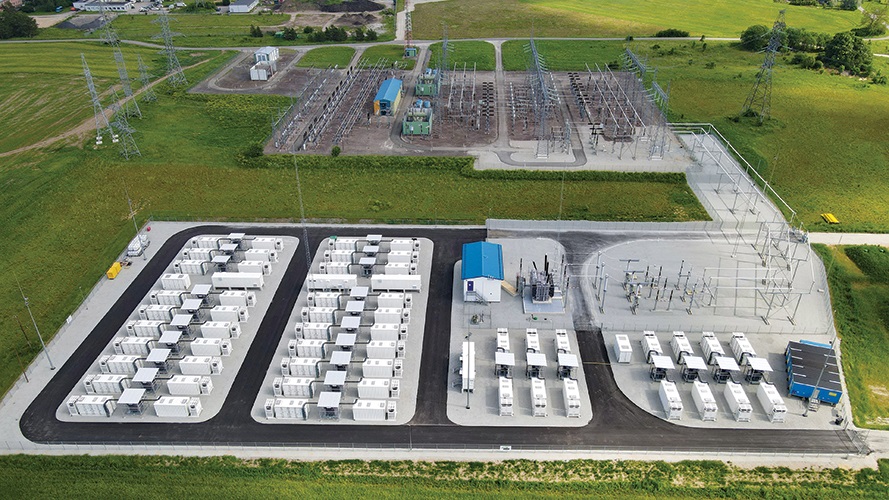
Get ready for some new thinking to enter the power landscape. An “energy park” is an installation that can tie into the grid or simply be its own power provider for commercial and industrial customers.
It can be fully fueled by alternative energy sources, or in some cases, supplemental gas turbines. A few parks exist in the United States, China, Australia and beyond. While adding poles and wires often moves at a glacial pace, planners of hyperscale data centers and large industrial concerns are taking note of the energy park idea.
Energy parks remain an evolving concept, but it is important to understand that they are not a big microgrid. They are larger-scale and focus on power export. Bundling energy technologies together is a central idea.
This bundle could vary depending on what is supported. For instance, steel or fertilizer manufacturers that rely on heat could turn to an energy park featuring thermal batteries and hydrogen production. A hospital or a data center, where 24-hour reliable energy is critical, might be supported by a park that bundles solar, wind and long-duration battery storage. Low-cost power could be available with an energy park co-located next to a data center.
Andrew Levitt, a senior consultant for the Brattle Group Inc., Washington, D.C., presented “Exploring Opportunities for Energy Parks: The Promise and Potential of Energy Parks” at a National Academies online seminar in February 2026. Levitt’s expertise in wholesale electricity policy, with a focus on evolving system needs, has drawn him to look closely at energy parks and their promise. He regularly works with utilities, regional transmission organizations (RTOs) and regulators on issues of interconnection. He defines energy parks as “essentially” a co-located generator and load facility designed for 24-hour operation.
“You could have an energy park that’s entirely off-grid, so not really a microgrid because it’s never grid-tied,” Levitt said.
The term “energy park” was coined by Energy and Innovation Policy and Technology LLC, described as a nonpartisan energy and climate policy think tank with offices in San Francisco and Washington, D.C. Eric Gimon, senior fellow, consults as a technical expert, research scholar and policy adviser with the organization.
“An energy park is typically larger-scale with a focus on export,” Gimon said. “When I was conceiving the idea, ‘park’ captured the scale. I authored a paper two years ago [“Energy Parks: A New Strategy to Meet Rising Electricity Demand,” co-authored by Mark Ahlstrom and Mike O’Boyle] and I have been thinking about [energy parks] for four years. It is not a fully mature concept, but to the extent it is being done, it is being done in a lot of different ways.”
Gimon sees energy parks as more than a band-aid solution that could help upgrade an aging grid.
“Utilities have historically moved slowly and lacked a strong incentive to adopt changes at the pace seen in IT and telecommunications,” he said. “The A.I. boom is really providing a push. Energy parks are intriguing.”
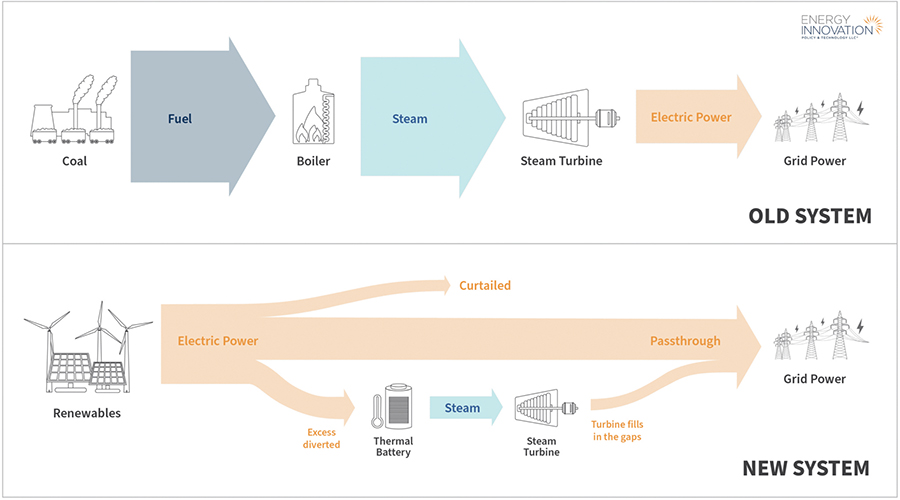
An illustration of coal-based power production contrasted with an energy park alternative.
The grid-supportive version
The National Academies of Sciences, Engineering and Medicine released an issue paper, “Strategies for Energy Parks in the United States,” and sees energy parks as grid-supportive. “Energy Parks are an emerging approach to designing integrated hubs that co-locate generation, storage, and large-scale load (e.g. data centers, advanced manufacturing) at one point of interconnection to the electric grid,” according to the paper.
Gimon further explained the value of energy parks as he and others see it: “Energy parks can add elements like additional storage, load and generation behind a point of interconnection to optimize for the needs of both the on-site load and the grid. Energy parks with on-site loads can achieve multiple benefits, building on what hybrid resources already have proven.”
Such advantages include larger equipment savings by directly connecting load and generation to the same grid interface sharing single-directional or bidirectional high voltage and transformer; leveraging tax credits and local economic development benefits; and the aforementioned modularity allowing a park to evolve.
A power quality bump
Power quality and stability is another advantage Gimon feels energy parks could provide the industry.
“Data centers are not clean, in terms of power quality,” he said. “Because of the way these data centers operate, you have a bunch of units doing similar things, and it creates resonances degrading power quality near data centers. You need to buffer the data center from the grid to clean out those subharmonic signals. The easiest way is with a brute force DC, AC or AC/DC connection, but that is expensive. You might use a grid-forming inverter. The best option is using batteries as the buffer. And if you are already looking at a hybrid resource between the data center and some kind of batteries, you are already at a place where you need to think about an energy park offering orchestrated resources that present to the grid together. Wanting to improve the power quality pushes you in the same direction.”
Obstacles
According to the National Academies paper, energy parks will face some challenges, including complex permitting and siting procedures, long interconnection lines, murky regulations for their connection to the grid and participation in wholesale markets, and underdeveloped financing strategies.
“If the current crop of large loads, which is data centers, had the same level of patience as the prior industrial crop had, everything would just proceed fine,” Levitt said.
“The real issue is a matter of speed and scale,” he added. “We are seeing the data center developers expressing a lot of interest in off-grid, gas-fired energy parks so that they can connect even more quickly. X.AI’s Colossus data center is a famous example of this. X.AI is the Grok A.I. It is the fastest large-scale data center [A.I. hyperscaler] that took only a matter of months to come online. You are going to see more of that because the hyperscalers in question, including Google and Anthropic, have clean energy goals in one form or another: Amazon, Meta or Oracle, as well. They are not really going to be happy running on gas for years on end.”
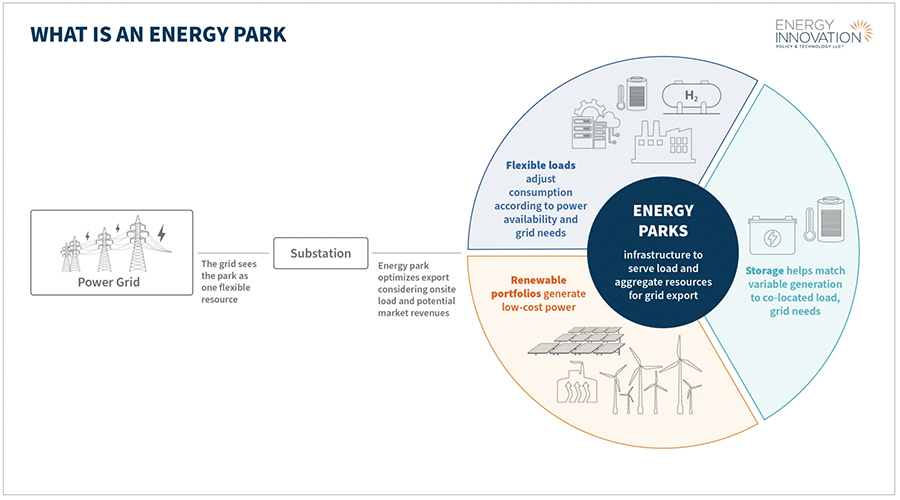
Serving as a co-located generator and load facility, an energy park could be a flexible resource for a utility.
That is where a grid-connected energy park could be valuable. For instance, solar could be connected behind the meter to reduce gas use.
However, “On one trapeze, you have the data center guys. On the other trapeze is the utility,” Gimon said. “One of them must fly across and hold hands, and they do not have years of practice working together.”
The long line of interconnection
Cliff Ho serves as an adviser for the National Academies and spent six years as senior scientist for Sandia National Laboratories.
“There is a queue for interconnection right now,” Ho said. “My own personal take with interconnection using an energy park is about two to three years, so much quicker than adding transmission capacity.
“There’s certainly solar and battery deployments already. What would make it an energy park? It is co-location and co-optimization with a load. There are some rules that show the flexibility of getting guarantees that the load can be flexible while allowing for a behind-the-meter source such as the energy park,” he said.
Ho continued, “The local generation and the grid are key. If I am a data center that ties into an energy park, I will use the same SCADA, supervisory control and data analysis systems to control loads in concert with power from a utility. There are some good examples of where energy parks play a role within some of these new rules like through PJM.”
Further, Ho and others suggest energy parks could be divided into categories of large consumers or those with critical consumption needs, such as a hospital that maintains power for medical devices or life support equipment. In this case, you can build your energy park around critical services.
“I also think energy parks can be self-sustaining,” Ho said.” If you have the capacity of energy needed by that load it is co-located with, there is no reason not to just continue even when the grid is operating normally.”
Soon to be or in action
There are several U.S. energy parks on the boards or active. An early example is Portland General Electric Co.’s Wheatridge Renewable Energy Facility in Oregon that began commercial operation in March 2022. Today, it serves as a 50-megawatt (MW) solar energy generation facility on 357 acres of private land. The project also includes 300 MW of wind power (200 MW/NextEra Energy and 100 MW/Portland General Electric) and 30 MW of battery storage.
Reported in May 2026, Energy Abundance Development Corp. (formerly known as Green Hydrogen International Corp.) is developing Hydrogen City in the Coastal Bend region of Texas. Plans are to generate 60 gigawatts (GW) of wind and solar to produce more than 2.5 billion kilograms of green hydrogen yearly. The wind turbines will serve as wind-powered electrolyzers. Pipelines will carry hydrogen to Corpus Christi and Brownsville [Texas]—ports that have existing industrial infrastructure. The hydrogen will be converted into green ammonia (a cleaner fertilizer feedstock) and be used for sustainable aviation fuel. With access to the ERCOT grid (Texas’s main electricity network), the energy park could offer power back to the grid.
In June, Alphabet and Intersect announced construction of the Meitner Energy Center, also in Texas. It will include a data center that will tap 1 GW of wind, solar and battery storage system power supplied from a co-located energy park in Gray and Roberts counties, Texas.
“I see a lot of progress, though I wish progress was faster,” Gimon said. “For instance, China already has zero-carbon industry parks. That country will likely lead in this space, followed by parts of Australia, but we can be third here in the United States.”
STOCK.ADOBE.COM/Dark Artistic, Energy Innovation Policy & Technology LLC
About The Author

GAVIN, Gavo Communications, is a LEED Green Associate providing marketing services for the energy, construction and urban planning industries. He can be reached at [email protected].
.tmb-art-li-th.png?Culture=en&sfvrsn=9278ce2b_1)