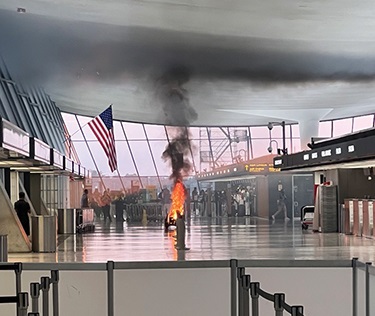
Last month’s article examined why a 15A AFCI breaker tripped, indicating a possible arcing fault in a residence’s wiring. Based on the tests conducted, the conclusion was that the breaker was misoperating. The 10-year-old AFCI breaker was replaced and there have been no false trips in the past 6 weeks. Since the 2020 National Electrical Code, in which sections 210.12(A), (B), (C) and (D) require arc-fault circuit interrupter protection, this not-unique problem of false trips is an ongoing concern. While it isn’t a power quality problem per se, it does encompass a number of power quality phenomena that the AFCI must recognize and deal with properly.
Manufacturers of such devices aren’t forthcoming on the different algorithms used to identify acceptable voltage and current waveforms versus a potentially dangerous arc fault. The typical marketing statement is that an AFCI uses advanced electronic technology to “sense” the different arcing conditions, detecting parallel arcs (line-to-line, line-to-neutral and line-to-ground) or series arcs (arcing in series with one of the conductors). The dangerous faults generally mean that the insulation between the conductors or ground has been compromised.
When arcing happens
Arcing can normally occur in AC motor-driven equipment or when a light switch is turned on or off. An arcing voltage waveform can have a signature similar to noise riding on the power frequency signal. AM radio transmission towers can couple noise into the conductors. There have been case studies in the past about handheld communications (such as walkie-talkies) coupling signals into a data center and causing misoperations, but no arcing.
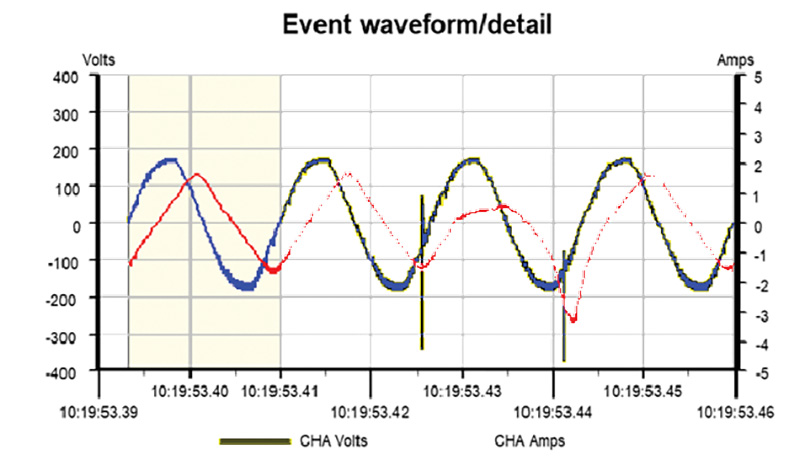
Figure 1
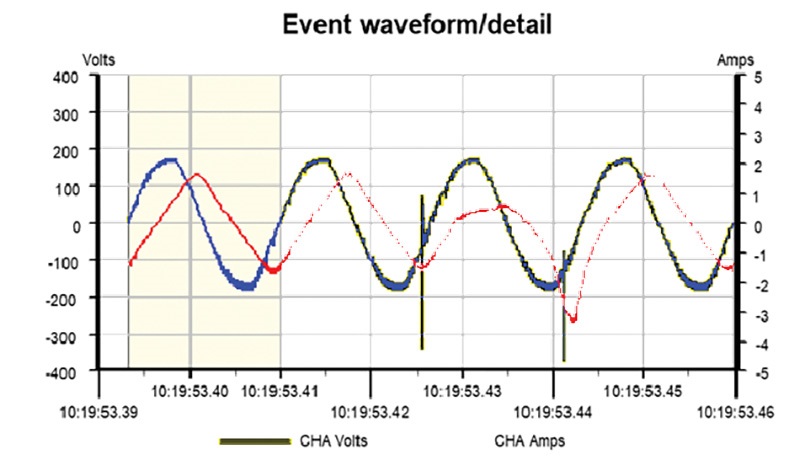
The arcing waveform is typically in the 100 kHz–10 MHz region. Figure 1 shows continuous high-frequency noise on the voltage and current waveforms along with very short-duration bipolar voltage transients that aren’t due to arcing. Figure 2 shows an arcing voltage waveform occurring on the distribution circuit, not within a structure.
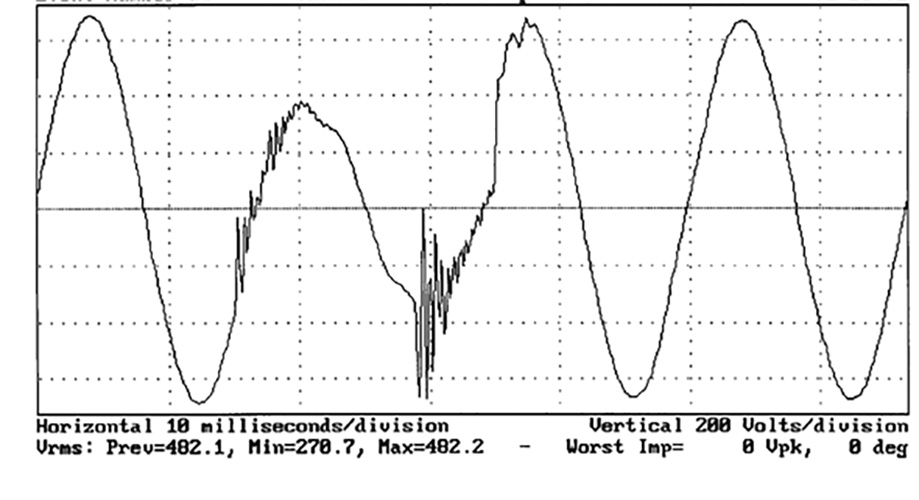
Figure 2
Arcing can lead to a dangerous situation, undetected by human senses until a fire breaks out. While in the fire service, we had a death of a person sleeping in a bedroom where a nail had been driven through the armored cable and disrupted the insulation on the line conductor. Over time, the heat from the arcing had caused pyrolysis of the wooden stud that the cable had passed through until it lowered the ignition temperature enough to start a fire in the walls. Unfortunately, a working smoke detector wasn’t in the area and the person succumbed to the smoke before the fire destroyed the room.
Testing AFCIs
Many of the power quality monitors on the market don’t have a high enough bandwidth in their circuitry to accurately detect these dangerous faults. A lack of recorded evidence does not mean the event did not occur. On the flip side, there are reported to be low-cost devices being given away by insurance companies that claim to detect arcing anywhere in the residence from a single device plugged into a 120V receptacle. That claim means that it measures only the voltage on one circuit.
An AFCI breaker monitors the voltage on the circuit and parallel circuits as well as the current on the single circuit. It makes no claim on protecting other circuits. As a well-known expert in the PQ field once said about power quality problems, “it’s the current, stupid.” Where there is smoke, there is fire. Where there is arcing, there is significant current. Noise coupled into the conductor as a voltage distortion generally has very little current distortion in proportion to the load current.
IEC 62606 is an international standard that addresses the proper operation of AFCIs, including test protocols that must be met. It covers product safety and performance requirements for certification of arc fault detection devices. Hopefully, this will lead to more robust AFCIs with significantly fewer false trips. We don’t want a similar scenario as with the early development of smoke detectors, which alarmed too easily and people removed them. AFCI breakers, GFCI receptacles and smoke/fire detectors are all proven to save lives.
Note: Some readers have expressed interest in learning more about the signature analysis work of the IEEE Working Group on Power Quality Data Analytics. Click here to visit the website. Drilling down through the links will show some interesting data and discussions, such as the Signatures of Arcing and Incipient Faults from Underground Power Distribution Cables by Thomas Cooke at EPRI, which can be found here.
richard p. bingham
About The Author

BINGHAM, a contributing editor for power quality, can be reached at 908.499.5321.