The evolution of local area networks (LANs) for connecting users indoors or on a campus has mainly been driven by speed. If you’re new to computer networking, gigabit speeds may be all you know, but it's taken a half century of LAN development to get us to where we are today.
Ethernet, the computer network developed by Xerox in the early 1970s to connect PCs in the office, was first standardized as IEEE 802.3 by the committee that manages the development of the technology. By the late 1980s, LANs had been widely adopted, but ethernet remained the industry standard until recently.
Ethernet began at about 3 megabits per second (Mbps) and quickly jumped to 10 Mbps, then 100 Mbps, 1 gigabit per second (Gbps), 10 Gbps, 100 Gbps and is now heading to terabits per second (Tbps)—1,000 Gbps. Office LANs generally peak out at 10 Gbps, but data centers today keep pushing speeds to Tbps. Ethernet has also been adopted for the internet and is used worldwide for most telecommunications, using the fastest speeds that are practical.
Developing ethernet speed drove the growth of network architecture and cables to support it. Ethernet began on coaxial cable with a “bus” architecture because coaxial was the only high-speed copper cable at the time.
A development of telephone wire, unshielded twisted-pair (UTP) cable became the cable of choice in the late 1980s, using the switched star architecture of the phone system. This cabling infrastructure became standardized as “structured cabling” with TIA Standard 568.
Supporting ethernet
Cabling needed a fast development cycle to support ethernet as its speed went from 10 Mbps to nearly 1 Tbps today. Supporting faster ethernet has been easier for optical fiber than UTP cable. Below gigabit speeds, fiber solutions had one basic problem—cost—compared to inexpensive copper wire and electrical equipment. But for speeds of gigabits or higher, fiber became the preferred choice.
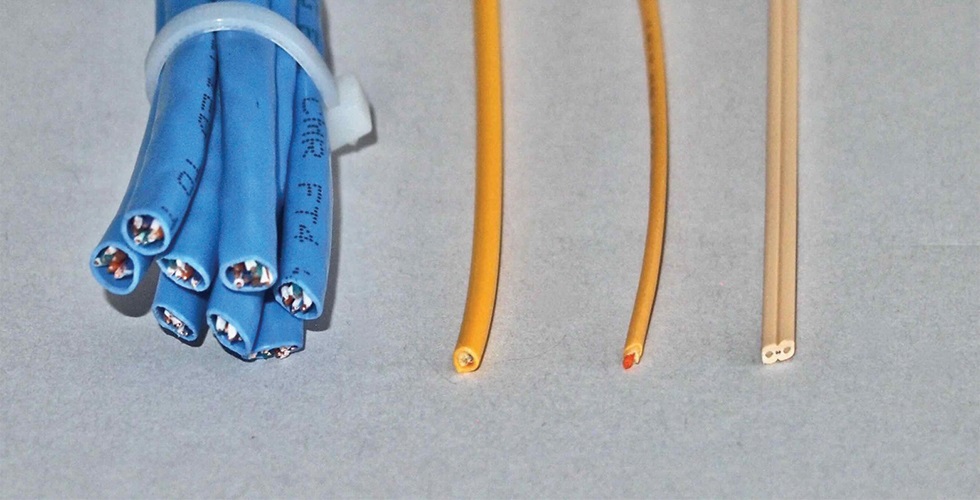
Copper versus fiber to the desktop was the ”battle royale” in LANs around the year 2000. Copper was cheaper, but fiber beat it on distance, so fiber could use a simpler centralized cabling architecture that eliminated additional switches in local telecom closets required for copper networks. This nearly equalized prices.
The copper versus fiber battle became moot in the early 2000s. Wi-Fi became fast enough to allow users the flexibility of mobility. Laptops and smartphones with built-in Wi-Fi became standard, so users could roam about the office and stay connected. The introduction of Wi-Fi-connected smartphones and tablets negated the need for cables to the desktop, with the exception of power users like engineers or graphic designers who needed more bandwidth than wireless could provide. LAN cabling networks became mainly connections to wireless access points.
Passive optical LANs for the win
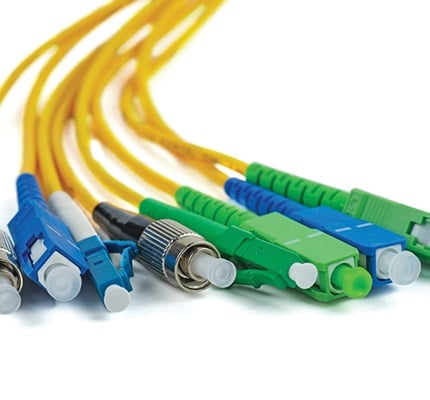
A new development in fiber optics has become a popular choice for LANs. Telcos have been using a different fiber architecture for fiber to the home (FTTH) called passive optical networks (PONs). PONs operate at 2.5 Gbps or 10 Gbps, speeds adequate for LANs. PONs are very cost effective because they use a single fiber for transmission in both directions and passive splitters instead of switches. One PON transceiver at a head end can support 32, 64 or even more users. PONs also have the advantage of manufacturing volume; hundreds of millions of users have been connected on FTTH PONs, so components are inexpensive.
Converters from the fiber network are available to connect Wi-Fi access points, indoor cell antennas, video cameras and provide Cat 5 ethernet ports to those still needing to plug in a computer.
Case studies have shown that passive optical LANs usually cost about half as much to build as a traditional LAN, and because they eliminate many of the electronics that consume power—especially at high speeds—they cost much less to operate.
It took a few years to get recognized by the standards committees, but now singlemode cabling for a passive optical LAN is a recognized option in structured cabling.
Passive optical LANs have become popular for networks in universities, hospitals, hotels and even cruise ships. A passive optical LAN is a great option for upgrades in older buildings because so few fibers are needed to connect large numbers of users, simplifying installation. It's useful in new buildings, too, saving the space that telecom closets typically use for traditional structured cabling.
Jim Hayes
About The Author

HAYES is a VDV writer and educator and the president of the Fiber Optic Association. Find him at www.JimHayes.com.