The age of quantum computing is here. Already, the U.S. government is pushing for its use to strengthen military defense and improve grid reliability. Global consulting firm McKinsey & Co. reported last April that more than 300 global companies are working with quantum technology firms to solve business challenges. But while quantum computing poses concerns about excessive energy consumption, some anticipate the actual power needs could turn out to be less daunting than originally thought.
Early lessons from RPI
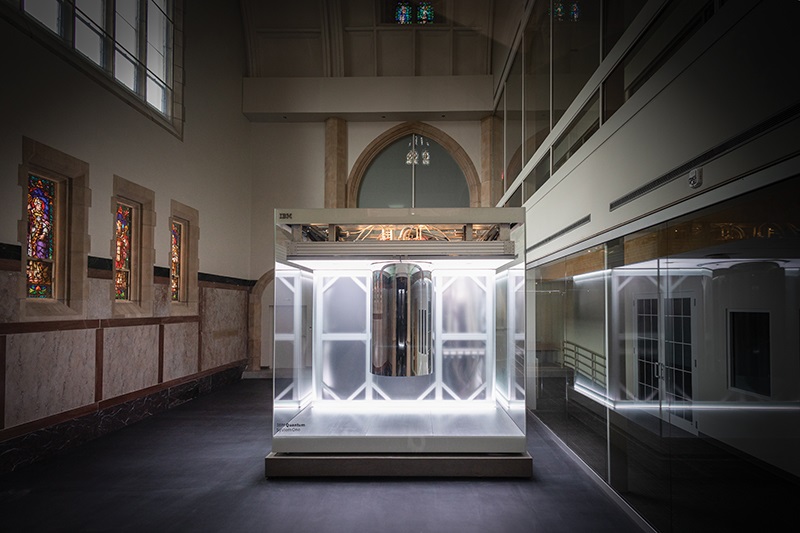
The IBM Quantum System One in the Voorhees Computing Center at Rensselaer Polytechnic Institute (RPI) in Troy, N.Y., cuts a provoking figure in quantum research circles. Housed in a brightly lit glass vitrine measuring 10 feet3, it resembles a modern holy icon.
The deep-cold cryostat refrigeration system providing life support to the 120-quantum-bit chip resembles a gold-plated chandelier. It is gold-plated by design to prevent heat buildup, but it’s also eye-catching.
“IBM designed its first commercial quantum computer to be beautiful, awe-inspiring, a visual tour de force,” said Jeff Miner, special advisor to the vice president for RPI’s Future of Computing Institute and former assistant vice president for RPI Information Services.
The “holy ground” occupied by the quantum computer is the main floor of a former Roman Catholic chapel built in 1933 for the Sisters of St. Joseph convent, with stained glass windows devoted to saints of innovation.
RPI makes the System One available for student use with faculty oversight, and it is open for viewing by campus visitors. The installation of System One in April 2024 was the subject of a recent PBS documentary called “Project Chapel.” Though not as powerful as other quantum devices now in existence or soon to arise elsewhere, it is the first commercial quantum computer in the world to be located on a university campus. Already, it communicates autonomously with—and takes on tasks assigned by—RPI’s primary supercomputer.
“It’s important to remember, quantum computers are in their infancy,” Miner said. “Rather than replace traditional systems entirely, we see them becoming viable members of data center and research setting ecosystems—also referred to as ‘quantum-centered supercomputing.’”
How much power?
An ELECTRI International policy brief released this year posed the question, “How much power do data centers actually use?” The estimate for the United States in 2023 was 176 terawatt-hours, roughly 4.4% of national consumption. That proportion could increase by 6.7% to 12% by 2028, according to the Department of Energy. While that increase is formidable, the brief suggests it can be reasonably planned for, taking into account technology efficiency gains and potential state mandates requiring data center owners to pay for new power generation.
The brief also mentions that while data centers are often blamed for rising energy costs, efforts to replace aging electrical infrastructure and harden off against climate-related disasters also figure heavily into the cost equation.
“Communities are asking hard questions about data center growth regarding power, water, health, noise and taxes,” said Josh Bone, executive director of ELECTRI International. “They deserve straight answers, not talking points from either side.”
That’s what the brief is, he said, adding that every claim was traced to a federal agency, national lab or public tax filing.
“The data center conversation works best when it’s a planning conversation, not a fear conversation,” Bone said.
Deep-cold computing
System One requires less energy to operate than RPI’s main supercomputers, but, like other quantum computers, it will be used to solve more complex problems, possibly related to medical, biological and climate research as well as space travel, development of communications technologies and more.
For now, the lion’s share of energy consumption for System One (around 30 kilowatts [kW], enough to power 30 homes) is devoted simply to keeping the powerful computer chip cool. The cryostat vacuum vessel must remain at 0.015 Kelvin (K), or –459°F. In comparison, the temperature of outer space is 2.7 K, about 200 times warmer.
IBM owns the computer and leases it on a five-year term to RPI. IBM also monitors the temperatures remotely, relying on sensors.
“It’s a multistage cooling process, using conventional techniques to get down to the temperature of liquid nitrogen,” Miner said. “Beyond that, it’s a dilution refrigeration process that uses helium isotopes to get temperatures down to near absolute zero [0 Kelvin].”
RPI’s administrative computers, also housed in the Voorhees Computing Center, consume around 60 kW. Google is already operating quantum computers that are 10 times more powerful than RPI’s and consume more energy. But while power needs of supercomputers, quantum or otherwise, are high, the IEEE committee working to establish efficiency standards for quantum computers considers their electricity use and potential effectiveness at solving problems.
The quantum chip in System One cannot withstand temperature variation, making it a steady power draw. A surge suppressor keeps that power clean and evenly flowing, said Steve Quinn, manager of engineering for RPI’s campus planning and facilities design department.
While it might make sense to employ a sustainable form of backup energy, for now the Voorhees Computing Center is served by the local electrical utility, a backup generator powered by diesel and an uninterruptible power source relying on lead acid technology.
RPI may eventually consider lithium-iron-phosphate energy storage less prone to dangerous thermal runaway than lithium-ion battery energy storage systems, Quinn said. Meanwhile, the 2023 National Electrical Code, which New York uses, requires the installation of a sprinkler system inside of the brightly lit glass vitrine.
In just six months working with other trades and IBM personnel, a crew of 10 university staff electricians handled the installation of electrical infrastructure supporting System One, along with a security system installed by a vendor specified by RPI. That system includes motion detection, glass break detection, retinal scan for entry and multiple security cameras.
A lighting contractor installed a showcase-style stand-alone LED illumination system with no building controls, Quinn said.
The quantum computer at RPI makes the case that skilled electricians can handle infrastructure installations that support quantum computing. Making that same case was an article in the March 2023 issue of Lab Design News, which said quantum labs require significant amounts of electricity, backup power to avoid interruptions, exceptional adaptability and potential for expansion, and installers who can work and collaborate with researchers. None of these requirements are unusual for electrical contractors that take on projects ranging from national laboratories and manufacturing operations to medical centers, commercial buildings and elaborate industrial complexes.
Orders of magnitude
Although quantum research facilities may have a reputation of being complex, according to an article by The Lab Design News, the spacial requirements can be straightforward. Along those lines, Quinn and Miner believe quantum computing will play out on the order of Moore’s Law of efficiency gains for new technologies.
“If we look at the last 25 years, not only did we drop power requirements for our data centers, we created more room [in the machine room of the computing center],” Miner said.
Practical uses
These early first steps come amid a push to bring quantum computing into practical use, including beefing up defense capabilities and bolstering reliability of the power grid. For example, last August, Eaton announced it received a $7 million, 24-month contract from the U.S. Air Force Research Laboratory to apply quantum computing, machine learning and advanced visualization to improve resilience of the power grid. This effort aims to take transmission systems beyond a North American Electric Reliability Corp. requirement of withstanding two sequential failures to enabling preparation and response to multiple and simultaneous threats.
eleanor goldsmith
About The Author
.jpg?sfvrsn=a64b988b_1)
DeGrane is a Chicago-based freelance writer. She has covered electrical contracting, renewable energy, senior living and other industries with articles published in the Chicago Tribune, New York Times and trade publications. Reach her at [email protected].