Multiple changes in the 2026 National Electrical Code involve emergency service disconnects, emergency feeder disconnects, surge protection and barriers that must be followed for one- and two-family dwellings.
I was a member of Panel 4 for the 2005 and 2008 NEC cycles, with our jurisdiction covering Article 225 for outside feeders and branch circuits, as well as Article 230 for services. Requiring emergency disconnects located on the outside of dwellings and commercial and industrial buildings was discussed during proposal and comment meetings. After numerous discussions since 2005, emergency disconnects were finally required in the 2020 NEC in the new 230.85 for one- and two-family dwelling units.
As we determined in the 2005 and 2008 NEC process, requiring emergency disconnects for commercial and industrial buildings would almost be impossible due to the services’ ampere size and voltage. In addition, many commercial buildings have zero lot lines where the buildings occupy the entire property, leaving no room for an emergency disconnect on the outside of the building.
Service disconnects
NEC 230.70 covers the general requirements for service disconnects and 230.70(A)(1) applies to one- and two-family dwellings. They state that the service disconnecting means must be installed in a readily accessible outdoor location either on the dwelling unit or within sight of it in accordance with NEC 110.29. NEC 110.29 states that equipment must be “in sight from,” “within sight from” or “within sight of” a building, structure or other equipment and located not more than 50 feet from the building, structure or other equipment.
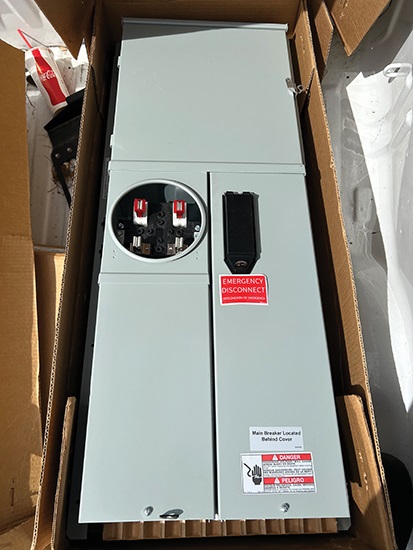
Disconnecting means are located outside to provide first responders with ready access to the disconnect without having to enter the dwelling unit. Prior to the 2020 NEC, first responders did not have a safe way to easily remove power from a dwelling unit without waiting for the electric utility company to respond. The property owner can still lock the disconnect, since most first responders can easily cut off the lock and disconnect power.
The exception to NEC 230.70(A)(1) states that the service disconnect is not required to be installed on or within sight of the dwelling unit when an emergency disconnect is installed in accordance with 225.41. There are dwelling installations where utility company power terminates on a garage or a similar outbuilding, rather than on the dwelling unit building. The text in 225.41 is similar to the text in 230.70(A)(1) as follows: Emergency disconnects must be installed in a readily accessible outdoor location on the dwelling unit within sight of the dwelling unit where it is a feeder supplying the dwelling unit.
There is an exception in 225.41(A)(1) [similar to the exception in 230.70(A)(1)] that applies to a feeder supplying the dwelling. It states that if the service disconnecting means for the dwelling unit complies with 230.70(A)(1) or the disconnecting means in accordance with 225.31 is in a readily accessible outdoor location, on or within sight of the one- and two-family dwelling unit, an additional emergency disconnect is not required.
For the utility company power delivered to the dwelling as a service or feeder, the electrical disconnect equipment must have a short-circuit current rating equal to or greater than the available fault current. Where there is more than one disconnecting means, either for a service or multiple feeders, the disconnects must be grouped in one location.
NEC 225.31(B), dealing with the location of disconnecting means for outside feeders, requires the feeder disconnecting means to be installed either inside or outside the building or structure served or where the conductors pass through the building or structure. However, if located inside the building, the disconnecting means shall be at a readily accessible location nearest the point of entrance of the conductors.
NEC 230.62(C) requires identified barriers to be placed in service equipment so no energized and uninsulated, ungrounded service busbars or service terminals are exposed to inadvertent contact with people or maintenance equipment while servicing load terminations with the service disconnect in the open position.
Surge protection
Surge protection is required for all services for dwelling units, dormitories, guest rooms and guest suites of hotels, motels, areas of nursing homes and limited-care facilities used exclusively as patient sleeping rooms, and areas designed for use exclusively as sleeping quarters in fire stations, police stations, ambulance stations, rescue stations, ranger stations and similar locations. Surge protection has been expanded for many areas where people may be sleeping for protection of electronic early warning systems, such as fire alarm systems and smoke alarms.
David Sanchez
About The Author

ODE is a retired lead engineering instructor at Underwriters Laboratories and is owner of Southwest Electrical Training and Consulting. Contact him at 919.949.2576 and [email protected].