Located at the heart of the nation, where waterways, railroads, interstates, flight paths and time zones connect, Chicago has always enjoyed a reputation for sparking innovation. Considered the birthplace of the skyscraper, this “City of Lights” is where alternating current was introduced to the world, and nuclear fission was developed. It’s also where the nation’s first quantum computing lab is expected to rise on the shores of Lake Michigan. By enhancing the infrastructure supporting hospitality, air travel and public safety, electrical contractors continue to support Chicago’s spirit of innovation, inspiring the country as a whole.
Hyatt Regency McCormick Place
To gain a sense of Chicago’s electrical contracting work, look no further than the location of NECA 2025 Chicago.
Considered an economic engine of Chicago’s booming tourism industry, McCormick Place identifies itself as “the largest and most flexible convention space in North America.” It regularly hosts conventions for Fortune 500 companies such as Microsoft and international associations.
Last year, a late November day spent setting up and tearing down highly complex incoming and outgoing convention displays broke an employment record for IBEW Local 134, which noted 719 journeymen and apprentices working at a single work site.
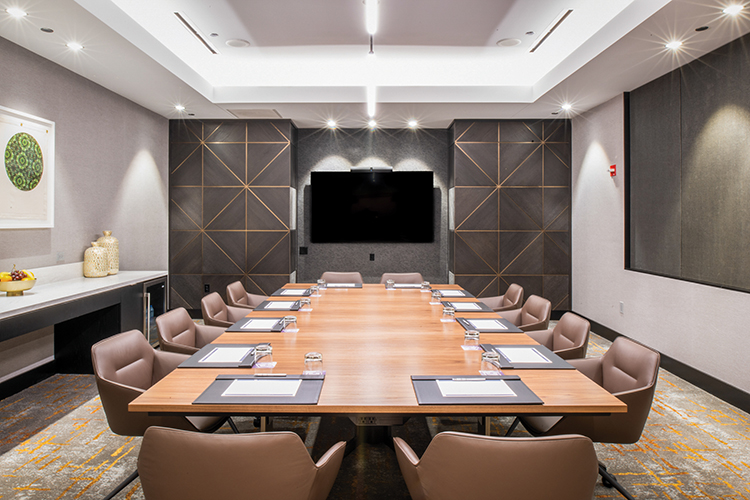 | 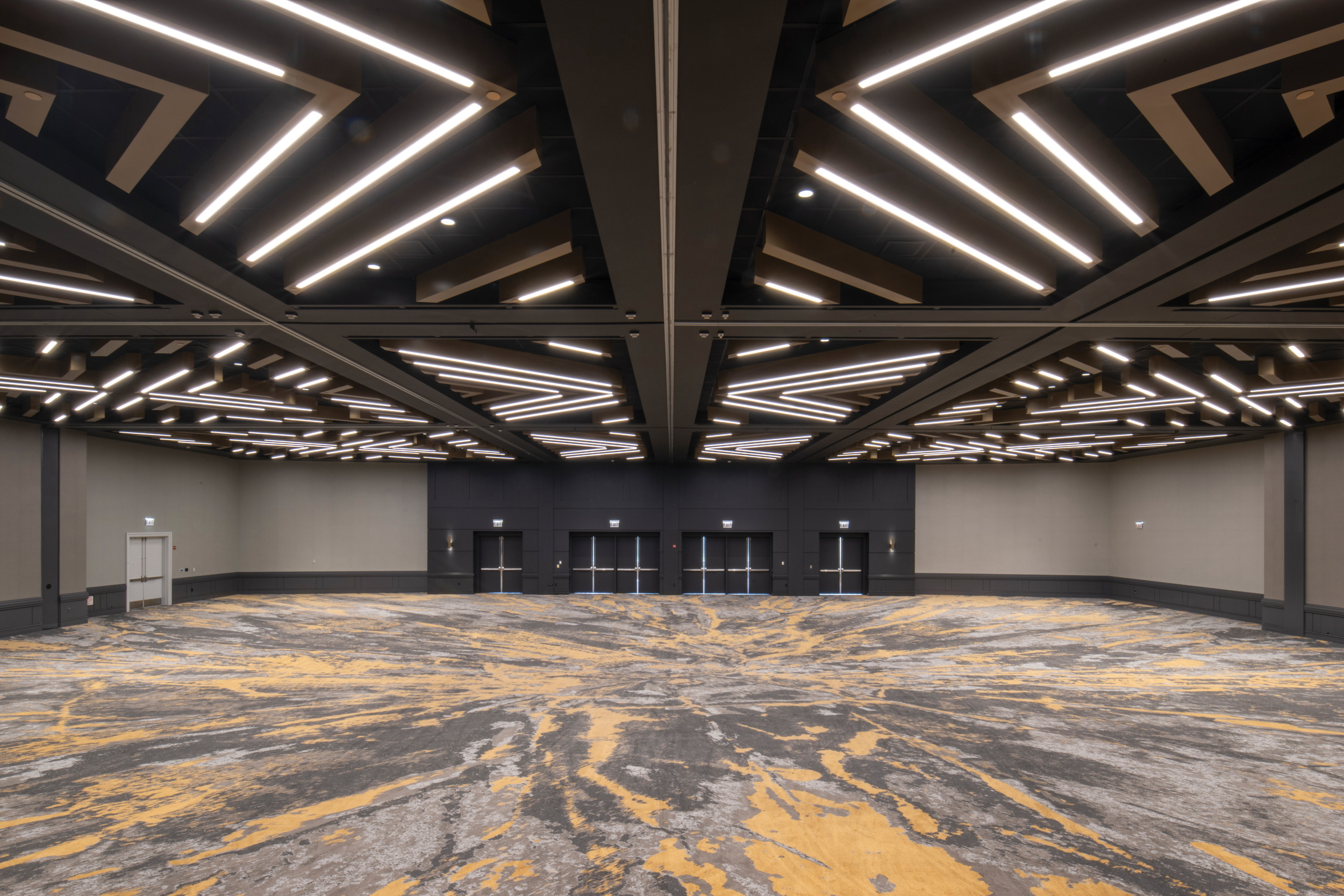 | |
A conference room at Hyatt Regency McCormick Place includes updated lighting features and Wi-Fi connectivity. | A ballroom at Hyatt Regency McCormick Place displays a unique zig-zag lighting design. |
Despite the dampening effects of the pandemic on many urban convention centers, this venue promises to maintain its unique distinction, thanks to ongoing efforts to renew the McCormick Square Convention and Hotel Complex.
The complex includes the iconic black steel and glass McCormick Lakeside Center built in 1971, exhibition campuses west of Lake Shore Drive and the Hyatt Regency McCormick Place.
During the pandemic, bookings for the hotel remained brisk, even when trade show traffic for Lakeside Center teetered. Around that time, the city’s Metropolitan Pier and Exposition Authority (MPEA) considered converting the Lakeside Center into a casino, but eventually decided to reimagine and revitalize it.
MPEA, a municipal corporation run by state and municipal appointees, owns the Hyatt Regency McCormick Place, along with the convention center and other Chicago-area tourism attractions and entertainment venues.
MPEA contracted with Chicago-based general contractor The Walsh Group to perform renovations on the hotel in 2024. As an electrical subcontractor, JMS Electric Inc., Schaumburg, Ill., updated wiring, lighting fixtures and controls and extended the fire alarm system for inside the hotel’s ballroom, meeting rooms and conference rooms.
Renovation of the public space at Hyatt Regency McCormick Place commenced in December 2023 and concluded in March 2024.
“A majority of the lighting was a combination of incandescent and florescent lighting,” said Kevin Conlin, vice president of hospitality and special projects for JMS Electric. “Now the lighting consists of new surface and recessed LED luminaires, and we replaced the existing ALM controls with a Lutron Athena system, creating significant energy savings.”
The ballroom has a baffle ceiling with contours. It now features pendant-style luminaires positioned flush with the ceiling panels. IBEW Local 134 crews of 20–30 journeymen and apprentices preassembled the panels on the floor before installing them with the help of lasers and lifts.
“It was a quick project—16 weeks overall,” Conlin said. “We had to meet a strict timeline due to scheduled events for the ballroom, meeting rooms and conference rooms.”
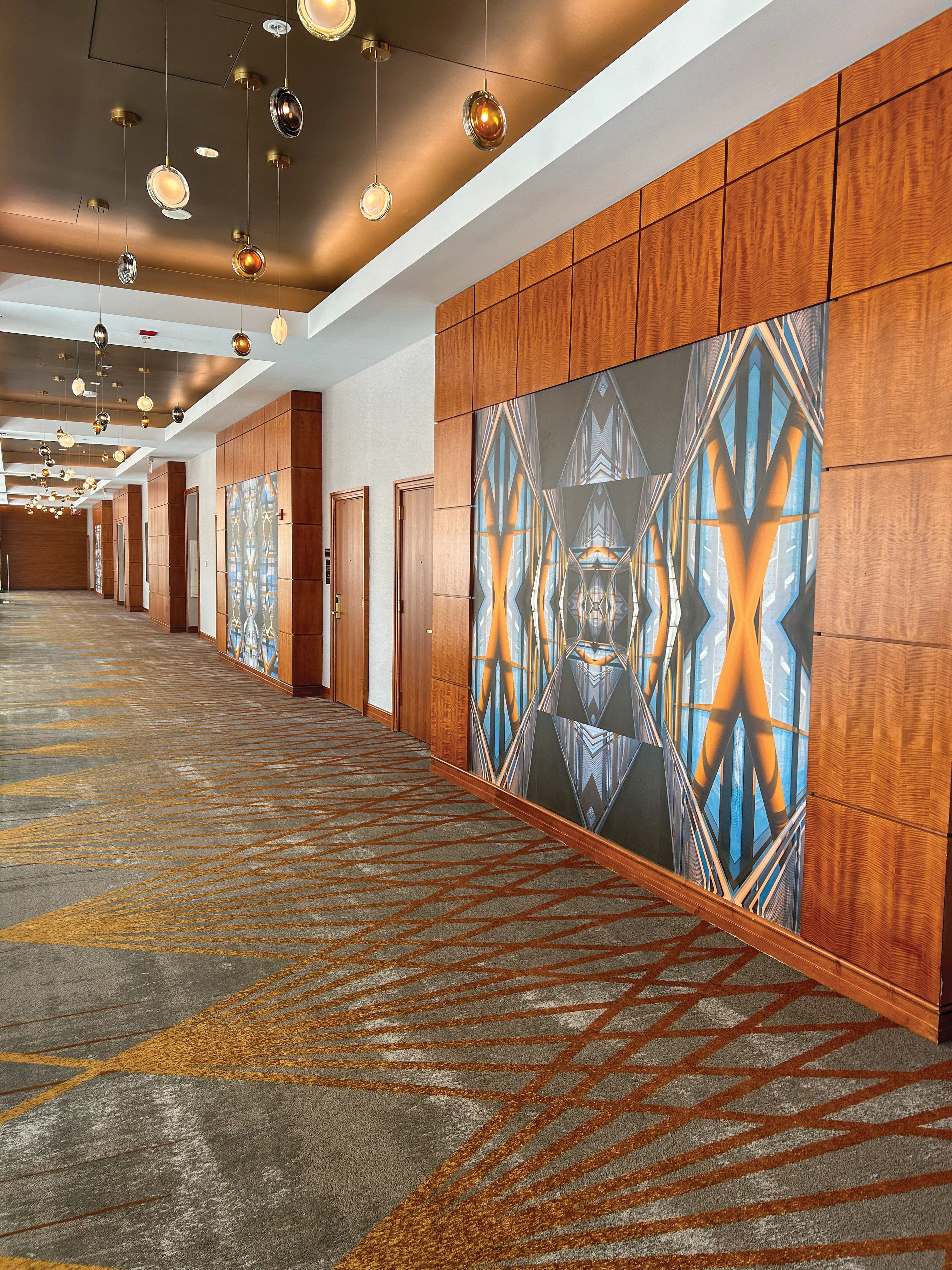
A hallway at Hyatt Regency McCormick Place displays new
lighting for daytime hours activated by occupancy sensing technology.
Working around a mechanical engineering contractor that installed new heating and ventilation duct work, JMS Electric disconnected an old heating system and restored connections and terminations for new heating units.
The company also provided the infrastructure for the indoor digital signage that notifies hotel guests of event locations and times.
JMS Electric will provide additional electrical contracting services for another two-phase renovation effort on the hotel starting in November 2025, Conlin said. Phase 1 will include installing new lighting fixtures that meet energy standards with energy controls and occupancy/vacancy sensors for 798 guest rooms and 29 corridors in the hotel’s south tower.
“For the corridors, we’ll be doing the same with sconces and recessed lighting,” Conlin said.
Corridor lighting will be controlled through occupancy sensors, but the contractor is installing night and emergency lights, so the corridors are never completely dark, Conlin said.
Like many hotels serving business customers, this one emphasizes the comfort and convenience of guestrooms, equipping USB ports for devices on headboards and a wall where desks are located.
Phase 2, starting in November 2026, will include working on 462 guest rooms and 11 corridors in the hotel’s 14-story North Tower. All phases to be completed by JMS Electric are scheduled to occur in the next two years, during months with typically lower occupancy rates for the hotel industry—December through April.
O’Hare Airport’s Terminal 5
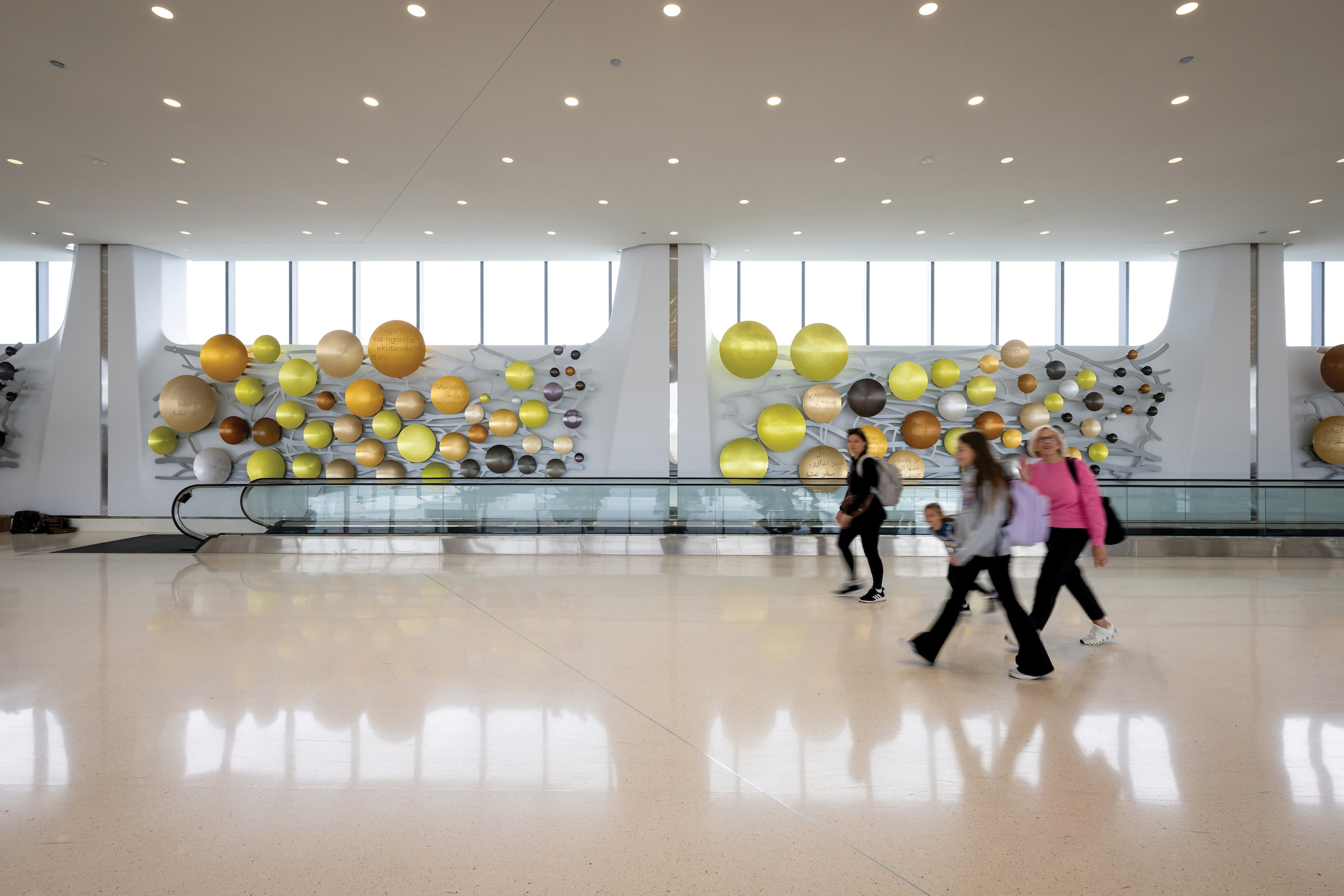
O’Hare Airport’s Terminal 5
Serving 10 million travelers every year, Chicago’s O’Hare Airport is one of the busiest international flight hubs in the world. It has undergone numerous renovations and improvements in recent years, including a $1.3 billion multiyear investment in Terminal 5. The expansion included 10 new gates, reconfiguring an arrivals facility and checkpoint, expanding space to accommodate additional amenities, installing art and replacing a massive baggage handling system (BHS).
With five new baggage screening machines that doubled the terminal’s screening capacity, Terminal 5’s new BHS represented a $23 million contract for Hartmann Electric Co. Inc., Elk Grove Village, Ill.
“This was the biggest job we’ve ever done,” said John Hartmann, second-generation executive vice president of the company.
The project started in 2019 and concluded in 2024 amid the terminal’s transition from only serving international flights to adding domestic flights. This work precedes a different terminal’s demolition and reconstruction as the O’Hare Global Terminal.
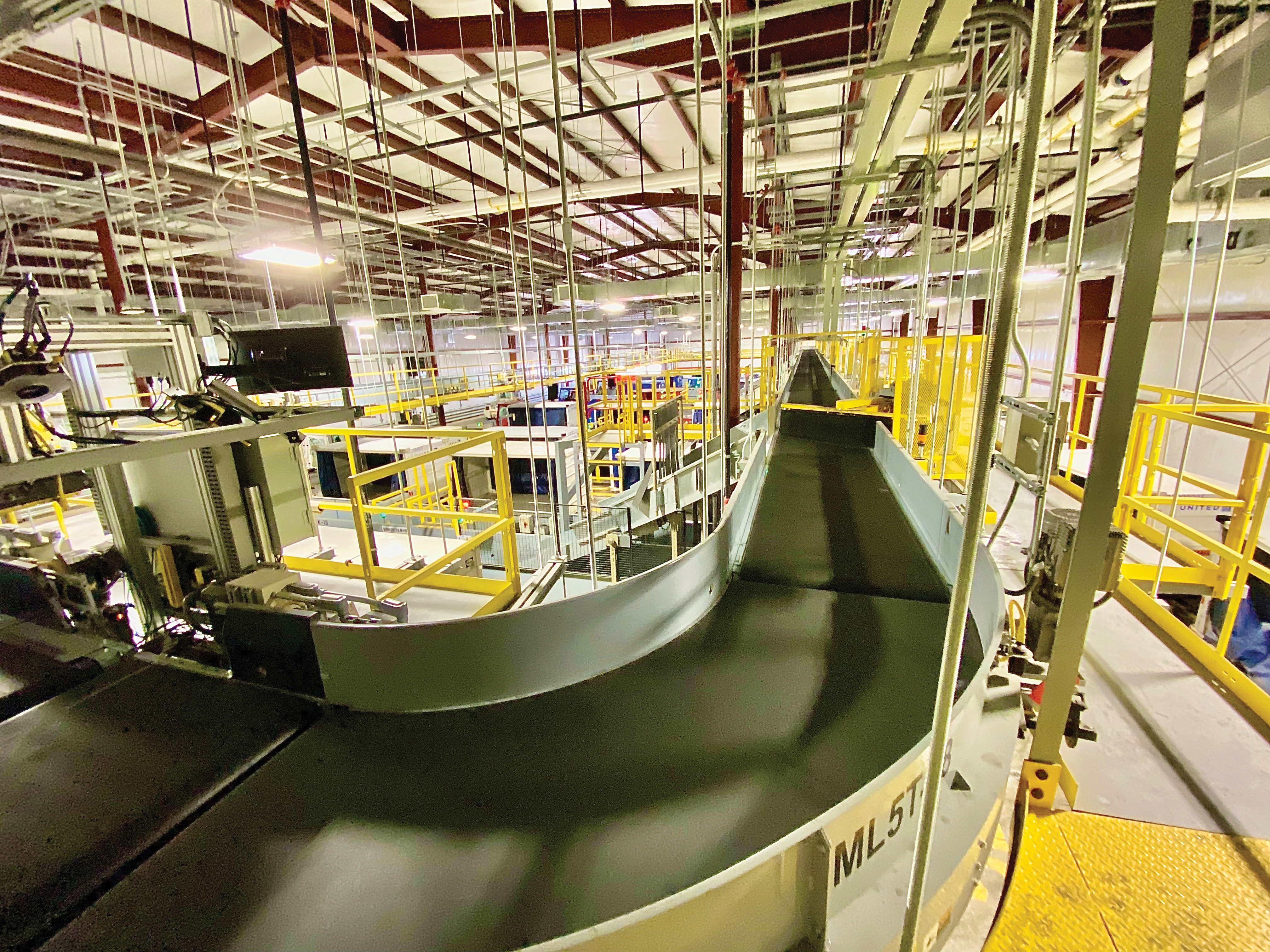
The Terminal 5 baggage handling system at O’Hare Airport required the installation of
miles of steel conduit and 1,500 variable-frequency drives to keep power connections
and controls safe for moving luggage to and from planes.
Installation of Terminal 5’s BHS progressed steadily through the pandemic amid numerous material shortages and workplace safety restrictions. Half of the terminal stayed up and running while the other half was taken out of service. Once the first half was completed, the other half was shut down.
Meanwhile, Hartmann Electric set up a temporary BHS, which also required electrical power, to support the terminal’s function through transition. This is not a new type of work for Hartmann Electric. The company performed the installation of Terminal 5’s original BHS in 1993. Since its founding in 1990, Hartmann has specialized in airport work and completed more than $120 million in baggage handling projects.
Success hinged on Hartmann Electric’s expertise and its ability to maintain a complicated work schedule while not disrupting airport operations.
“When you travel, your first impression when you land is based on, ‘What does this place look like? Is it clean and modern?’ But then your next thought is, ‘Is my luggage here?’” Hartmann said. “If it’s lost or delayed, that good first impression just goes away.”
Relying on the skills of around 60 journeymen and apprentices, Hartmann Electric served as the prime electrical contractor, with crews working in offline areas during the day and times of low traffic.
The expanded work schedule added time-and-a-half pay for evenings and double-time pay for weekends, but Andrew Murphy, senior project manager, said, “Our foremen were good about anticipating what was needed and doing as much work as possible to get ahead in case of unanticipated delays. They kept things moving.”
Hartmann Electric performed wiring and cabling work according to Chicago’s stringent electrical code, which requires the use of metal conduit. Conduit increases project costs but greatly enhances the system’s reliability by offering protection for power and control wiring.
The terminal’s electrical infrastructure included 54 control panels. For added security and safety, the design separated 480V panels from the 120V and 24V panels serving low-voltage controls.
“Our men and women are experts at specialty controls,” Hartmann said. “They are meticulous in their craft when it comes to mapping out, pulling, organizing, tagging, terminating and testing cables. This ensures the highest level of quality workmanship, which is paramount for mission-critical equipment. Airlines are unable to operate at a major hub like O’Hare without a properly functioning baggage system.”
Hartmann Electric partnered with a skilled minority contractor for the crucial function of creating wiring spreadsheets for tracking wire and cable, for making tags and labels, and for producing historic documentation.
Crews installed miles of raceway and did terminations on thousands of input and output devices responsible for baggage routing and sorting based on barcoded luggage tags.
“Correctly wiring the system was critical, and we’ve received praise from controls contractors for our installation accuracy,” Murphy said. “Our teams’ attention to detail eliminates downtime for controls contractors when they test the system.”
Due to all the motorized parts, Murphy said, the BHS entailed the wiring of 1,500 variable-frequency drives.
“Each section of the system is driven by an electric motor,” Murphy said. “The system includes photo-eyes that can detect the presence or absence of a bag, automatic bag tag readers and shaft encoders that measure revolutions and provide feedback on rotational position, speed and direction of the drive shaft that moves the system’s conveyors along. These devices work together, sending information back to the control room where it is monitored by a central computer and humans.”
Much like a switching yard moving trains to different tracks, the system also includes diverters that route bags from one area to another. In reaction to explosive detection, the system diverts the bags to a special location for direct examination by humans. Once the bags are cleared, they return to the baggage stream.
Over the years, Hartmann Electric’s work at O’Hare has included a major upgrade of the electrical system for the fuel farm, new concessions, work on the people-mover train system, Wi-Fi and cellular upgrades, construction of new terminals, hold rooms and a recently completed hangar. The electrical contractor also maintains maintenance contracts with two major airlines, the fuel farm and the O’Hare Airport transit system.
Joint Public Safety Training Campus
Malko Communication Services LLC, Chicago, was founded in 1926 and has performed electrical and low-voltage work on a variety of Chicago attractions, including Navy Pier, McCormick Place, Shedd Aquarium, Soldier Field, Wrigley Field, Rate Field, Water Tower Place and Ravinia Music Festival.
Its most recent contribution to maintaining Chicago as a destination city is low-voltage installation and maintenance work at Chicago’s Joint Public Safety Training Campus.
In 2023, the 180,000-square-foot campus and center located on the city’s West Side began simulating real-life emergencies, from active shooters and traffic accidents to burning buildings and public health emergencies.
The idea was for the state-of-the-art facility to provide specialized immersive training for first responders to enhance public safety, improve emergency response times, improve disaster preparedness and foster community engagement.
Built on a 30-acre campus, which also houses a Boys and Girls Club and two restaurants, the $170 million project resulted from private and public funding and a collaboration between the city’s police and fire departments, Office of Public Safety Administration, Emergency Medical Services and Office of Emergency Management and Communications. The setting was developed to support better coordination and cross-training among all first responder departments while providing access to cutting-edge technology and modern resources.
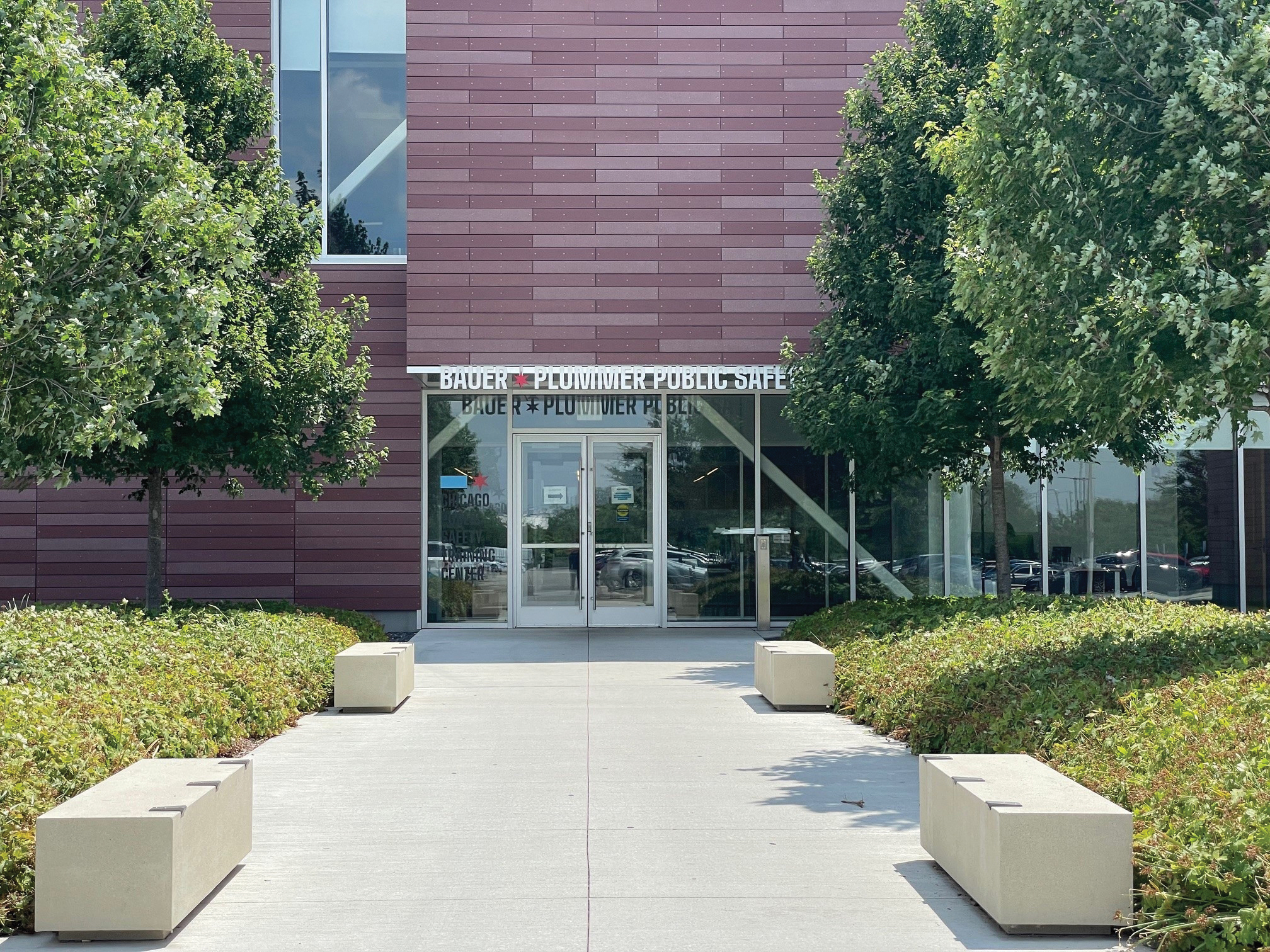
Chicago’s Joint Public Safety Training Center recreates emergency
situations to safely train first responders.
Besides simulated indoor streetscapes, the center’s dedicated emergency response areas include burn rooms and outdoor tactical training zones.
“It definitely underscores Chicago’s commitment to public safety training and putting the best foot forward to keep the streets and businesses safe,” said Thomas Pedergnana, vice president of Malko Communications.
To set up the center’s multifaceted indoor and outdoor training environments, Malko Communications coordinated the entire project team and installed low-voltage work including audiovisual systems, structured cabling, wireless distributed antennae systems, security systems and low-voltage voice and video data technology.
“This system stretched our capabilities,” Pedergnana said. “We’ve supported other training facilities, but they were always more for the corporate environment, never for anything tactical. For this project, we spent more time with the end-user, which required a higher level of intensity because we had to convert their needs to a plan of action that would bring their training scenarios to life.”
Malko Communications’ services covered AV, CCTV security and surveillance, access controls and DAS, which supported cellphone and emergency radio use.
Malko Communications personnel met frequently with center staff to gain understanding of various training needs. Then low-voltage technicians performed the installation in concert with the center’s team.
Inside the building, where advanced training exercises take place, Malko Communications employees installed a zoned paging system that enables trainers to control command messages to trainees and simulate factors in the environment.
To create this level of realism, the system allows for uploading sound effects such as sirens, crowd noises, loud music, and even fireworks and gunfire.
Programmable lighting controls provided day and night lighting for life-like indoor streetscapes, which included brightly lit and shadowy darkened areas.
“This lighting system is extremely varied and tailored to the customer’s needs,” Pedergnana said.
The lighting controls system also activates smoke machines to simulate evidence of pending fires.
A city press release said the center enables Chicago’s first responders to work together more effectively. It is used to train new recruits and seasoned emergency responders.
Malko Communications’ involvement continues in the form of responses to center staff requests to expand capabilities, fine-tune control settings and lend technical support.
Because Chicago’s strategy for improving public safety includes encouraging community engagement, the center also includes a room with AV systems, which residents can use to give presentations, offer input on issues important to their neighborhoods and have general public safety discussions.
Malko Communications set up this facility and remains available for fine-tuning.
John Hartmann Electric | Chicago Department of Aviation | Malko Communications | The walsh group|auromod/stock.adobe.com | LUBOVCHIPURKO/stock.adobe.com
About The Author
.jpg?sfvrsn=a64b988b_1)
DeGrane is a Chicago-based freelance writer. She has covered electrical contracting, renewable energy, senior living and other industries with articles published in the Chicago Tribune, New York Times and trade publications. Reach her at [email protected].