Located on the east bank of the Susquehanna River and sporting a population of more than 600,000 across its greater metro area, Harrisburg, PA., is Pennsylvania’s capital.
With the area’s business and residential population increasing in recent years and placing growing demands on the aging electric grid, the local utility identified the need for a transmission line rebuild over the Susquehanna River, but the difficult terrain and inherent hazards of the job made it a complex proposition. I.B. Abel Inc., York, Pa., and its subcontractors completed the job on time and with no accidents.
According to Nick Cummins, senior superintendent at I.B. Abel, the 1.2-mile rebuild over the Susquehanna River was a reliability project that represented one portion of a four-phase upgrade.
“The existing line had been built in the 1930s and both the line and lattice towers on Hess Island and Stucker Island were in rough shape,” Cummins said, who noted that all of the towers on the river’s west shore, east shore and on Hess Island were ultimately deemed unsafe to climb and were condemned by the utility.
“With this circuit providing power to the growing capital area of Harrisburg and surrounding towns, demand for electricity was on the rise and the utility needed more capacity and greater reliability,” he said.
The project ultimately went out to bid in November 2022. I.B. Abel was awarded the contract in February 2023, and construction started the following month.
A cavalcade of challenges
According to Cummins, challenges confronted I.B. Abel team members and their industry colleagues right out of the gate.
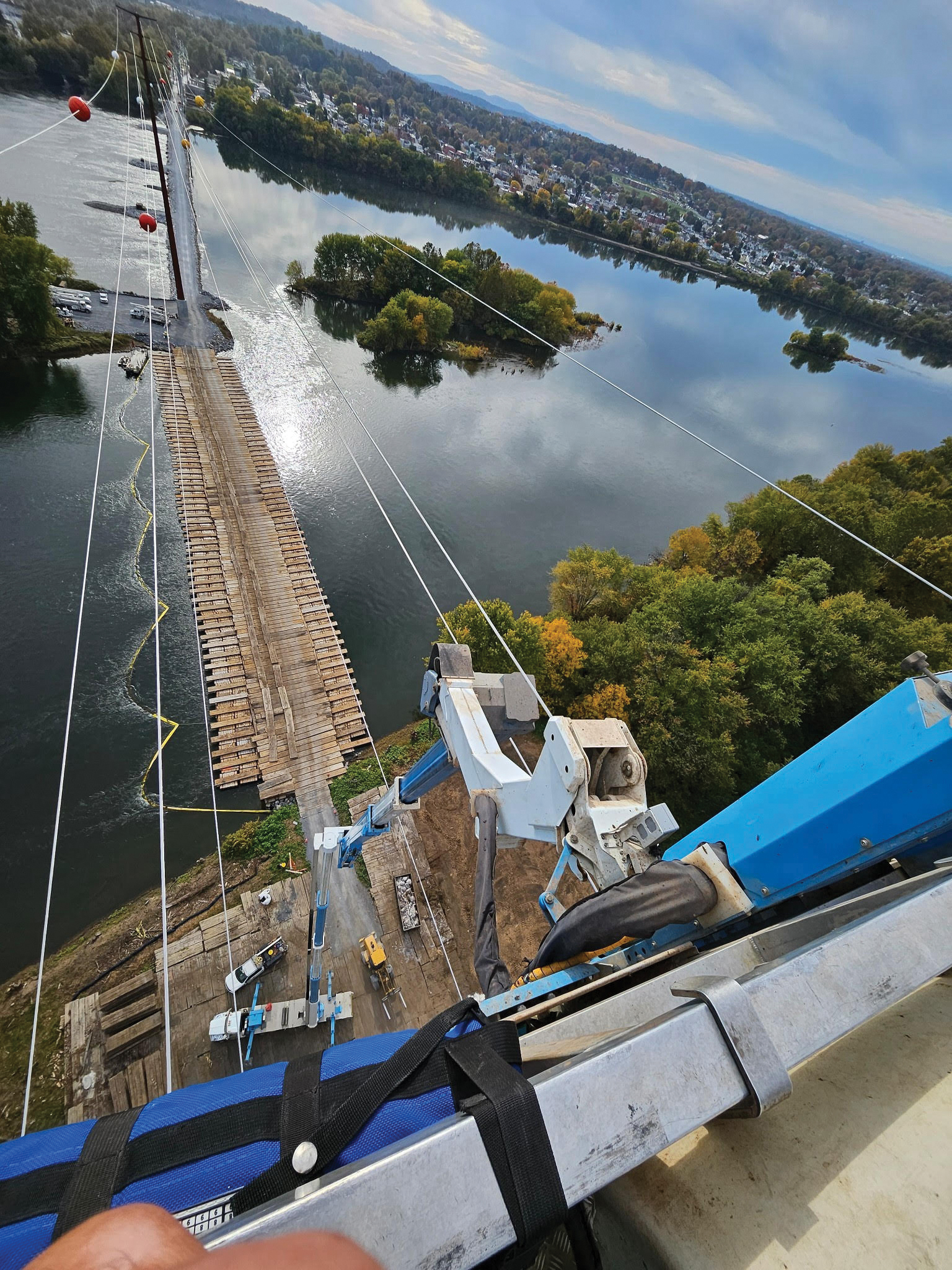
An aerial view of the West Shore Harrisburg River Crossing project from I.B. Abel’s 336-foot bucket truck
“To rebuild the line, we had to gain access to the islands on both sides of the river, which required us to build a 1,700-foot causeway to access Stucker Island (along which 16–18 steel pipes for direct drainage were installed) and an 800-foot floating road to access Hess Island,” Cummins said. “The floating road was engineered and built by contractor BluRoc [Northampton, Mass.] using special mats from Sheridan, Ark.-based Emtek Access Solutions and required us to drill into the bedrock of the Susquehanna River with a drill rig off a barge, which we undertook in the summer when the river’s depth was at its shallowest level in that area.
“However, in building the causeway where the river was deeper, the flow rate of the water was so significant that we had to weigh down our scuba divers at depths of 15–20 feet off one side of the barge in order to have them install the grouted rock anchor, attach the hardware and bring it back to the surface so that we could tether it off and secure it to the floating road,” he said.
Removal of various electrical assets—including 18 spans of dual-circuit 69-kilovolt (kV) lines, six steel monopoles, 10 wood poles and three lattice towers—was also critical before the construction of new utility equipment could begin.
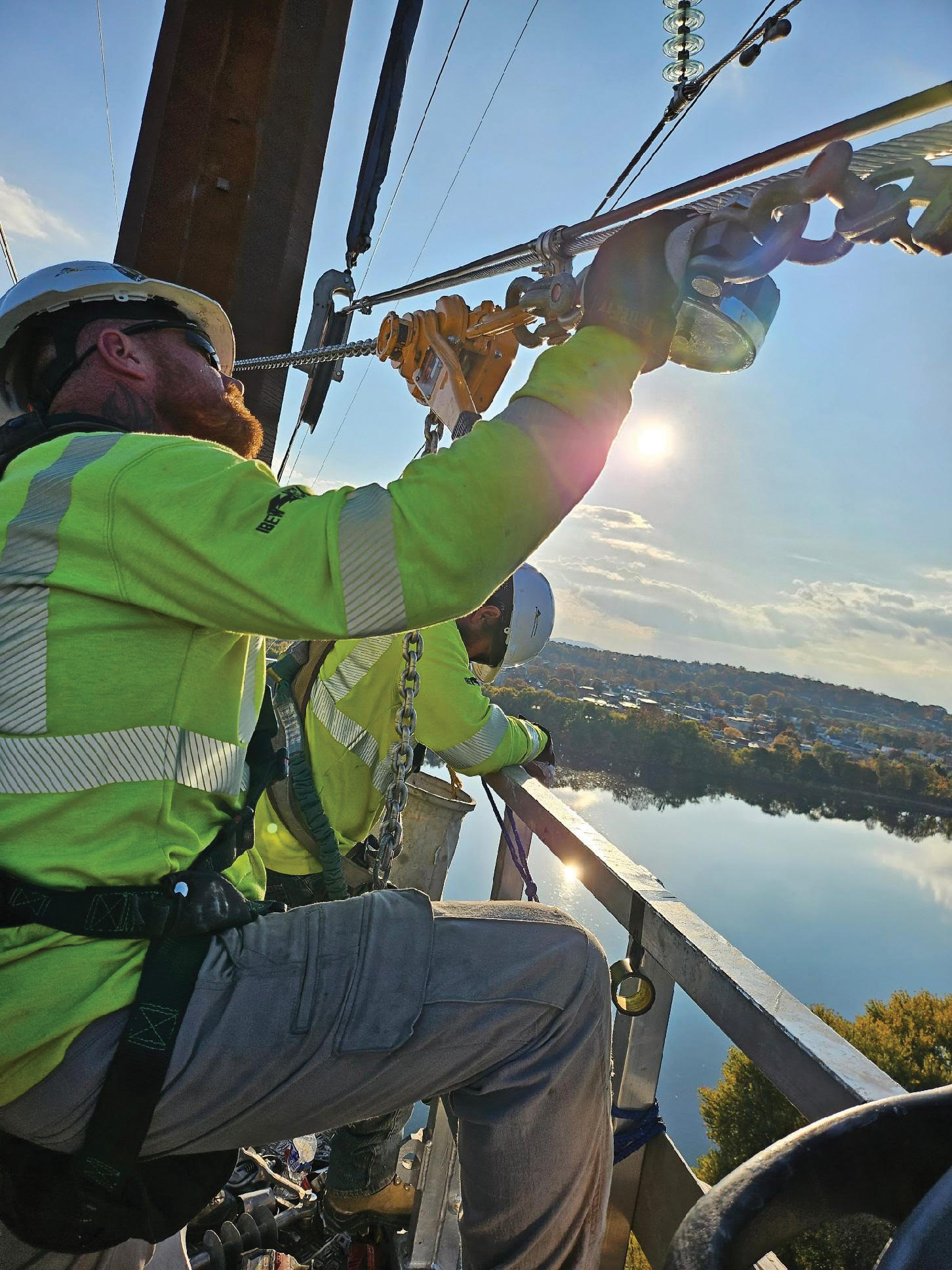
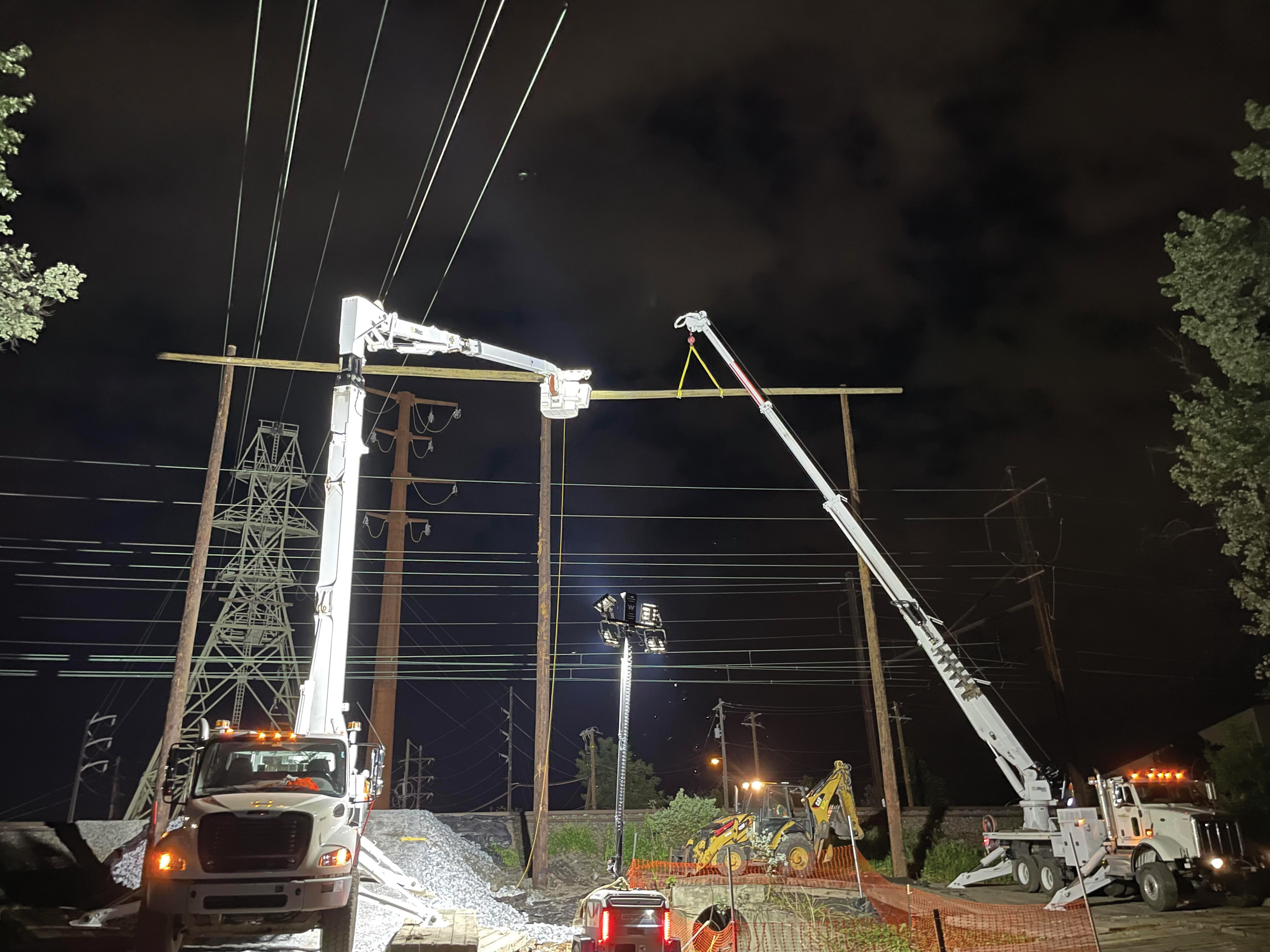
From their staging area established in nearby New Cumberland, Pa., “we used some large pieces of equipment, including 336-foot, 235-foot and 125-foot bucket trucks for different applications; 60-ton National cranes; telehandler forklifts with 10-ton capacity; an Altec DT80 digger derrick; and other heavy-duty utility equipment,” Cummins said. “We also engaged a helicopter to enable our installation of FAA-required lumened and nonlumened aviation marker balls and lighting as well as wire-stringing equipment to remove and install the conductors necessary for the dual-circuit 69-kV line. We ultimately installed six conductors and three optical ground wire cables as well as an electrical source to power the FAA lighting.”
To keep power to the metro area, the team rerouted circuits and power sources accordingly based on respective demands.
“The line portion crossing the river was able to be worked under a dual-circuit outage, which allowed us to install new foundations, set poles and begin the wreck-out across the river,” Cummins said.
To remove the old towers and wires, the team attached ropes to the old wires and used a rewind machine and a split drum.
“Because we had to keep tension on the wires to keep them out of the water, we had the helicopter keep the rope taut and above the water as we rewound the rope machine, and once all of the old wires were off the towers, we demoed them,” Cummins said.
I.B. Abel crew members finalize the power source for the FAA-required lighting on the shore of the
Susquehanna River
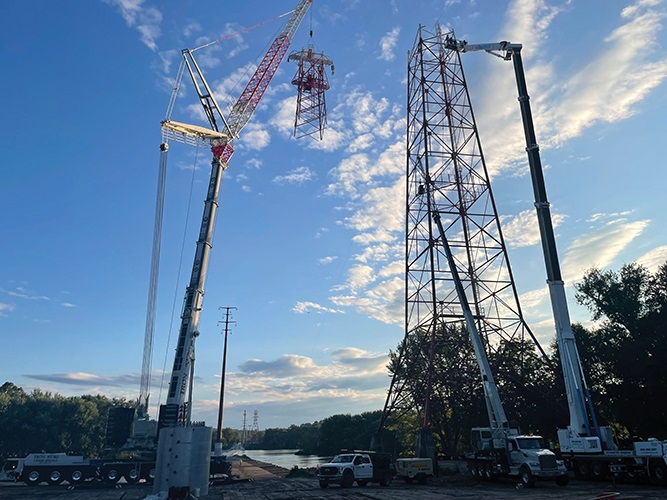
Though the utility had hired a blasting contractor with explosives to demo the 305-foot tower on Hess Island, Cummins’ experience with lattice tower demolitions and expert calculations in the nick of time revealed that if it was brought down with explosives, the tower would end up 60 feet into the river and expose the water to lead contaminants.
To avoid this, “I.B. Abel sent the utility a proposal for demolishing the tower without explosives that involved use of a 500-ton crane to demo the old tower down to a manageable height, after which we’d cut the lattice legs,” he said.
The utility approved his creative approach and, though the maneuver caused some of the greatest debate of the entire project, the team cheered when the demolished tower successfully landed 15 feet shy of the water. After the demolition was completed, Cummins’ team used their helicopter to fly in ropes, which allowed them to install the new circuits spanning the Susquehanna River.
Among other activities, the team also successfully completed the replacement of a load break air brake switch and installed a variety of overhead power line spans on nine new foundation steel monopole structures, which feature poles extending 230 feet in height on top of 22-foot concrete supports.
While dealing with complications from the water and air, I.B. Abel’s crew also navigated a range of other challenges, including the project’s proximity to railroad tracks and the team’s need to work over the railway’s powered signal, distribution and transmission lines.
“We had to coordinate with Norfolk Southern and Amtrak daily so that we didn’t interrupt their train schedules,” Cummins said. “Every day, we had to submit a detailed work plan identifying our crane heights, the rigs/slings we were using and more, and we had to build an elevated work pad of timber wood mats over their crossing that was tall enough so that our wires wouldn’t make contact with theirs. This also required our team to work at nights and over the weekends when the trains were able to get their transmission lines out of service but remain energized with catenary.”
While the weather was mostly pleasant during the project’s run, a rainy period in August 2023 flooded the area and washed away a portion of the causeway the team had constructed, requiring a time-consuming repair.
“I needed to figure that out for our client because we didn’t want to delay things—I’m a second-generation lineman and where there’s a will, there’s a way,” Cummins said.
He ultimately requested one line to be deenergized so that the team could undertake the weeks of work it took to reconstruct the causeway and maintain the project’s forward momentum.
An achievement
With nearly 25 crew members from I.B. Abel, BluRoc and Plymouth, Minn.-based Tri-State Drilling on-site at the height of the project (during which time I.B. Abel team members worked at nights on fiber cutovers to transfer communications from one line to another), the team completed their work in October 2023—a full two weeks ahead of the target date.
“Not only did we finish early, but we completed the job with zero accidents across I.B. Abel, BluRoc and Tri-State,” Cummins said of the project, which involved thousands and thousands of man-hours. “We subsequently received extremely positive recognition for this project from our client, as well as from the local community, which was incredibly rewarding.”
Looking back on the upgrade they made possible, “we built it to last,” Cummins said. “Should there ever be any flooding, our 60-foot concrete foundations with a 22-foot reveal will withstand the pressure, and we also revegetated the islands after we worked there and installed armoring in the form of huge boulders to protect the islands from washing away.”
“Everyone truly came together on the contractor and utility side on a daily basis to achieve the end result, and without all of us doing our jobs, the project could have been derailed,” he said. “So many things changed every day, from the stages of the river to the train schedules and more, so our success required a lot of close cooperation and communication. There were so many times when we left our office trailer with a specific plan but had to pivot because of a new and/or unforeseen circumstance. We had to stay on our toes and remain flexible to deal with all of the challenges.”
For Cummins, the opportunity to work as a lineman and provide an important public service to community members is a privilege.
“There’s nothing more fulfilling than knowing I’ve done an honest day’s work for an honest day’s pay and that I helped support an essential system that people rely on every day,” he said. “Being able to look back on this project and discuss our achievements as a team is such a proud moment.”
“While this wasn’t my first river crossing project, it came down to the way we planned and executed it,” Cummins said. “It was all about bringing in our past experience, being observant of approaches by other utilities in these situations and thinking outside the box.”
About I.B. Abel
Founded in 1913, I.B. Abel Inc. has roughly 600 employees and designs, builds, maintains and services a broad range of commercial and industrial systems. The company works in electrical, transmission, distribution, substation, telecom and data, commercial wireless and storm restoration. It largely performs work in the northeast and southern regions. The Storm Task Force has traveled across the country to perform storm-related repairs.
I.B. Abel
About The Author

BLOOM is a 25-year veteran of the lighting and electrical products industry. Reach her at [email protected].