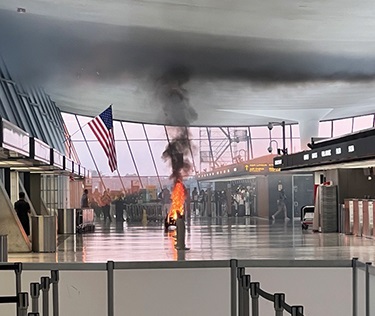
Next-gen artificial intelligence data centers are aligning around 800V DC, but a new white paper from Schneider Electric, Boston, delves into whether it’s possible to use existing methods to conduct an arc flash analysis for such a facility and get accurate results.
Concerns about arc flash incidents in data centers isn’t new, according to Manav Patel, Schneider Electric’s vice president for strategy and business transformation. But what is new is converter-fed DC at 800V at a scale the industry has never deployed.
“Many of the established calculation methods and field practices were developed primarily around AC systems,” Patel said. “DC faults behave differently. There is no zero crossing to help extinguish the arc, and the energy stored in capacitors and batteries, and where it is placed relative to the converter, shapes the first milliseconds of a fault.
“In an AC system, contractors generally work with mature equipment characteristics and well-established protection practices. With converter-fed DC, the response depends not only on the breaker, but also on the converter controls, stored energy, grounding method, conductor impedance and the overall protection sequence. The converter, breaker and distribution system therefore have to be evaluated as one coordinated powertrain,” he said.
Thus, the new white paper underscores that the system architecture, rather than the presence of DC alone, is the primary driver of incident energy.
“In the power rack case we studied, calculated incident energy remained below the commonly referenced 1.22 cal/cm2 threshold, even before adding downstream protective devices to the model,” he said. “That is an encouraging result, but it should not be generalized to every design. Each project still requires an architecture-specific assessment.”
Bear in mind that the shift to 800V DC in A.I. data centers is a response to the power needs of the rack more than the facility at large, Patel said.
Five years ago, when he worked on the hyperscale side of the industry, “the standard racks we designed were around 15 kW, and 70 kW counted as high-density. A.I. training racks now draw hundreds of kilowatts, and NVIDIA’s public roadmap takes them past 400 kW with a clear path to 1 MW,” he said.
He added that for ultra-high-density A.I. clusters, Patel expects 800V DC to become “potentially (the) predominant architecture.” Centralized 800V DC scales better for gigawatt-class A.I. factories, he said, and tracks the next-gen racks on NVIDIA’s public roadmap, which the industry expects in 2027-28.
What does the industry need next in terms of guidance and standards for 800V DC?
“I think about it in three parts: product standards that reflect how converter-fed DC systems behave in a fault, a system-level standard so these systems can be predictable and repeatable at gigawatt scale, and a validated method for calculating DC arc flash incident energy,” Patel said.
But he said there is a fourth component, and that is the ecosystem, which is where contractors come in. As of now, consultants, engineering firms, contractors and authorities having jurisdiction (AHJ) don’t have established methods to specify, install and inspect such systems.
“Codes and standards will continue to evolve, but installations will begin before every question is addressed in a prescriptive code requirement,” he said. “The near-term bridge must therefore be built around engineered system designs, documented operating sequences, manufacturer instructions, third-party evaluation where required and early engagement with the AHJ. I would bring contractors and electricians into the design review early, keep interim practices conservative and use system pilots and digital-twin simulation before a 50 MW block of this technology lands in the field.”
About The Author

VOSS is a freelance writer based in the Chicago area and has worked extensively in the low- and high-voltage areas of the electrical industry. Contact him at [email protected].