
How fiber optic color codes are used
When a fiber optic tech splices cables, makes terminations behind patch panels or selects patch cords to interconnect cables or connect electronic equipment, they use color codes to make the proper connections. These color codes are covered in the TIA 598 standard. For some reason, there does not seem to be an international standard for color codes.
Here are some examples of how color codes are used.
Preparing fiber optic cables for splicing
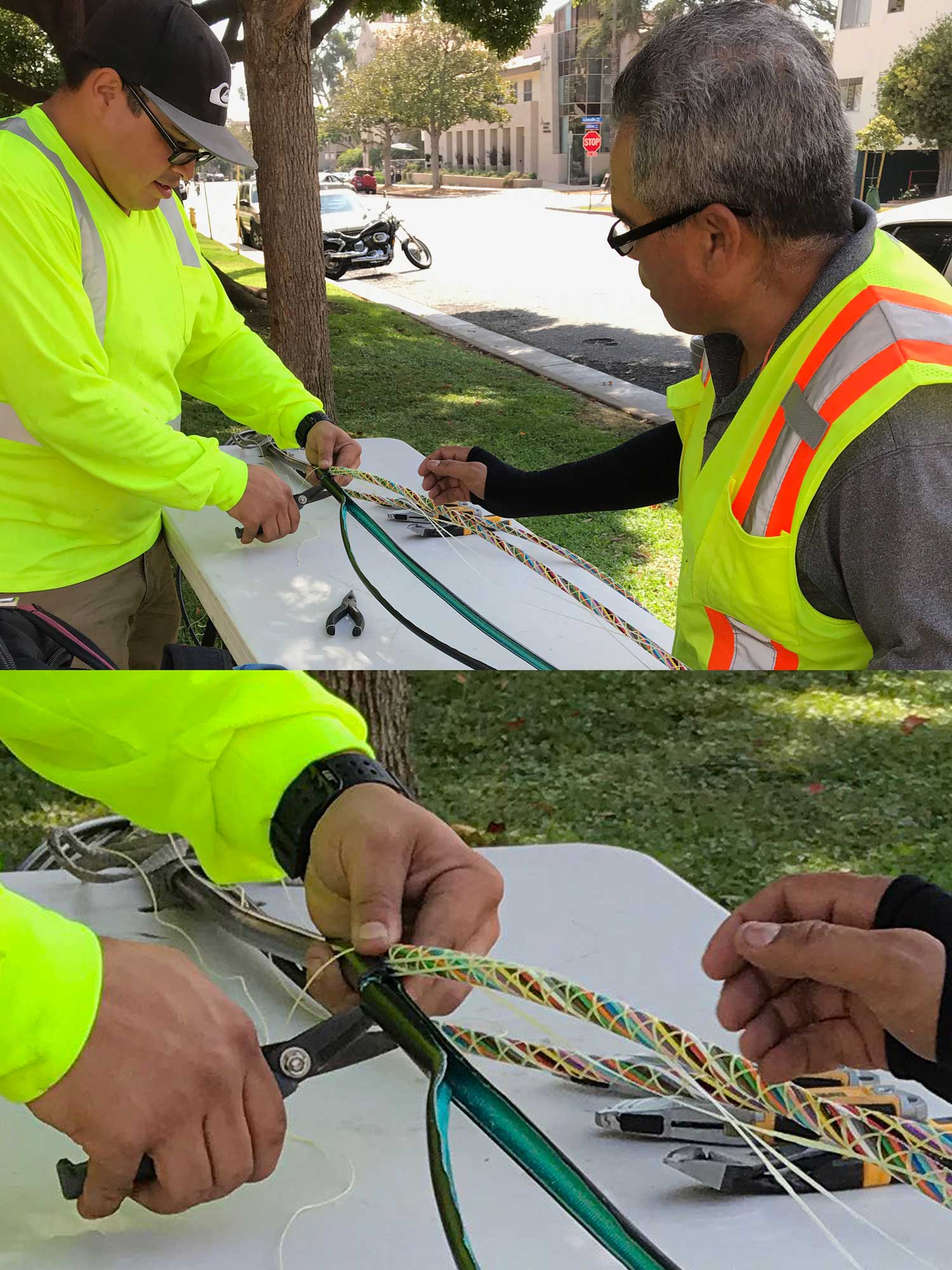
Here are two techs preparing an armored outside plant cable for splicing. Note all the colored buffer tubes held together by binder tape. The color codes used for each tube in this loose tube cable, defined by the TIA 598 standard, will identify fiber groups for splicing. Inside each tube, the fibers are also color coded for identification.
Outdoor splice trays and fiber identification
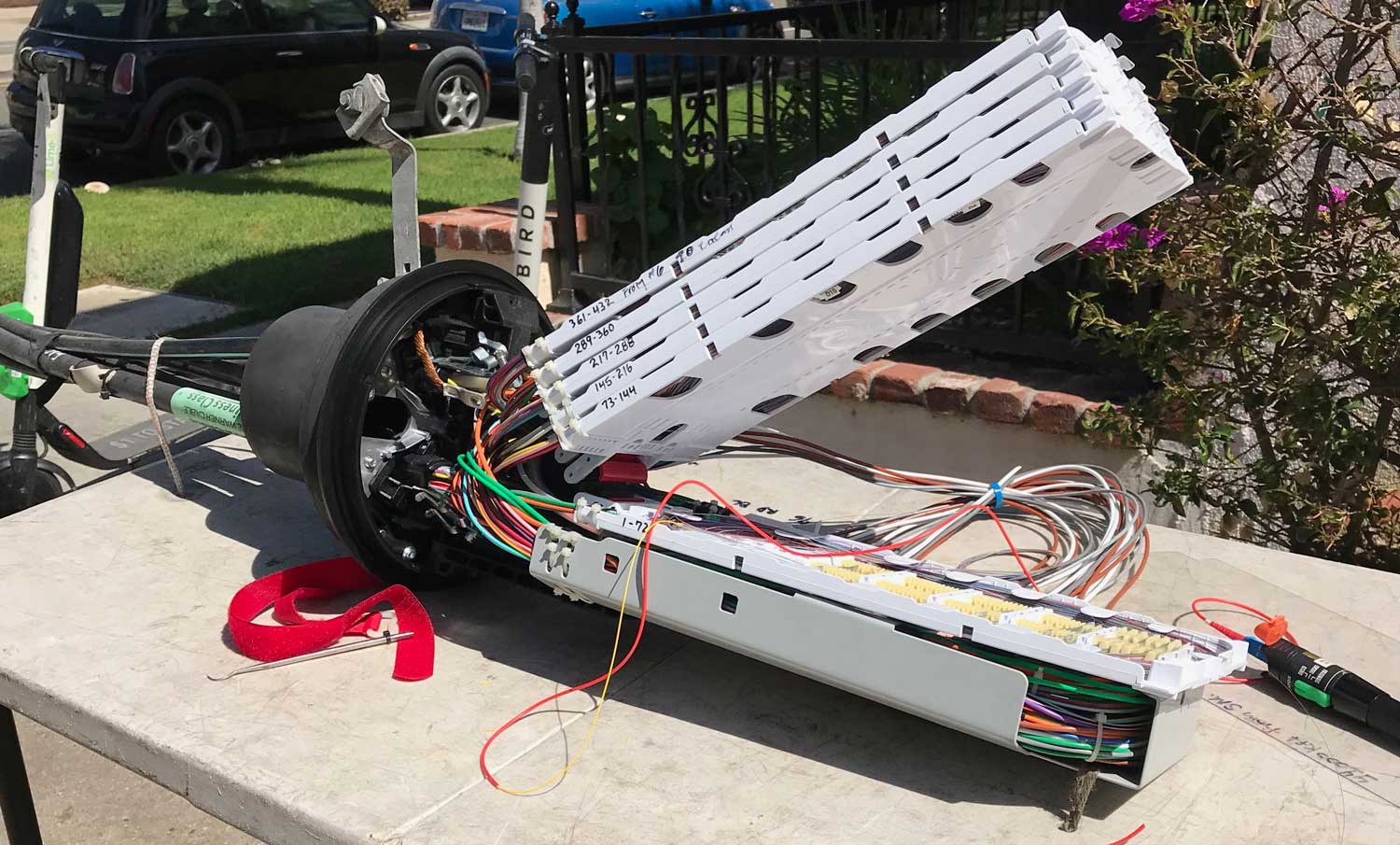
Here is the splice closure they are working with. Note all the colored buffer tubes coiled up under the trays and ending at the tray where the relevant fibers will be spliced. This closure has 432 splices—6 trays of 72 splices each. Without color codes, techs would have a very difficult time making the right connections.
Pedestal splicing: Simplifying connections with color codes
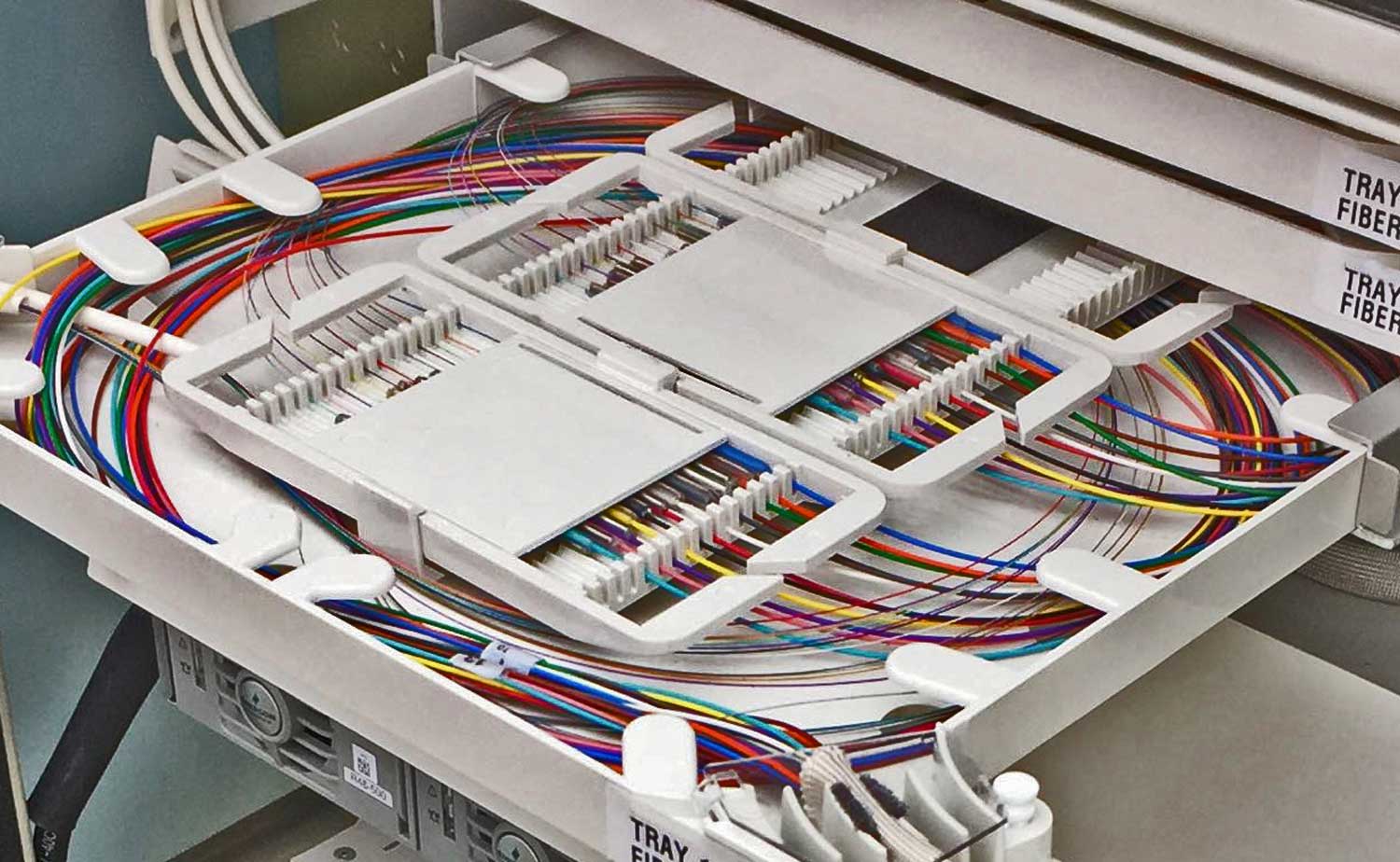
Here is a simpler splicing situation. A 24-fiber cable enters a pedestal and is spliced to pigtails for making connections. You can see the 250-micron buffer fibers from the outside plant cable on the left and the 900-micron buffer pigtails on the right. The splices are under the cover in the center. If you look closely, you will see that the colors of each fiber are matched at the splice to ensure continuity in the cable and make fiber identification and tracing easier.
Fiber optic color codes overview
The color codes for fibers are based on the color codes used for many years with copper cables, with colors from 1 to 12 like this:
| Number | Color |
|---|---|
| 1 | Blue |
| 2 | Orange |
| 3 | Green |
| 4 | Brown |
| 5 | Slate |
| 6 | White |
| 7 | Red |
| 8 | Black |
| 9 | Yellow |
| 10 | Violet |
| 11 | Rose |
| 12 | Aqua |
Thus, a 144-fiber loose tube cable would have 12 tubes color-coded as above, containing 12 fibers that are each color-coded in the same sequence. Of course, many cables shave more than 144 fibers these days. So loose tube cables will have tubes 1–12 color-coded as above, while the next twelve (13–24) will be the same colors with a colored stripe, simplifying splicing and management for high-fiber-count cables. That will be repeated for each batch of 12 tubes until you cover all the fibers.
Managing high-fiber-count cables
If you have tubes with 24 fibers, which occurs in some high-fiber-count cables, the fibers may be bound into groups of 12 with color-coded binder tapes. More often, high-fiber-count cables like this 1,728-fiber cable use ribbons of fibers.
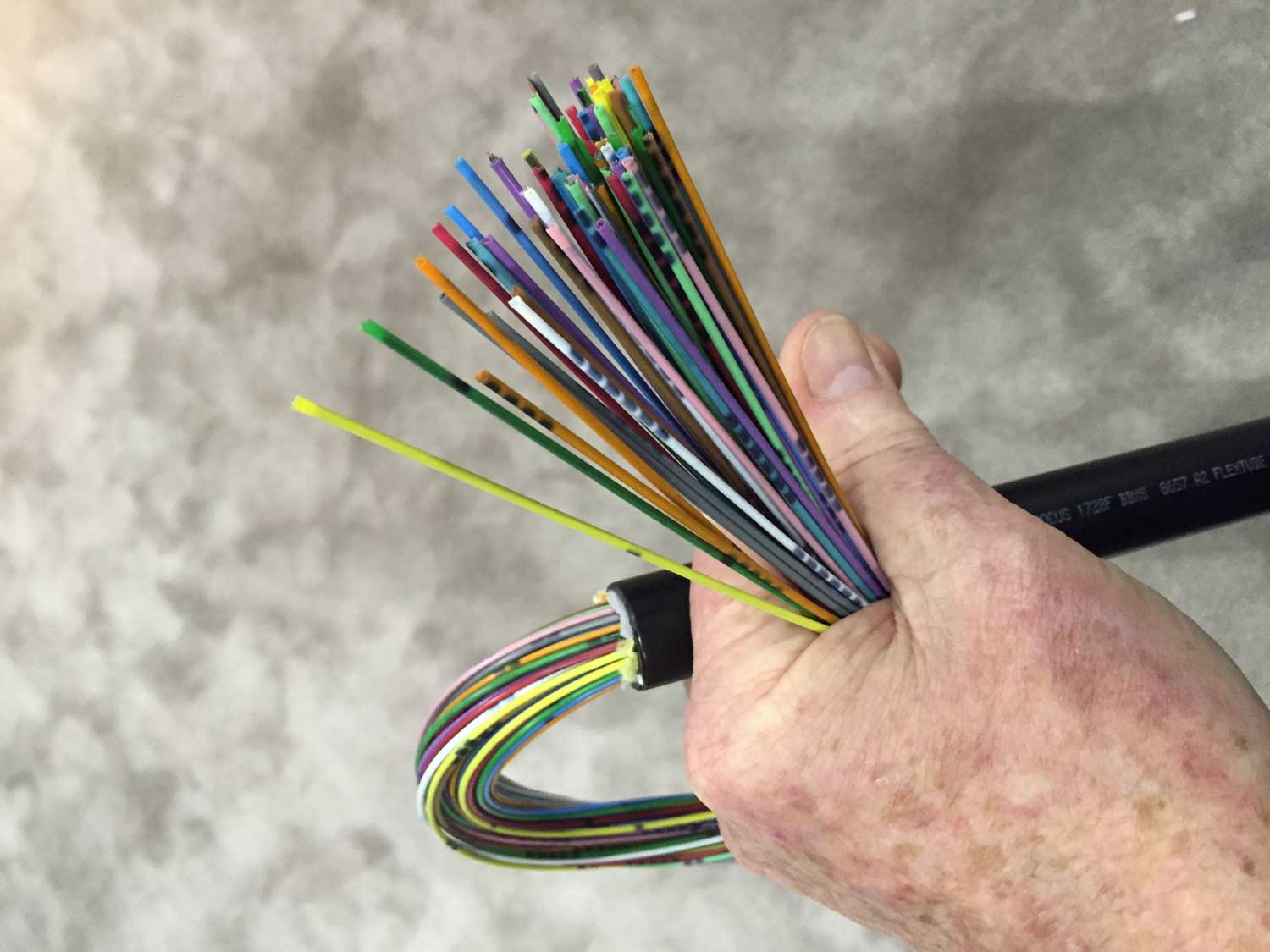
Ribbons of fibers follow the same color codes for fibers 1–12. Some cables have 24-fiber ribbons and they will just start over with the sequence of colors for fibers 13–24.
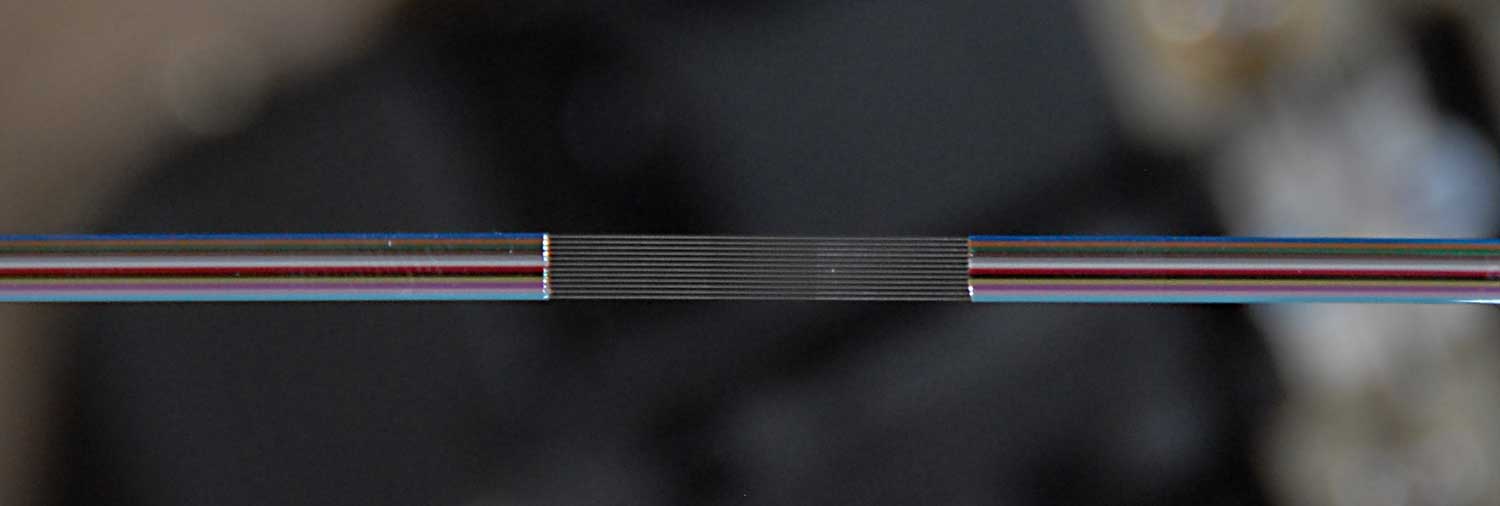
This splice of ribbons shows the sequence of color codes from 1–12 and how splices maintain the proper color codes.
Outside plant cables, as specified for outdoor applications, are always black for UV resistance, but indoor (premises) cables have colored jackets to identify the fibers inside, reflecting their unique applications and standards. Here is the color-code chart for premises cabling:
Indoor cable color codes
| Fiber type | Commercial applications (1,3,4) | Military applications | Suggested print nonmenclature |
|---|---|---|---|
| Multimode (50/125) (OM2) | Orange | Orange | OM2, 50/125 |
| Multimode (50/125) (850 nm laser-optimized) (OM3, OM4) | Aqua | Undefined | OM3 or OM4, 850 LO 50 /125 |
| Multimode (50/125) (850 nm laser-optimized) (OM5) | Lime Green | Undefined | OM5 |
| Multimode (62.5/125) (OM1) | Orange | Slate | OM1, 62.5/125 |
| Multimode (100/140) | Orange | Green | 100/140 |
| Single-mode (OS1, OS1a, OS2) | Yellow | Yellow | OS1, OS1a, OS2, SM/NZDS, SM |
| Polarization-maintaining single-mode | Blue | Undefined | Undefined (2) |
Notes:
1) Natural jackets with colored tracers may be used instead of solid-color jackets.
2) Because of the limited number of applications for these fibers, print nomenclature is to be agreed upon between the manufacturer and end-user.
3) Other colors may be used provided that the print on the outer jacket identifies fiber classifications.
4) For some premises cable functional types (e.g., plenum cables), colored jacket material may not be available. Distinctive jacket colors for other fiber types may be considered for addition to Table 3 at some future date.
Newer fiber optic color codes
Most techs are familiar with orange for multimode and yellow for single-mode, but as new fiber types were introduced, laser-optimized 50/125 fiber is the most common fiber for LANs and other premises cabling applications, so aqua cables have become common. Lime green and blue cables are rare because the use of those particular fibers is rare.
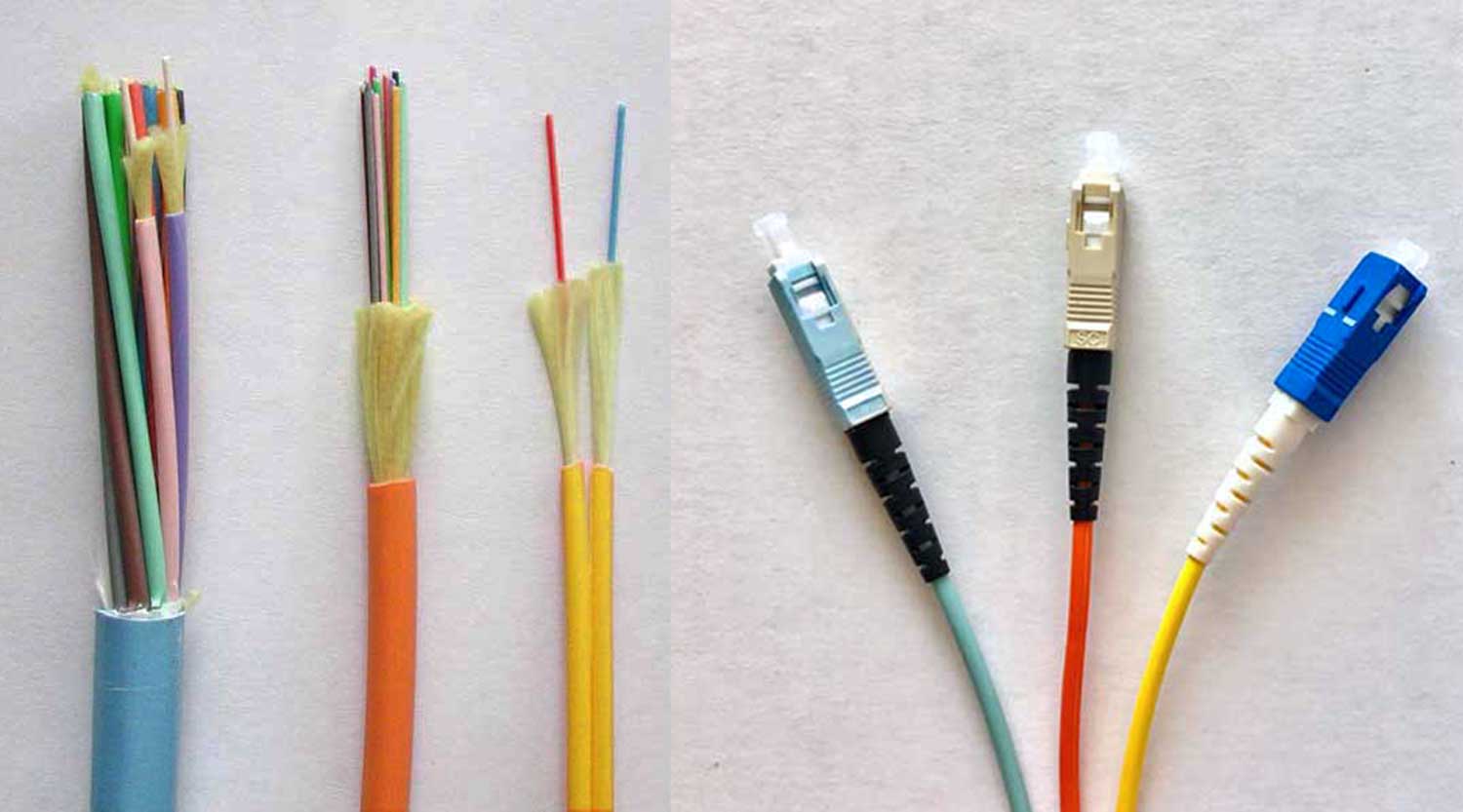
Here are examples of premises cables and patchcords. The colors of the jacket on the breakout cable on the left shows it’s 50/125 OM3 or OM4 fiber and the individual cables inside are color-coded in the same sequence as fibers or buffer tubes. Likewise, the distribution cable in the center is orange, but you will have to read the printing on the jacket to determine if it’s 50/125 or 62.5/125 fiber. Note the 900-micron tight buffer fibers in the distribution cable are also color-coded for identification. The yellow zip cord is single-mode and the fibers are also color-coded in blue and orange (#1 and #2).
Connector color coding and fiber identification
The patchcords add another color code—connectors. Sometimes cable jacket colors alone cannot provide sufficient clarity, so connector color codes help identify the fiber types when the cable color is ambiguous. Here are connector color codes:
| Fiber type | Connector body | Strain relief/ mating adapter |
|---|---|---|
| 62.5/125 | Beige | Beige |
| 50/125 OM2 | Black | Black |
| 50/125 laser-optimized (OM3, OM4) | Aqua | Aqua |
| OM5 wideband fiber | Lime green | Lime green |
| Single-mode | Blue | Blue |
| Single-mode APC | Green | Green |
Custom fiber optic color coding options
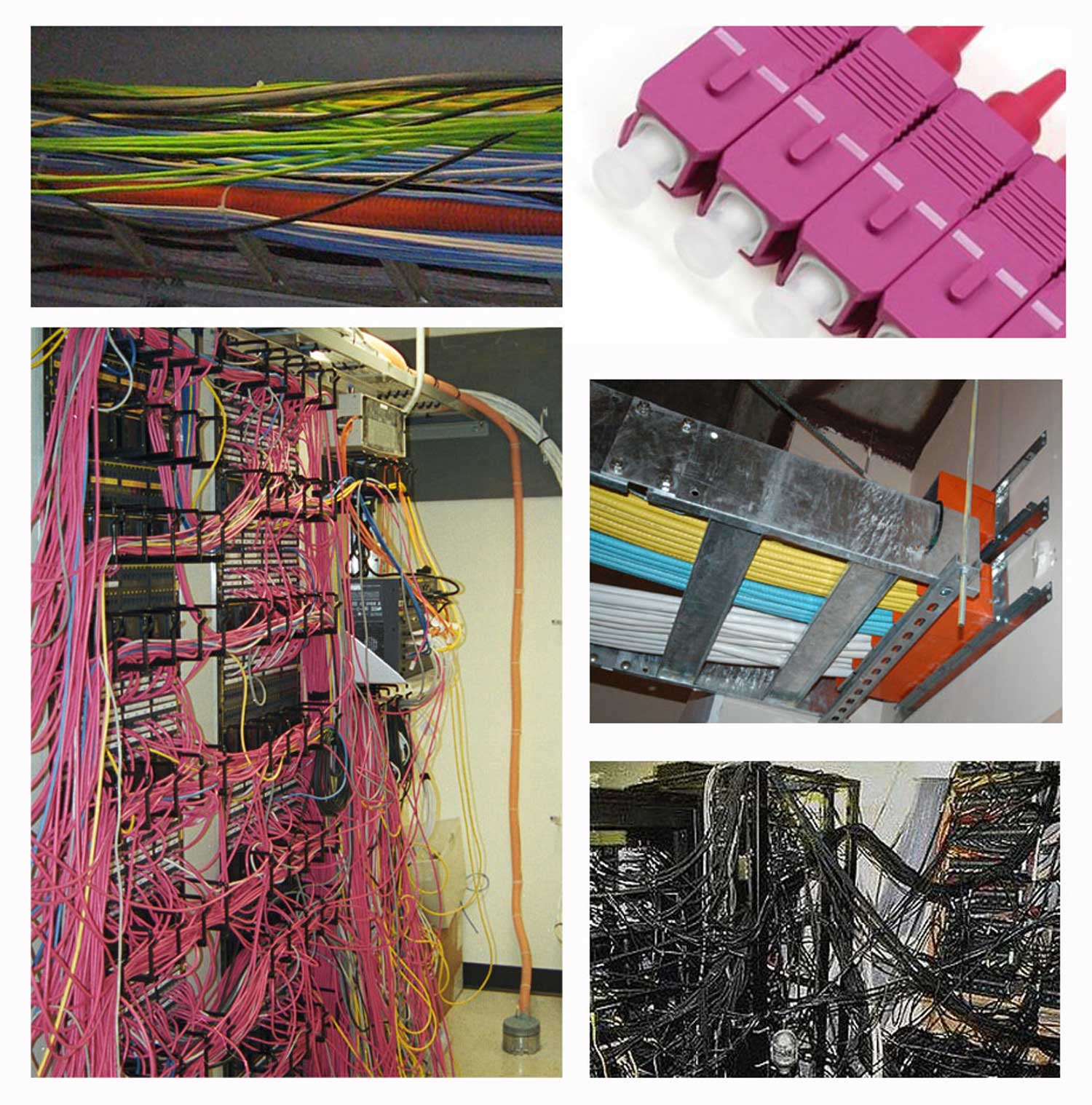
One thing to remember on color coding—it’s an industry standard, TIA 598—which means it’s voluntary. Don’t be surprised if you find black, pink, olive or any other color cables. While the TIA 598 standard provides a baseline for fiber optic color coding, customers can specify any colors they want, enabling custom colors to meet project-specific requirements.
Now the cables with connectors in the photo above become more obvious. The aqua connector and aqua cable tell us that cable is 50/125 OM3 or OM4, and for a short patchcord, there is no real difference in the two. The beige connector on an orange cable says it is 62.5/125 fiber and the yellow cable with blue connector means that patchcord is single-mode fiber with a regular PC connector.
Summary: The importance of fiber optic color codes
That’s how we use color codes in fiber optics to identify and trace fibers. This is something every fiber tech needs to know, but until you have them all committed to memory, you can bookmark this page in your smartphone to have as a reference in the field when you need it.
About The Author

HAYES is a VDV writer and educator and the president of the Fiber Optic Association. Find him at www.JimHayes.com.