Data centers supporting artificial intelligence (A.I.) technologies are driving historic demand for natural gas generators and turbine equipment. Developers and the utilities supporting them say these power producers are the most reliable option for the 24/7 electricity supplies A.I. servers require. But their rapid deployment has fueled fears that related fossil fuel emissions could push back environmental gains achieved over the past two decades.
However, with historic demand driving back delivery schedules for fuel-based generators, developers are looking at new ways renewables can meet the demand. With many leading tech companies still sticking with their sustainability goals, they also are hedging their bets with significant solar, wind and storage investments.
Green energy options also are penciling out financially, even as the clock is running out on the 30% investment tax credit, especially given how much more quickly they can be deployed.
The attractiveness of this model has even pushed Alphabet—Google’s parent company and a major data center operator—into the power development business. Earlier this year, it acquired Intersect, a leading independent power producer focused on renewable generation.
Demand-growth basics
At this point, it’s not news that A.I.-related power demand is on the rise. The Electric Power Research Institute (EPRI) recently projected data centers could comprise 8%–17% of U.S. power production by 2030, boosting its 2024 estimates by 60%.
Some see these projections as overly ambitious. A May report from JP Morgan noted that construction has yet to begin on more than 60% of data center capacity planned for completion in 2027, and another 7% is delayed.
Still, there’s no denying this technology is forcing a rapid buildout of new generating capacity. One of the contributors to current data center delays is the backlog in generation equipment needed to power these loads.
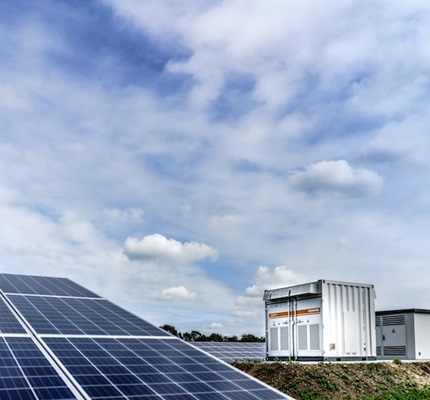
To keep their aggressive buildout plans on schedule, the largest tech companies are now developing their own renewable resources—especially solar-plus-storage—because these systems can be up and running in a fraction of the time required to bring generator plants online. They also offer stable energy pricing, with no volatile fuel markets to consider once systems are operational.
A new paradigm
Technology companies have had an outsized effect on renewable energy development for the last two decades or so. Many companies set “net zero” carbon emission targets by matching energy used from fossil fuel generation with equivalent renewable energy purchases. Often this was accomplished through power purchase agreements (PPAs) that provided financial backing for solar and wind projects located outside the service territory of a data center’s local utility.
Today, though, more data center operators are seeking to tie their operations directly to the resources they’re financing. In some cases, they’re creating microgrids to enable operations independent of the local grid, escaping the need for interconnection agreements and the time-consuming capacity studies those contracts require. While flexible natural gas generators might be a part of the mix in these designs, they serve more of a backup function, with solar and batteries providing baseload support.
With its purchase of Intersect, Alphabet has now become an electricity provider. This company started out developing and operating traditional grid-tied, utility-scale renewable resources. As a minority investor, Alphabet began collaborating with Intersect on a microgrid-style installation comprising solar, storage and natural gas at a Google data center in Texas.
With its purchase of the company, Alphabet now has its own power-development company focused on supporting the buildout of Google A.I. data centers, with expertise in solar-plus-storage installations that could be co-located to exclusively serve those operations.
In January, Amazon announced its own entry into solar development with its purchase of the shovel-ready Sunstone solar-plus-storage plant in Morrow County, Ore., also home to several of its data centers. Sunstone’s original owner, Pine Gate Renewables, filed for bankruptcy in November, but it had already secured interconnection agreements with the area’s local cooperative utility. It is scheduled to be built over six phases, each adding about 200 megawatts (MW) to the grid. Unlike many traditional PPAs, the project’s presence within the same region means its output will directly support Amazon’s operations.
Independent data center developers also are seeing advantages in directly pairing new facilities with renewable options. Soluna Holdings is one such company. In April, it purchased the 150-MW Briscoe Wind Farm in West Texas, which is co-located with an existing Soluna data center. The output feeds into the local grid, rather than directly powering the data center, but it does offset the center’s demand. It’s also a money maker—electricity sales are expected to earn between $20 million and $24 million over the next year, making it a green investment in more ways than one.
stock.adobe.com/ABCDstock
About The Author

ROSS has covered building and energy technologies and electric-utility business issues for more than 25 years. Contact him at [email protected].