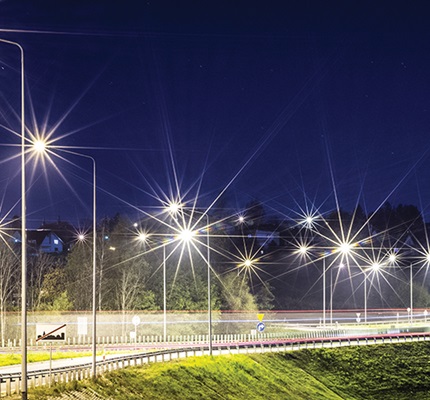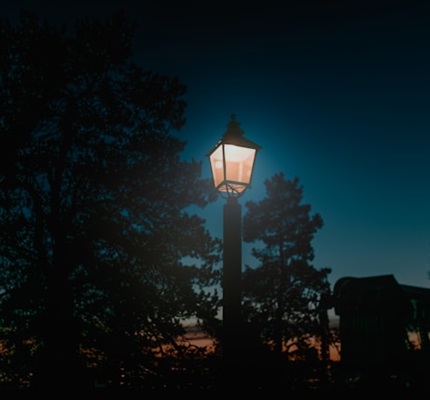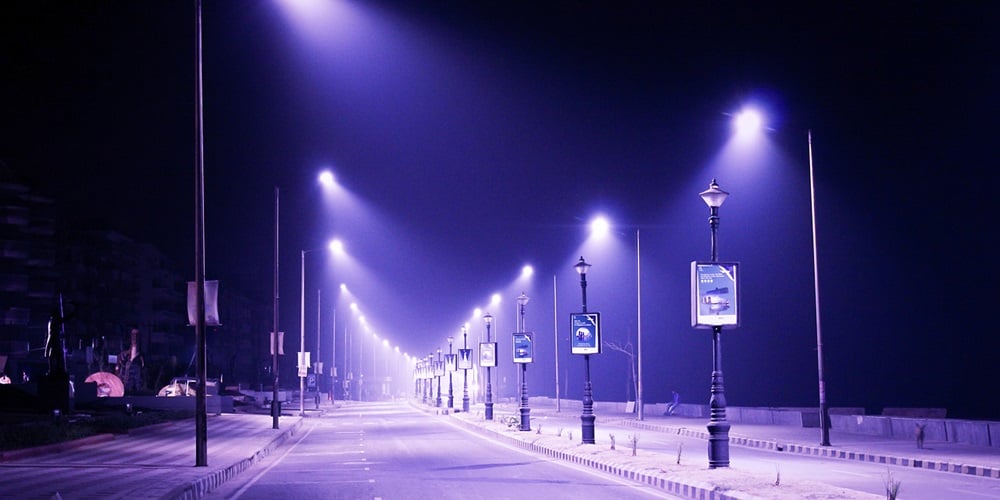
Since many cities and towns began switching to LED streetlights about 15 years ago, a peculiar phenomenon has begun to occur. As specific batches of LED streetlights age, their cool white light fades to blue and then eventually emits a purple wash, due to delamination of the phosphor-silicon layer in some LED chips. This has been linked to a manufacturing defect that eluded quality inspections.
LED streetlights became popular for several reasons:
- Cost savings of up to $150,000 annually, due in part to minimal maintenance requirements
- Energy efficiency: consuming an average of 50%–80% less energy than traditional high-pressure sodium or metal halide lamps
- Longer lifespan: averaging 50,000 to 100,000 hours, compared with 10,000 to 24,000 hours for traditional streetlights
- Lower environmental impact due to reduced carbon emissions
- Ability to integrate with smart technology, enabling dimming, motion sensors, remote monitoring and more
- Improved safety by providing bright, uniform illumination to enhance visibility
- Safety becomes compromised, however, with the “great purpling” of dying lamps. The purple wash indicates reduced luminous output, skewing the spectrum toward shorter wavelengths that don’t illuminate asphalt and concrete as well as a whiter beam. This can affect how drivers view lane markings, traffic signs and pedestrians. Contrasts flatten, shadows deepen and colors appear muted or distorted, all of which can slow reaction times and make it harder to judge distances.
Now that the defect has been identified, many municipalities are including performance guarantees and warranties in their street lighting contracts, allowing them to get lamps replaced for free or decreased cost.
The average cost of replacing an LED street light fixtures runs from $100 to $500. If only the lamp needs replacing, the cost is around $50 to $200. The cost of replacing the entire fixture can be as much as $400 to $1,200.
The difficulty of replacing LED lights depends on the type of fixture, the location and accessibility of the pole, the complexity of the installation and the technician’s experience. Replacement often takes longer in solar streetlights than the standard variety, due to additional components such as the battery and solar panel.
Early adopters of new technology often serve as guinea pigs when they put new products to the test in real-world conditions. LEDs still offer the same promises of longer life, lower energy usage and reduced maintenance. But, as municipalities have now seen, one of the potential defects—in this case, a single weak link in the materials stack, such as a phosphor-silicone interface—can result in the need for large-scale replacement, a costly endeavor.
Other results of this technical failure include municipalities learning to examine performance claims and evaluate the details of warranties, while manufacturers scramble to design more durable fixtures. It has also underscored the importance of resident engagement for municipalities to maintain trust with the community in “light” of these visible defects.
About The Author

Lori Lovely is an award-winning writer and editor in central Indiana. She writes on technical topics, heavy equipment, automotive, motorsports, energy, water and wastewater, animals, real estate, home improvement, gardening and more. Reach her at: [email protected]