You're reading an older article from ELECTRICAL CONTRACTOR. Some content, such as code-related information, may be outdated. Visit our homepage to view the most up-to-date articles.
The importance of monitoring the quality of the electrical supply has increased with the ongoing push to boost uptime, productivity and profits. When carrying out business 24/7, having a process or operational interruption can negatively affect of the bottom line. If a customer can’t instantly purchase what they want from one company, a competitor is just a click away. Coupling with this trend, experienced power quality professionals are becoming fewer and fewer. Once having extensive power quality departments, utility companies have reallocated personnel or don’t replace those lost to attrition. With overworked staff who often don’t know Kirchhoff from Kierkegaard, facility managers have taken on more responsibility for solving power quality problems.
Power quality monitor designers and manufacturers have noticed this trend. The latest generation of power quality meters, portable monitors and monitoring systems incorporate features to make the analysis of existing problems—and the prevention of future ones—easier and safer. International standards continue to evolve to allow for data comparison and evaluation from different vendors. And, like much of the electronics industry, more features and better performance are available at lower prices.
Most handheld meters are single-phase instruments. Besides real-time metering functions of voltage, current and power parameters, many products incorporate harmonics and other power quality parameters. Some meters can log data for hours or days. Others can provide waveform capture and display. Rather than just a simple digital multimeter, having a meter with some power quality capabilities allows for quick measurements to help determine if a more comprehensive monitoring program is needed. At prices less than $1,000, every toolbox should have one.
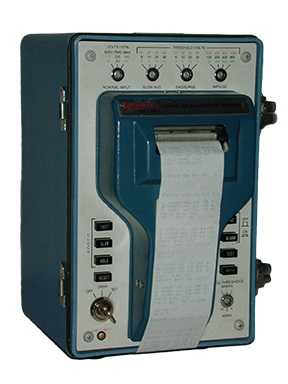
Traditional power quality monitors are in their fifth generation. The above images of the first dedicated monitor Model 606 Universal Disturbance Analyzer and the latest HDPQ Xplorer family from Dranetz illustrate this dramatic evolution. Screwdriver adjustments for trigger thresholds of voltage are replaced by automatic and wizard setups for thousands of parameters. Data output has evolved from hundreds of feet of thermal paper to gigabytes for display on touchscreens. And now, the data can be transmitted to software to compare multiple sites in automatic detailed reports. The large screens provide a clear picture of waveform and trending data without having to download the information to a PC. Providing answers to certain power quality questions helps the less knowledgeable user determine what tripped their adjustable-speed drive offline. With low-cost GPS modules, time accuracies across portable units can be in the subcycle range, aiding in the finger pointing.
User safety also is an important factor in product design by AEMC, Dranetz, Extech, Fluke, Hioki, Ideal Industries, Megger, PMI, PSL and others. Voltage inputs are generally rated for CAT III, 1,000 volts (V) and CAT IV, 600V. Current can be measured using flexible probes that snake around conductors without the danger of moving them. Instruments can be put behind the switchgear panel with the door panels closed, using communication methods such as Wi-Fi and Bluetooth to get data out and adjust settings using laptops, tablets or smartphones.
Permanently installed power quality monitors incorporate many of the technical advances of the portable monitors in sampling rates, storage memory and accuracy while calculating more parameters than just about anybody needs. While these systems have been communicating by wired and wireless methods for years, the stand-alone systems are becoming less common. Integration into other management systems is the trend. For utilities, data from revenue meters, protection relays, digital fault recorders and power quality monitors all help manage the smart grid. Facilities incorporate the data into building management systems that provide complete facility energy profiles.
Other necessary tools include infrared or thermal imaging cameras. Thermal imaging is a key predictive maintenance tool in the electrical inspection program, which provides quick safety checks of energized equipment before beginning maintenance work to avoid costly service interruptions and exorbitant equipment losses. Just like benchmarking and trending power quality data, doing periodic thermal imaging surveys can pick up on problems before they become major issues. By spotting potential issues, the device helps avoid process interruptions, loose bolts, degrading contacts, and overloaded transformers, motors and neutral conductors due to harmonics.
With all of these tools at your disposal, you can help add positively to the bottom line without having to become a power quality expert. A little knowledge can go a long way.
About The Author

BINGHAM, a contributing editor for power quality, can be reached at 908.499.5321.