You're reading an older article from ELECTRICAL CONTRACTOR. Some content, such as code-related information, may be outdated. Visit our homepage to view the most up-to-date articles.
There is an old saying that liars figure and figures lie, which implies that the truth can be a challenge to discern from both people and data. At a recent standards-making conference, I encountered some examples of this concept that seemed worth sharing.
The first instance of disbelief came from a series of presentations by a panel of “experts” regarding the effects on the electrical grid from modern or newer technologies being applied to it, including solar and wind generation as well as advanced measurement capabilities from smart meters and phase measurement units (also called synchrophasors). Several presenters addressed the effect of distributed (or dispersed) photovoltaics (PV) versus bulk PV (also called solar farms) on the power-quality phenomena of voltage fluctuations that result in the perception of light flicker. One presenter stated that the baseline flicker in the area will increase; the second said there is no effect; the third said “Here’s lots of data, but we don’t know what it means.” Really?
One of the selling points that has contributed to the proliferation of smart meters installed using stimulus money from the Energy Independence and Security Act of 2007 was that the grid would become more reliable with all of the power quality information provided to the utilities. Many millions of smart meters have been installed around the world.
Yet presentations showed that a majority of smart meters do not have any traditional power quality capabilities enabled, due to either cost or the inability of the communication and data processing infrastructure to receive the data. Even worse, all of the single-phase meters tested in one study produced erroneous voltage readings during sag or swell conditions, and most meters tripped offline under typical sag magnitude/duration events. Three-phase units only fared better if the sag was only on phase B or C, since they were self-powered from phase A. Really?
Another session covered the trend in voltage quality of the electric grid. Is it worse and will it worsen as modern technologies are applied? Total harmonic distortion (THD) is up, and the number of voltage sags seems to be increasing. With higher power demands on the electric utilities despite the increase in efficiencies of equipment connected to the grid, is the source of the increased number of sags related to the current generation capacity, the demands on the grid, or the inclusion of renewable generation that is generally considered “less stiff” than traditional generation? Or, is the “Third World state of the U.S. grid” becoming a reality?
Only one person had an answer to the question of whether the decrease in clearing vegetation from the proximity of conductors increased sag numbers. While I was describing the scenario on many distribution systems, this person related an increase in vegetation clearing activities on transmission systems—including wider right-of-ways—that have resulted in increased sags due to more lightning strikes hitting the towers as they are now more exposed and more likely targets for lightning strikes. Really?
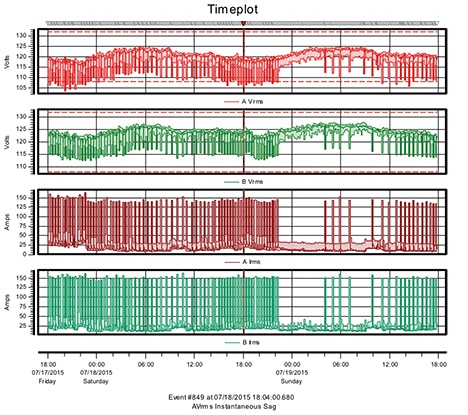
I recently conducted a power quality survey at a residence that was scheduled to have 14 kilowatts of solar panels installed on the roof. I believe that having a baseline of performance prior to making such a radical change in the power system, even on a residence, is a good way to evaluate the impact. The graph above shows the rms voltage and current plots for the split-phase service over several days. It didn’t take long to trace the repetitive sags to the recently installed 5-ton heating, ventilating and air conditioning unit that is located on the opposite end of the large house from the service.
I was concerned with the voltage sags that could go below 100 volts depending on other loads being on in either of the two same-served dwellings along with voltage reduction from the utility due to extreme demand on its generation by the recent 99-degree weather. Would the anti-islanding protection scheme of the PV system trip offline on the sag and then be out of service for 5 minutes per the IEEE 1547 interconnection requirements? Would it damage the PV system or any equipment in the house?
With the disclaimer that their responses in no way diminished my respect for them and their expertise in the power quality and electric utility systems in general, I received three answers when I asked, “What will happen when the solar panels are energized?” The answers were as follows:
- "It will work fine."
- "There may be a problem depending on the scheme used by the vendor of the PV system, which is a carefully guarded secret of most vendors."
- "It will actually improve the voltage quality at the house by reducing the sag magnitudes due to the close-in voltage-generation sources."
Really?
So if rooms full of experts in the field can produce such a varying set of answers to the same questions, what is the “real” answer for the general public and those making decisions on where and how to best spend money to improve the quality of the power for those who consume it? It’s something we really gotta find out.
About The Author

BINGHAM, a contributing editor for power quality, can be reached at 908.499.5321.