You're reading an older article from ELECTRICAL CONTRACTOR. Some content, such as code-related information, may be outdated. Visit our homepage to view the most up-to-date articles.
When considering power quality disturbances or the quality of the electrical supply, phenomena such as rms variations (sags, swells and interruptions), harmonics, unbalance and flicker usually come to mind. Except for facilities that regularly operate on their own generators, variations in the power frequency that cause equipment malfunction or process interruptions are generally rare on most electrical networks. This is especially true in the United States, where there are two major interconnected networks of generation and transmission lines that, under most conditions, provide a “stiff” system where the frequency is normally maintained at 60.0 hertz (Hz) +/-0.05 Hz.
The 2003 Northeast blackout originated from an Ohio fault and shut down major U.S. and Canadian cities. The grid recovery took so long that many backup generators ran out of fuel, and refueling trucks weren’t able to get there in time to keep things running. For those of us who were on the “upstream” side when the breakers operated to keep things from cascading further, we experienced frequency variations up to 60.4 Hz as massive amounts of loads dropped off the generators. Yet, there were few reports of problems as a result of this frequency variation.
So why is frequency on the list of the IEEE 1159 and IEC 61000-4-30 power quality standards? It is even on the top of the IEC list. Load-requirement changes can drag down or speed up generators as loads are added or removed, respectively. But, the size of a load in a facility that can cause a significant voltage sag is an infinitesimal amount of current compared to the capacity of the utility’s power plant generators. Regardless, if your facility’s backup generator is properly sized and maintained, this will not be a problem.
However, an aspect of frequency is gaining a lot of attention, even mentioned in the Energy Independence and Securities Act of 2007. Synchrophasors, or phase measurement units (PMUs), are being deployed rapidly across the grid in most countries. In the United States, this total has grown from less than 100 to more than 1,100 PMUs. PMUs accurately measure the phase-angle relationships between the voltage phases with microsecond-precision time stamps. The frequency is determined by derivative or rate of change in phase angle as the generators go round and round producing the voltage.
Changes in the voltage stability usually indicate a problem is going to occur within cycles or, at most, in seconds, which is not much time to take effective corrective action on a grid. Frequency-stability changes provide a little more warning, usually seconds to minutes. But by watching the changes in the phase angles among various nodes within an interconnected area, pending problems can be addressed minutes or even hours before catastrophic failures occur.
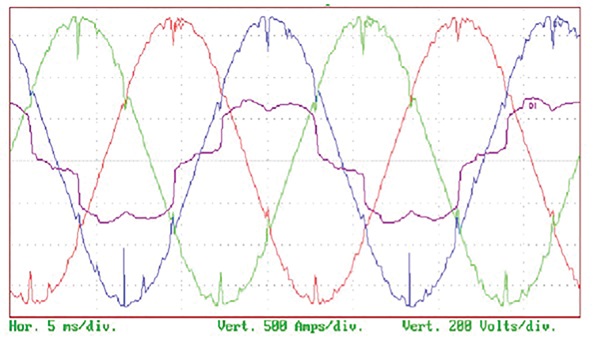
Since most of us don’t control or oversee operation of a large grid or even a microgrid, do frequency and phase angles still matter as much as other power quality issues? Phasors are still useful tools, even if monitoring one piece of equipment. While connecting the voltage leads and current probes of the power quality monitor to the circuit being monitored, check the phasor diagram to determine if all of the connections are on the proper wires and that the phase rotation is as expected (clockwise or counterclockwise). Since most systems are slightly inductive, the current phasor should lag behind the voltage phasor, as in the example above.
Saving the min/max/average value of the phase-angle relationships of the three voltage phasors over each 10- minute interval can show things remaining stable or something going askew. Unbalance load changes, or a problem with the power source, can be the source of this, especially if it is an electronically created alternating current (AC) waveform from a direct current (DC) power source. The relationship between voltage and current of a given phase or between the three current phasors is less significant in most cases, unless the loads on the electrical system are constant. Examining the changes during each cycle of a motor start and comparing to historical data can reveal pending problems.
Even though frequency is not one of the top PQ problems in most systems, the creation of frequency from the changing phase angles of the voltage phases and their corresponding currents can be a useful tool, especially on the predictive side of maintenance. The primary job of the PQ engineer or electrical contractor should be to prevent PQ problems from causing process interruptions, rather than trying to figure out why the product line shut down or the equipment was damaged after the fact.
About The Author

BINGHAM, a contributing editor for power quality, can be reached at 908.499.5321.