You're reading an older article from ELECTRICAL CONTRACTOR. Some content, such as code-related information, may be outdated. Visit our homepage to view the most up-to-date articles.
The basic principles of harmonics have been the same since 1822, when Joseph Fourier first proposed that some functions could be composed of an infinite sum of harmonics. Interest in harmonics has grown significantly in the power-system analysis with the proliferation of nonlinear currents from loads, often labeled “electronic loads,” though fluorescent lights have generated harmonic currents for more than a century.
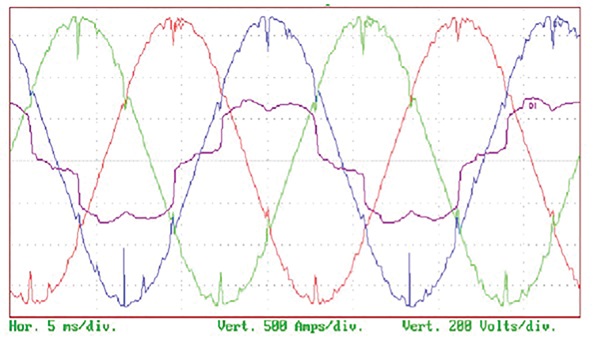
Figure 1 is typical of an electrical system in which there are a significant number of three-phase, full-wave rectified loads, such as in the front end of most adjustable speed drives. The harmonic currents resulting from such systems are high in 5th (21 percent), 7th (6 percent), 11th (11 percent) and 13th (4 percent) harmonics. Like all other power quality phenomena, voltage and current harmonics obey Ohm’s and Kirchhoff’s laws. The harmonic voltage resulting from this depends on that particular harmonic’s impedance.
System harmonic impedances are more complicated than a simple resistor circuit; they vary with the frequency or harmonic number because the capacitor and inductor impedance are frequency-dependent. As the frequency goes up, the inductor impedance (such as circuit wire) increases, while the capacitance (power-factor capacitors and the capacitance between two conductors) decreases. As a result, determining the harmonic voltage from harmonic currents is a serious math exercise that most people won’t do without the aid of a specialized program. However, it is generally safe to say more harmonic current, more harmonic voltage, more harmonic problems.
Until recently, most people were concerned with harmonics up to the 40th or the 50th, depending on location and applicable standards. Other countries limit the harmonic currents equipment can generate and harmonic voltage the utility can pass along to other customers. Newer equipment is starting to use different power-conversion schemes that result in harmonics well above 2 or 3 kilohertz (kHz).
For example, some inverters used with solar panels have a switching frequency of 30–50 kHz. While the International Electrotechnical Commission (IEC) had some work in the 2–9 kHz region, now this is expanding to 150 kHz. These higher order harmonics are referred to as the “supra-harmonics.”
The IEEE Working Group that developed the long-awaited new version of IEEE 519 2014 has been considering this in recent meetings. However, there aren’t many North American examples of this; even if they are there, no one knows because instruments that comply with IEC 61000-4-7 or IEEE 519 are required to have a filter to remove any frequencies above the 2- or 3-kHz limits. In addition, the problem in Europe seems to be that these higher order harmonics are interfering with the power-line carrier signals used with smart meters. In the United States, however, power-line carrier signals are generally not used with smart meters.
So, should we be more worried about the effects of these higher order harmonics? The more traditional 0–50th harmonics are still present and increasing in most locations with more nonlinear loads replacing linear loads. Even washing machines have become nonlinear loads. It’s not uncommon today to see the total harmonic distortion (thd) increase each evening, as less industrial/commercial load is on the system and more residential nonlinear load makes up the bulk of the power consumption, as in Figure 2.
Harmonic currents of any order are causing losses, particularly in electromagnetic equipment. Triplen harmonics are not just the 3rd, 9th, 15th, etc. They include the 300th (18 kHz) and the 903rd (54.18kHz), and they will add the neutral conductor of wye circuits with the related issues. Negative sequence harmonics (5th, 8th, 11th, etc.) try to turn motors in the opposite direction. Depending on the magnitude and phase of the particular harmonics, the peaks of the voltage waveforms can be clipped or flat-topped, which result in reduced energy available during sags and dips.
Waveform analysis aficionados may have noticed that the example in Figure 1 also has another power quality problem due to the harmonics: multiple zero crossings. Fortunately, the harmonic impedance was low enough that the resulting voltage waveform did not have the same scale of distortion around the zero crossing as the current does. If it did, equipment that uses the voltage waveform to synchronize time and processing could be seriously compromised without proper filter protection in its circuitry.
Harmonics aren’t all bad. Anyone who has sung in a choral group or played in an orchestra knows that, without them, music would be pretty boring. This is not true with harmonics on electrical circuits, where “boring” is good, as the power quality of the electrical supply meets the requirements of loads.
About The Author

BINGHAM, a contributing editor for power quality, can be reached at 908.499.5321.