You're reading an older article from ELECTRICAL CONTRACTOR. Some content, such as code-related information, may be outdated. Visit our homepage to view the most up-to-date articles.
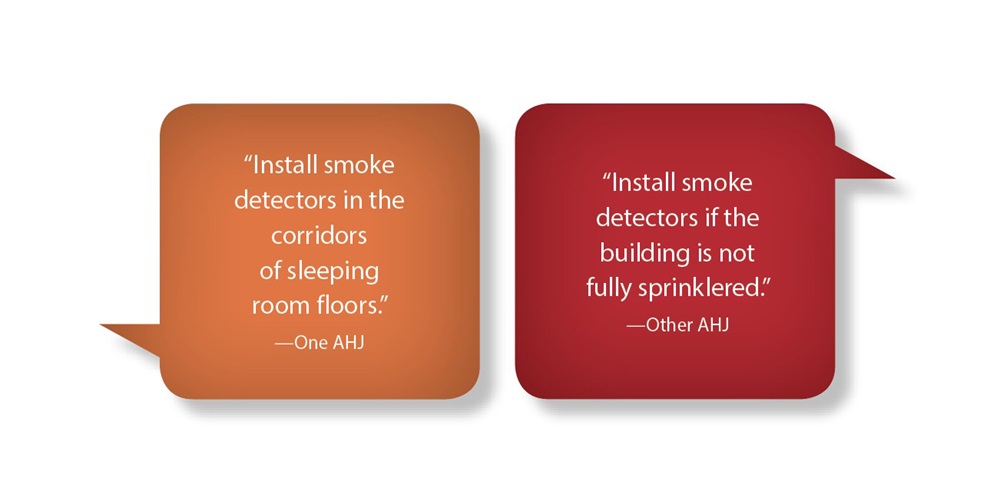
I’m sure all of you have run into an issue such as this when installing a fire alarm system: One authority having jurisdiction (AHJ) wants one thing, and another AHJ wants exactly the opposite. What do you do? You can’t make both happy. When proposing changes to the codes and standards, my code partners and I always try to fix conflicts that cause this problem, but it is not always possible.
As you know, there are many different AHJs. You have the building official, which is usually the highest-ranking AHJ because he or she issues the certificate of occupancy. You have fire inspectors, elevator inspectors, healthcare inspectors, mechanical inspectors, electrical inspectors and more. Obviously, they all don’t enforce the same codes and standards. That is where the problems arise.
A good rule of thumb is to always follow the most stringent requirement. That will keep you out of trouble, for the most part, but it may be a challenge because of the price. For example, if you are installing a fire alarm in a new hotel in a state where both the International Building Code (IBC) and NFPA 1, Uniform Fire Code, or NFPA 101, Life Safety Code, are enforced, the codes conflict. The IBC requires you to install smoke detectors in the corridors of sleeping room floors. In NFPA 1 or 101, you only have to install the smoke detectors if the building is not fully sprinklered.
The problem is that you have to bid the job properly, and, if you include the smoke detectors, you may not get the job because of the increased price. It is always best to have a meeting with both AHJs and get the results in writing. I know what you are thinking—AHJs never put anything in writing! As an alternative, do what I used to do: Ask for their interpretation in writing, and, if they refuse, send both AHJs a certified letter detailing your understanding of the meeting with a time frame for them to respond in writing if they disagree with your summary. At least this way, you have documentation of the meeting in case an issue arises later.
Another common conflict between the IBC and NFPA 101 is the threshold for an emergency voice alarm communication system (EVACS) in assembly occupancies. The IBC threshold is an occupant load of 1,000 or more. The NFPA 101 threshold is 300 or more and allows a voice message using either a voice communication or public address system. That is a major difference. If both codes are enforced in your area, it is vital to discuss this with all applicable AHJs before submitting a bid. However, if the assembly occupancy is a high-rise, both the IBC and NFPA 101 would require an EVACS regardless of occupant load.
When the IBC requires voice, an EVACS is always required. When the Life Safety Code requires voice systems, NFPA allows the use of a public address system in lieu of an EVACS in many situations.
Another common conflict concerns the installation of smoke detectors in elevator hoistways. The elevator inspector enforces an edition of A17.1, the elevator code. The fire inspector enforces NFPA 72, and although it technically does not require smoke detectors to be installed, a common interpretation conflict arises regarding the hoistway. It is always best to try to have a meeting with both the elevator and the fire inspectors prior to installing (or not installing) a smoke detector in the elevator hoistway.
NFPA 72 provides requirements for the proper installation, testing and maintenance of fire alarm equipment. It does not require any equipment to be installed except the smoke detector protecting the control equipment and a single manual fire alarm box when automatic initiating devices are connected and the system is monitored at a supervising station. Remember that all requirements for fire alarm equipment comes from building, fire, life safety, mechanical or elevator codes.
These are just a few common misinterpretations. I have always believed that the best way to reduce problems with misinterpretations or conflicts is by communicating with the AHJs, design engineers, contractors of the interfaced equipment and the general contractor in advance. It is always easier to discuss the issues before a problem arises than trying to add equipment at the final stage of the job. As a side benefit, you gain some great contacts and earn a lot of respect as a professional.
There are also conflicts in the codes regarding testing of interfaced equipment, but these should be reduced with the adoption of NFPA 4, Testing of Integrated Fire Protection and Life Safety Systems.
About The Author

HAMMERBERG, SET, CFPS, is an independent fire alarm presenter and consultant currently residing in The Villages, Fla. Tom represented the Automatic Fire Alarm Association on multiple NFPA technical committees as well as actively participating in the ICC code making process for many years. He is NICET Level IV certified in fire alarm systems and a Certified Fire Protection Specialist. He can be reached at [email protected].