You're reading an older article from ELECTRICAL CONTRACTOR. Some content, such as code-related information, may be outdated. Visit our homepage to view the most up-to-date articles.
In preparing to write my next article, I often review the topics I have covered in the past year or so, and I consider the issue’s theme. Being a sometimes overly analytical engineer, I keep track of just about everything in a spreadsheet, from the topics of ELECTRICAL CONTRACTOR articles, to budgets to my home’s utility bills. It amazed me to see my family’s history through a graph of the consumption of water, gas and electricity. Each utility increased when each child was born. We had more laundry to clean and more baths to take. Our electricity consumption increased when my children learned how to turn things on, and then there was a downward trend as the nest emptied. But, going back to this magazine, the spreadsheet helps me see what I haven’t covered recently, and it reveals what may need an updated look.
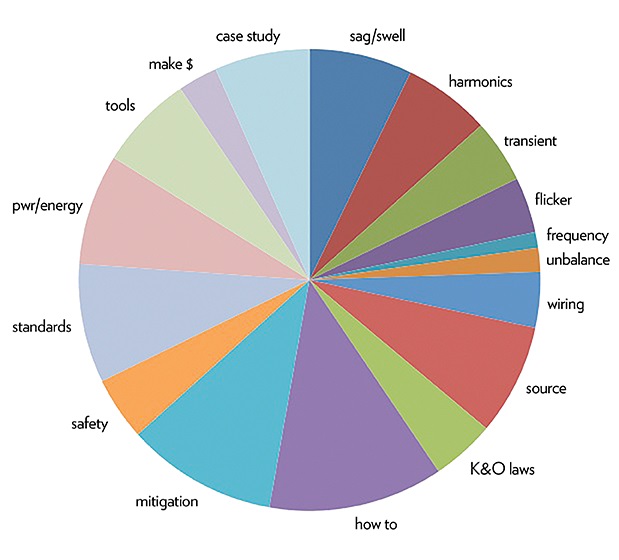
By simply turning a bunch of numbers into a picture, the pie chart at right makes a clear statement about the diverse topics the simple phrase “power quality” (PQ) brings up. While part of the chart shows some of the most common types of PQ phenomena, it is not just knowing them; it is being able to capture them with an instrument (since many are fleeting moments or microseconds), tracking the source, and effectively eliminating the problem from affecting the productivity of the equipment or facility. The process must be carried out safely and with a basic understanding of the laws of physics that govern PQ, namely Kirchhoff’s and Ohm’s laws. Standards from the IEEE and international community can help with understanding those principles, including recommended (in the United States) or mandatory (in most of the rest of the world) limits on emissions and susceptibilities.
It would seem that a wide range of skills and knowledge are necessary for working successfully in this field. In fact, one organization, the Association of Energy Engineers, offers a program to become a “Certified Power Quality Professional” and reinforces this idea by stating on its website, “The knowledge required of power quality specialists covers a broad range of applications and issues, ranging in scope from the vastness of the nation’s power distribution networks to the immediacy of devices sharing a wall outlet.” However, one of the organization’s requirements is a four-year degree. That directly contrasts with the typical person who works on PQ issues. Except for in high-reliability sites, such as data centers, the responsibility for dealing with these issues is falling more frequently onto the facility maintenance personnel and electricians, who may be not even be employees of the company but still get called in when production shuts down for some unknown power problem.
The July 2014 Profile of the Electrical Contractor reinforced this suspicion by reporting that 70 percent of the surveyed firms did PQ work in the past year, and the finding was up from 62 percent in 2012. Couple that with the decreasing or even decimation of PQ departments within the electric utilities through either attrition or the reassignment of vast knowledge resources to nonPQ jobs, the electrician is going to be called on to solve more of these problems and may be involved in benchmark studies and audits to prevent future problems.
So, what can you do to be more successful and efficient when dealing with PQ-related issues? There are plenty of reference books on the subject. A few seminars offered by independent training groups, PQ consultants and instrument manufacturers may be sales pitches for their products or services, but they are worth taking anyway. There are PQ interest groups in many areas, such as the Delaware Valley Power Quality group, where I recently had the pleasure of presenting a half-day seminar for more than 60 attendees.
And, of course, there is ELECTRICAL CONTRACTOR, which runs this column as well as various feature stories and other editorial covering the many aspects of PQ. Since you are reading this, it is probably safe to assume that you are one of the growing 70 percent. Email us about topics that you don’t have a good grasp on at [email protected]. If you are confused, you can bet thousands of others are, too. Help us help you become that PQ self-certified expert.
About The Author

BINGHAM, a contributing editor for power quality, can be reached at 908.499.5321.