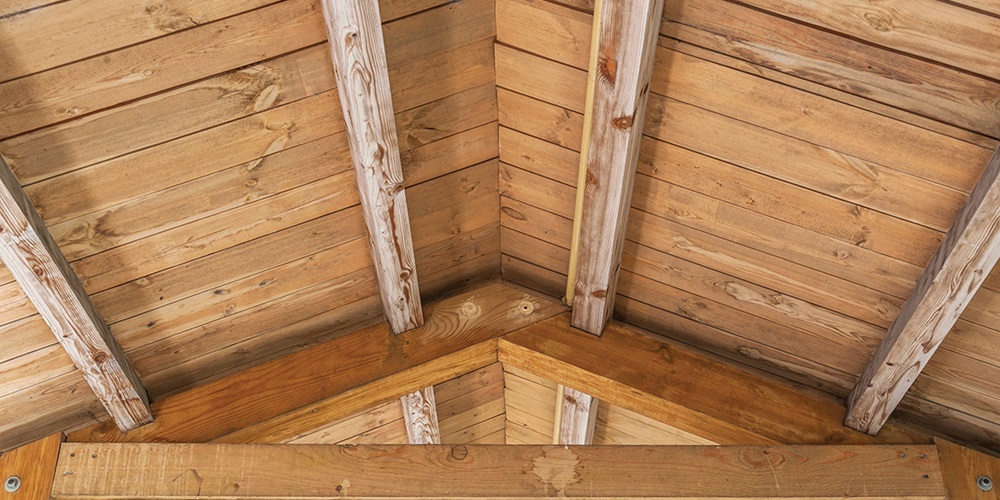
Heat and smoke detector spacing can be tricky. The requirements are found in a relatively small section of Chapter 17, Initiating Devices, of NFPA 72. There are many things to consider, such as whether ceilings are smooth, peaked, shed, beamed or joisted; ceiling height; and mounting locations near where the ceiling meets the wall. In addition, for beamed or joisted ceilings, you need to determine if the detectors can be mounted on the bottom of the beam or joist, or if they must be mounted on the ceiling in the beam pockets.
All of this can be found in Section 17.6 for heat detectors and 17.7 for smoke detectors. Annex A can also provide additional information to explain the code sections.
The initial criteria for spacing heat or smoke detectors are essentially the same, but once some of the above factors start coming into play, that is not always the case.
Methods for determining spacing
There are two basic methods for determining spacing of either heat or smoke detectors. Starting at one wall, the first detector must be installed within half the listed or nominal spacing from the side wall. Heat detectors have a listed spacing. Smoke detectors do not—they have what is referred to as a nominal spacing, which is 30 feet. We will treat the nominal spacing as a listed spacing for our purposes here to simplify the explanation of the spacing requirements. After the first detector location is determined, you can use the full listed spacing between additional detectors until the last one is again within half the listed spacing from the other side wall.
The second choice is to ensure all the detectors are within 0.7 times the listed or nominal spacing of all points on the ceiling. The simplest way to do that is to have a template of a circle 0.7 times the listed spacing based on the scale of your drawing. Since smoke detectors use a 30-foot nominal spacing, 0.7 times 30 feet would be 21 feet, so your template would have a 21-foot radius.
This method is useful for visibly showing that all points of the ceiling are covered by the detector. It is also helpful to determine spacing when you have corridors. Any further reductions in spacing due to peaks, beams, ceiling height, etc., are determined after that. There is a reduction in spacing for heat detectors based on the installed ceiling height, but not for smoke detectors. Use Table 17.6.3.5.1 to determine how much the heat detector spacing must be reduced. Always do this before determining any additional spacing reduction for beams, joists or peaks.
Another difference between heat and smoke detector spacing is that smoke detector spacing will be reduced in areas with high air velocity, but not heat detectors.
Ceiling type
Next, determine the ceiling type. The spacing reductions and mounting locations on beamed ceilings are not always the same. If you have a peaked ceiling, heat and smoke detectors are spaced the same—unless you have beams running up or across it. Heat detectors would then also factor in the slope angle of the ceiling to determine the ceiling height to be used. If the slope angle is less than 30 degrees, you use the height of the peak. If it is 30 degrees or more, use the average slope height or the height of the peak—your choice.
The definition of “ceiling surfaces” in Chapter 3, 3.3.44, explains the difference between beamed and joisted ceilings. Essentially, a joisted ceiling is a solid projection extending down more than 4 inches and spaced 36 inches or less. A beamed ceiling is a solid projection extending down more than 4 inches and spaced more than 36 inches apart. The spacing reductions are not the same. Obviously, if you have joists, you have more obstructions because they are closer together, so you must reduce your spacing more.
The depth of the beams can also be a factor. You may have to put a detector in each beam pocket. Where the beams project more than 18 inches below the ceiling and are more than 8 feet on-center, each bay the beams form shall be treated as a separate area.
As you can see, there are a number of factors to consider when spacing heat and smoke detectors. Always review Section 17.6 if installing heat detectors and 17.7 if installing smoke detectors. It is not as complicated as it seems if you take it a step at a time.
stock.adobe.com / Mariia
About The Author

HAMMERBERG, SET, CFPS, is an independent fire alarm presenter and consultant currently residing in The Villages, Fla. Tom represented the Automatic Fire Alarm Association on multiple NFPA technical committees as well as actively participating in the ICC code making process for many years. He is NICET Level IV certified in fire alarm systems and a Certified Fire Protection Specialist. He can be reached at [email protected].