For decades, homeowners have turned to natural gas furnaces when upgrading from less-efficient oil and electric baseboard-based heating systems. As gas prices fell in many regions, and furnace efficiency rose to 96% and higher, natural gas heating became the preferred choice. A big shift has occurred in just the last few years, however, as electric heat pump advances have caught homeowners’ attentions. Once seen as only a heating option for those in the South, compressor improvements now are boosting adoption in colder climates as well. Today, manufacturers are even packaging heat pumps into window-unit-sized boxes, bringing new efficiency to multifamily applications where retrofitting isn’t otherwise economically feasible.
Heat pump basics
Since heat pumps run on electricity, it may be useful for ECs to know how they work. To understand how recent advances are shifting the economics behind growing heat pump adoption, it helps to look at the basics of how this equipment functions. Heat pumps are air conditioners that can run backwards, and the technology mimics what is used in refrigerators and freezers.
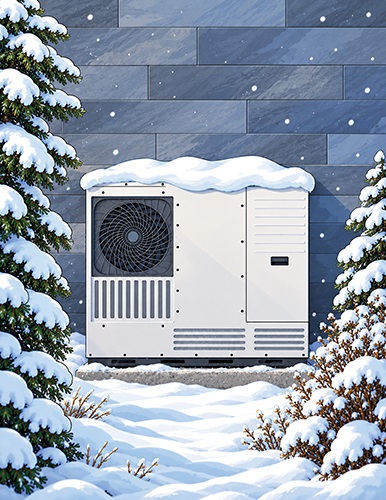
In these examples, a liquid with a low boiling point is the key to success. The liquid (called a refrigerant, even when used for heating) “captures” heat by boiling into a vapor, even in cold winter temperatures. A compressor then pressurizes that vapor into an even hotter gas that brings the heat to indoor coils and companion fans, which then circulate the resulting warm air throughout interior spaces. A reversing valve installed near the compressor reverses this process in cooling season, transporting indoor heat outside.
When used for heating, this approach is significantly more effective than even the most efficient gas furnace. Though furnaces can capture up to 99% of the heat energy available in natural gas, heat pumps can provide two to four times more heat energy than the electricity they consume because they’re designed to transfer heat, not create it. As an added benefit, the same equipment can provide cooling by using a reversing valve to switch the coolant flow.
How adoption grew
The basics of this process have been around for a century, and Southern homeowners have used heat pumps for decades.
“Heat pumps gained traction first in regions with moderate winter climates,” which also included areas in the Pacific Northwest and Mid-Atlantic regions, said Brooke Greenwood, director of residential product management at Carrier, Palm Beach Gardens, Fla. “The ability to provide both heating and cooling with a single system made them especially attractive in regions with year-round air conditioning demand.”
It’s only been in the last decade or so, though, that the technology’s advanced to serve colder climates. The key element has been a switch from single- and two-stage compressors to variable-frequency drives (VFDs), also known as inverters.
Traditionally, heat pumps operated only at full speed until inside temperatures reached the set point and then switched off, turning back on again as conditions drifted from the thermostat’s setting. This led to constantly shifting room temperatures. Additionally, during cooling season, setpoints can be reached before the equipment has had a chance to reduce humidity, making interior spaces feel warmer than they really are.
The inverters in today’s devices convert AC to DC, and then back to variable-frequency AC, enabling continuous modulation. So, instead of shutting down when setpoints are reached, modern heat pumps slow to near-idle speeds to maintain consistent temperatures over longer periods.
A second advance, called overspeeding, has helped eliminate the need for electric resistance heat strips previously required to supplement heat output in especially cold climates. In these settings, the VFD can be run safely at 15% to 20% higher than its rated speeds, maintaining up to 100% of heating capacity at outdoor temperatures as low as –15°F, though their efficiency diminishes in especially cold conditions.
“These improvements made heat pumps a practical option in colder regions that historically depended almost entirely on furnaces and boilers,” Greenwood said.
Additionally, some manufacturers are boosting heat transfer by cycling more refrigerant through the system via a process called enhanced vapor injection. David Rames, senior specialist, product promotion and development for Midea Residential Air Conditioning, Parsippany, N.J., compares it to the turbochargers powering his pickup.
“If I really need torque and power, those twin turbochargers kick in and give me the power I need if I’m towing or I’ve got a big hill,” he said. “Enhanced vapor injection basically does the same thing. It takes extra refrigerant vapor and injects it back into the compressor for extra boost.”
Understanding the options
This improved performance, along with incentives in numerous states, has helped lift U.S. heat pump sales above those for natural gas furnaces for the last four years, according to Air-Conditioning, Heating, and Refrigeration Institute numbers. This is despite higher upfront costs.
Consumers have a few options for form. Split units designed for individual rooms or areas feature smaller compressors and individual, wall-mounted air handlers where centralized, ducted connections aren’t available. Where ductwork is in place, exterior equipment fits the same space as a traditional outdoor air conditioning compressor. In new homes, the compressor is connected to a whole-home air handler, which is about the same size as a standard furnace. In retrofit applications where an existing furnace has useful life remaining, homeowners have the option of using the furnace as an air handler and possible backup heat source in place of the electric heat strips some air handlers feature.
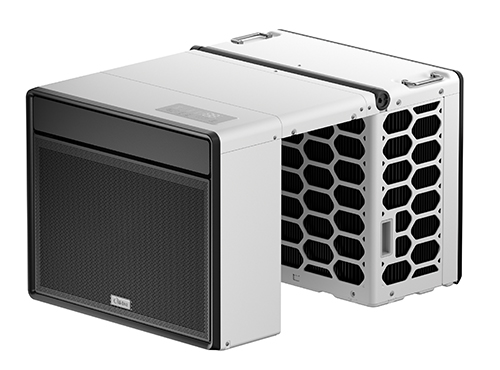
Midea’s saddle-style window-mounted heat pump is
designed specifically for multifamily buildings.
“This hybrid approach can reduce peak electrical requirements and, in some homes, avoid or reduce the need for an electrical service upgrade because high-power electric resistance heat is not required for backup,” said Jon Winkler, senior buildings researcher with the National Laboratory of the Rockies (NLR, formerly the National Renewable Energy Laboratory). “Second, it can provide flexibility, allowing the homeowner to retain combustion backup for the coldest periods while using the heat pump during milder conditions, potentially reducing operating costs where local energy prices support it.”
Of course, homeowners and contractors also need to consider existing panel capacity in retrofit decisions.
“A traditional natural gas furnace generally requires a 120V electrical load to power the blower fan and controls,” Winkler said. “A central electric heat pump typically requires a dedicated 240V circuit, and systems that use electric resistance auxiliary heat can require substantially more electrical capacity.”
These requirements can vary by manufacturer, though, especially where resistance backup isn’t included. For example, Rames said Midea’s latest air handler incorporates voltage detection, enabling operation at standard 115V levels.
Window-sized advances
More recent innovations have brought heat pump efficiency to high-rise rental units thanks to a competition co-sponsored by the New York City Housing Authority (NYCHA), the New York Power Authority and the New York State Energy, Research and Development Authority. New York City landlords, including the NYCHA, are facing deadlines to reduce their buildings’ carbon emissions, and heat pumps are seen as the most efficient replacement for their oil- and natural gas-fired boilers.
So, a call went out to window air conditioner manufacturers for similarly packaged window-mounted heat pumps. Units needed to maintain heating at 0°F without auxiliary resistance strips and using standard 120V power. Two designs—from Midea and Gradient—made the cut. Both feature profiles that straddle the windowsill, like a saddle.
“We took what we already knew about cold climate performance and implemented it in a packaged window heat pump—we can do 100% heating at 5°F, and there is no auxiliary heating,” Rames said, adding that the unique inverted-U design minimizes the window opening and offers multiple advantages. “You actually keep a lot of the infiltration, whether that’s weather or noise, from coming inside.”
Both companies’ products are only regionally available and primarily marketed to owners and developers of multifamily properties. Even when distribution widens, a contractor’s help might still be required for installation. The units are substantially heavier than standard window air conditioners and require proprietary brackets for support.
What contractors need to know
Electrical contractors’ involvement varies by technology. Establishing panel capacity is the first step across the board—a 100A panel, for example, could need upgrading. The needs of ducted systems mirror those of standard central air projects, including a dedicated 30A to 60A circuit for the exterior heat pump along with an exterior disconnect switch. Interior air handlers require a dedicated 240V, 15A to 20A circuit. Heat strips, if included, could need their own separate 15A circuit.
Ductless systems eliminate the air handler but still need their own 240V, 15A to 30A circuit and disconnect switch. Window units, as mentioned, are designed for a standard 120V outlet that should be on its own circuit.
Future prospects heating up
Cold-temperature heat pump technology may be maturing, but industry experts say there’s still room for improvement.
“Over the next five to 10 years, we are likely to see heat pumps that maintain higher capacity at extreme temperatures, require less supplemental heat and optimize operation automatically based on utility rates and grid conditions,” Greenwood said.
Winkler notes that such advances could provide stronger economic arguments for heat pumps.
“The integration of smart controls and machine learning can give consumers greater control over their energy bills,” he said. “By responding to local utility pricing and integrating with thermal storage systems, advanced heat pumps could allow homeowners to automatically shift some electricity use to lower-cost periods, saving money while also helping reduce peak electrical demand.”
Rames sees manufacturers maximizing production efficiencies. He noted that Midea is working to streamline its lineup by combining highest-level air conditioning and heating performance in a single unit, rather than offering different designs tuned to specific climate demands. A single, high-performance model would make life easier for distributors and enable cost reductions through greater economies of scale.
“The more of these things we manufacture, the lower the cost gets,” he said. “If I put all that performance into one package and we up the manufacturing, my cost goes down to where you’re not paying a premium for it just because it’s all in one package, now.”
Midea Residential Air Conditioning
About The Author

ROSS has covered building and energy technologies and electric-utility business issues for more than 25 years. Contact him at [email protected].