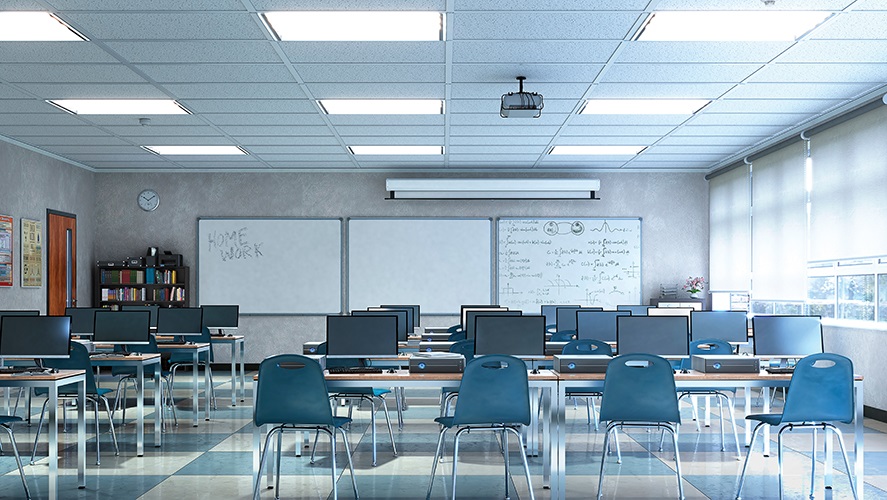
According to the U.S. Department of Energy’s (DOE) latest Lighting Market Characterization report, America’s schools lag behind all other commercial building types in LED lighting adoption. To address this gap, in November 2024, DOE published “Lighting Specification Guidance for Schools,” a guide for school lighting upgrades. This reference tool can help evaluate products using guidance on assessing existing equipment, developing a scope of work, gathering materials for procurement, product specifications, control strategies and more.
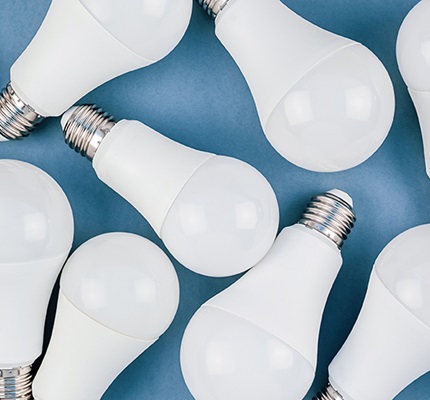
Fluorescent is the primary legacy source for general lighting in most school spaces. These lamps can be replaced by LED products for 20%–60% energy savings, greater longevity, controllability and other benefits. The three main options are tubular LED (TLED) lamps, retrofit kits and new luminaires. Each variation has its own advantages and disadvantages related to energy savings, cost, lighting quality and accessibility of utility rebates.
There are three main types of TLED lamps: UL Type A, which uses an internal driver and operates on the existing fluorescent lamp ballast; UL Type B, which uses an internal driver and bypasses the ballast to connect directly to line voltage for power; and UL Type C, which uses an external driver that replaces the existing ballast.
LED retrofit kits consist of lamps and electrical and optical components in a prepackaged unit, offering a repeatable solution. The kit either replaces the ballast with an LED power supply or entails ballast removal with the LED module or lamp wired directly to the branch-circuit wiring. The LED light source may use original lampholders or be installed with new ones.
The first step in a lighting upgrade is typically to assess the existing system, spaces and how the spaces are used, including floor plans and lighting layouts (if available) in addition to an on-site survey. Generally, if the existing luminaires are older or in poor condition, retrofit kits or new luminaires will be worth considering. If dimming is desired for daylight control response and to enhance teacher control, consider Type C TLED lamps, retrofit kits and luminaires. As lighting quality is a concern in key spaces, mockups are recommended, with retrofit kits and new luminaires generally offering greater lighting quality.
Considerations when doing updates
Typically, the driving rationale for lighting upgrades is to save on operating costs. Still, it is paramount to keep in mind that lighting’s purpose is to provide quality illumination—at a minimum, avoiding glare, flicker, poor uniformity and low light levels. As such, the lighting specification should cover the equipment (luminaire, driver or existing ballast, and LED lamp/array/module) and express its performance using accepted metrics. This performance, documented in manufacturer product information, is then matched to the application’s existing conditions and project goals.
These metrics include luminance (light output) measured in lumens and resulting efficacy, or ratio of light output to wattage used to compare product efficiency. The resulting quantity of light falling on the task surface is illuminance (light level) measured in foot-candles (fc) or lux. The Illuminating Engineering Society recommends a maintained illuminance of 30–50 fc or 300–500 lux.
The application may require uniformity of light level across the task surface, which is a function of the luminaire’s light distribution and spacing. Otherwise, the luminaire may produce light that is direct (90%–100% of output emitted toward the task surface), indirect (90%–100% emitted up to reflect back into the space as soft, diffuse light) or direct/indirect (up and down distribution). Softer and more diffuse illumination tends to be more visually comfortable since it minimizes glare.
The LED light source will be rated with a correlated color temperature (CCT), which expresses the shade of white light, and color rendering index (CRI), which expresses the color fidelity of objects compared to an ideal reference light source. Generally, it is advisable to use a consistent CCT in all interior spaces—typically 3,000K–4,000K light sources for education spaces—and to specify 80+ CRI. For flexibility, tunable-white LED lighting can be installed.
Otherwise, the selected products should avoid flicker and glare (both direct and, wherever possible, reflected glare). Higher-quality LED drivers minimize the potential for flicker, while avoiding exposed or unshielded light sources can minimize the potential for direct glare. Otherwise, a mock-up is recommended to evaluate the products installed before making a major commitment.
Dimming can also mitigate glare. LED upgrades are an ideal time to consider incorporating lighting controls to increase options, extend flexibility and maximize energy savings. If controls are not already installed, options include manual controls such as dimmers, tunable-white lighting, occupant- and daylight-responsive sensors and controls and networked lighting controls. The DOE guide contains detailed recommendations for implementation.
In addition to the above, the DOE provides guidance on executing the project, equipment disposal, mockups and lighting system maintenance. This guide offers a concise and informative primer on LED and control upgrades for education spaces.
sveta/stock.adobe.com
About The Author

DiLouie, L.C. is a journalist and educator specializing in the lighting industry. Learn more at ZINGinc.com and LightNOWblog.com.