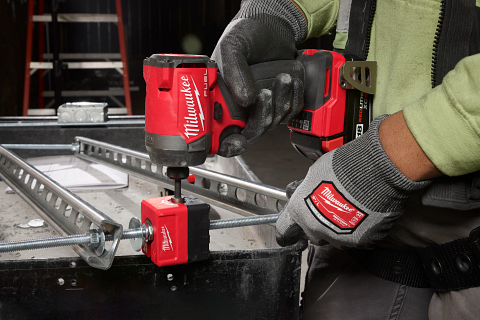
From small commercial buildings to large-scale industrial and manufacturing plants, electricians are responsible for installing critical electrical support systems that keep facilities powered, connected and operating. With demanding project schedules and increasingly complex installations, electrical contractors are constantly looking for ways to improve productivity, maximize labor efficiency and keep projects moving forward while still maintaining installation quality.
The role of threaded rod in electrical work
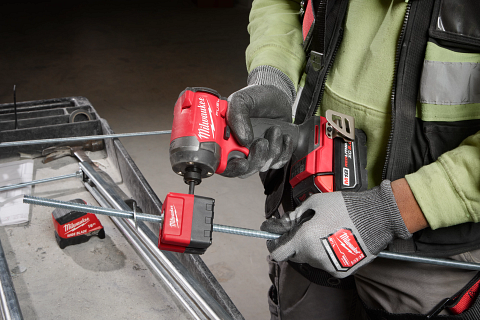
Across commercial and industrial facilities, electricians routinely install a variety of overhead support systems to reinforce conduit and cable trays, mount electrical panels and secure equipment throughout a project. One of the most common components used throughout these applications is threaded rod. From long runs of cable trays and strut racks to multi-tier trapeze assemblies, threaded rod plays a critical role in building the infrastructure that keeps electrical systems organized, accessible and properly supported.
Depending on the size and scope of a project, crews may install hundreds or even thousands of support points throughout a building, utilizing large quantities of threaded rod, hex nuts and support hardware. While threaded rod is a relatively simple component, assembling these systems often requires repetitive fastening tasks that can consume valuable labor time and impact overall productivity.
The challenge of repetitive nut running
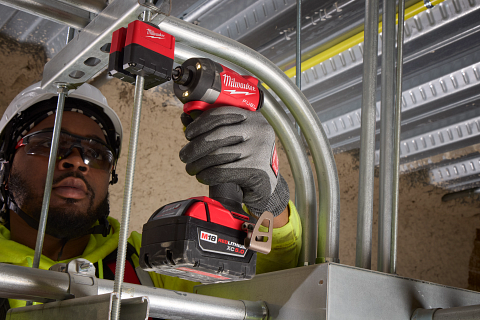
One of the most time-consuming aspects of the hanger production process is running the nuts onto the rod. While the task itself may appear straightforward, the repetition that is required can significantly impact productivity. For many electricians, hand-spinning nuts remains a common practice; however, this method can be labor intensive, particularly on large scale installations. The repeated hand motions throughout the workday can lead to hand and wrist fatigue, while the time spent manually running nuts limits the amount of installation work crews can complete in a day. As electrical contractors continue seeking opportunities to improve labor efficiency, reducing the time spent on repetitive assembly tasks has become a critical area of focus.
Current methods and limitations
To improve efficiency, many electricians have turned to homemade solutions, hollow nut drivers and other nut-running alternatives available on the market. While these methods can help reduce the time required to manually run nuts onto threaded rod, they often introduce additional challenges. In demanding job site environments, durability can become a concern, particularly when solutions are subjected to repeated use. Some methods can also make adjustments more challenging once support systems have been assembled, requiring additional time to access and reposition hardware. As a result, electricians may continue to face productivity challenges when assembling or adjusting these completed systems. These limitations can negatively impact workflow efficiency and reduce overall productivity.
A faster solution for electrical contractors
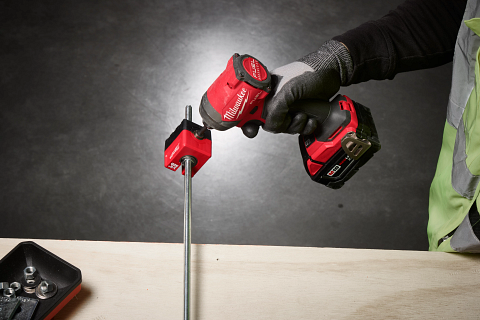
Recognizing the current challenges that electricians are facing with threaded rod assembly, Milwaukee Tool developed the SHOCKWAVE™ Impact Duty 3/8-inch Threaded Rod Nut Runner to provide users with a faster and more efficient way to complete support system installations. Designed for applications such as trapeze systems, strut racks, cable tray supports and other threaded rod support assemblies, this accessory provides a faster alternative to traditional nut-running methods
The SHOCKWAVE™ Impact Duty 3/8-inch Threaded Rod Nut Runner delivers up to 9x faster nut running compared to hand spinning. Compatible with standard 3/8-inch threaded rod and 9/16-inch hex nuts, it is designed for use with impact drivers. This accessory features a run and fasten design that allows users to both run and tighten nuts within the same workflow. By eliminating unnecessary steps and reducing time spent on repetitive manual assembly tasks, electricians can assemble support systems more efficiently.
Milwaukee® also engineered the SHOCKWAVE™ Impact Duty 3/8-inch Threaded Rod Nut Runner with durability in mind. An optimized SHOCKZONE™ helps absorb peak torque and reduce breakage during demanding applications. This accessory offers up to 100 pounds of lifting capacity, providing flexibility when making rack adjustments under load. Additionally, the split-socket side-access design allows electricians to access threaded rods from the side, making it easier to adjust support systems without disassembly. These features help improve the overall workflow efficiency.
As electricians continue searching for ways to improve productivity, solutions that reduce repetitive installation tasks can have a positive impact on overall job site efficiency. By delivering faster nut running, impact-rated durability and easier support system adjustments, the SHOCKWAVE™ Impact Duty 3/8-inch Threaded Rod Nut Runner helps electricians spend less time assembling support systems and more time advancing critical phases of a project. Milwaukee Tool’s commitment to understanding the users and the realities of the job site continues to drive innovations for electrical professionals. These innovations across the industry help electricians improve workflow efficiency, reduce time spent on repetitive tasks and remain productive throughout the entire workday.