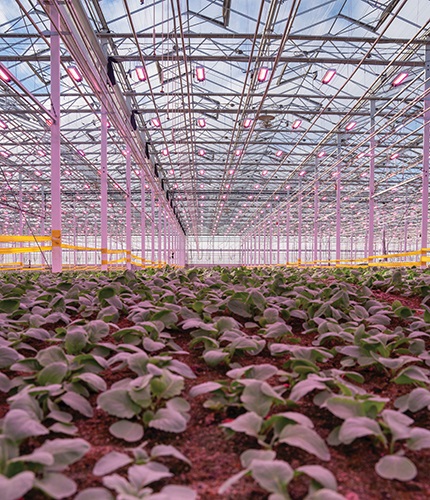
Controlled-environment agriculture in indoor vertical farms and greenhouses needs specialized lighting, and the market is growing considerably with new innovations. The agricultural lighting market, valued at $13.6 billion in 2025, is projected to reach $43.3 billion by 2035 at a compound annual growth rate of 12.3%, according to Future Market Insights’ “Agricultural Lighting Market Forecast and Outlook 2025 to 2035.”
“Technological progress in LED efficiency, spectrum control and smart automation has transformed crop yield optimization, enabling higher productivity with reduced energy consumption,” according to the report. “Government incentives promoting sustainable agriculture and the need to reduce dependency on climatic conditions are further accelerating adoption.”
Indoor plant growth challenges
While greenhouse lighting serves as a supplement to sunlight, the only light source plants receive in indoor agriculture—also known as vertical farming—is from installed lamps, said Erik Runkle, a professor at Michigan State University’s Department of Horticulture in East Lansing, and leader of OptimIA (Optimizing Indoor Agriculture), a USDA-supported Specialty Crop Research Initiative project.
“When you’re growing plants indoors without sunlight, you have complete control over the light spectrum and light intensity,” Runkle said. “But in a greenhouse, while you’re enriching light, you don’t have complete control. Indoor agriculture is more suitable in locations where it’s too dry and water is scarce, so you can conserve water in an indoor facility compared to a greenhouse.”
Indoor agriculture could also be appropriate for regions with periods of low light, such as the northern United States, where it’s difficult to grow a crop in the winter unless a substantial amount of lighting and heating is applied in the greenhouse, he said. Other factors that influence the viability of indoor agriculture include the amount of space and time to produce the crop and, of course, the value of what’s harvested.
“The advantage of indoor lighting is that you’re growing pretty much without worrying about the environment—sunlight, rain, pests —you have virtually complete control,” Runkle said. “It’s just that it’s more expensive to do that. There have to be circumstances where the crop can be economical to commercially produce it indoors.”
Runkle’s work, as well as the OptimIA project, is focused on mitigating challenges to production in indoor agriculture, with a focus on managing the environment. Because it’s typically more expensive to grow indoors, there’s a greater need to co-optimize different environmental factors while also considering economics, he said.
“What is similar between indoor and greenhouse lighting is the focus on changing the light spectrum during the day or perhaps during a phase of production,” Runkle said. “There’s a lot more unknown than there is known about how to exploit this technology, where you can modify the spectrum and try to elicit the sort of crop responses you want.”
Growers and manufacturers are doing their own research and in partnerships with growers or universities to try to understand how to apply their technology, but Runkle believes there are still questions about how to exploit that technology to get the outcomes the growers are seeking.
“In my research, I’m looking at how the light spectrum interacts with light intensity, and sometimes with other environmental parameters such as temperature, to elicit different growth responses,” he said. “Because we really can’t just think of one environmental factor in isolation—we need to be considering these simultaneously.”
There are also different standards for controlled-environment agriculture lighting versus general illumination lighting, Runkle said.
“When we’re growing plants, oftentimes we are growing in humid environments or in dusty environments, especially in a greenhouse,” he said. “So, in many cases, it’s not appropriate to take a generic lighting fixture and think it will perform well in a greenhouse or in an indoor farm. Rather, lamps for indoor agriculture or greenhouses need to have an IP rating for ingress protection.”
Choosing controls
Sollum Technologies, based in Montreal, designs, engineers and manufactures a smart solution—advanced dynamic LED lighting that adapts to what plants need in real time, said Francois Roy-Moisan, co-founder and chief technology officer.
“Growers often manage multiple varieties, and genetics change slightly year to year, so performance shifts,” Roy-Moisan said. “One season a virus might devastate a crop—the next, a more resistant strain may yield a little less. We use dynamic lighting treatments to help new crops recover yield and increase productivity.”
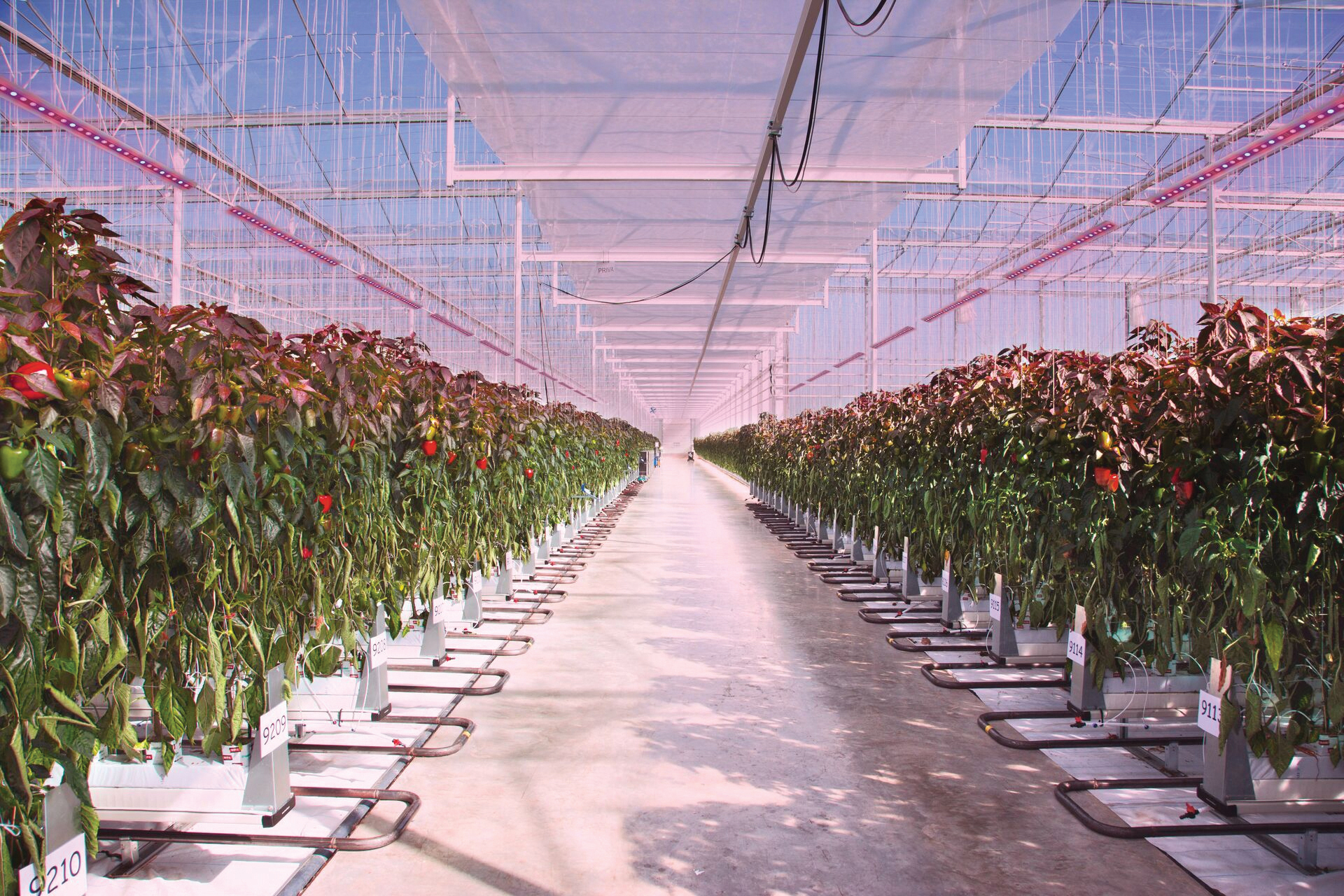
In a greenhouse, each fixture includes internet of things microcontrollers, so every light is addressable and autonomous, he said. Sollum’s system is orchestrated by the company’s cloud platform, SUN as a Service (SUNaaS). Sollum’s team of agronomists and horticultural specialists can help growers get the most from the solution.
“Because the fixtures are intelligent, they adapt both in intensity and spectrum,” Roy-Moisan said. “With SUNaaS, growers can create their own light recipes—while the platform continuously adjusts in real time to maximize natural light and ensure plants get exactly what they need at every stage.”
This gives growers the right light to achieve the best yields while optimizing energy costs, he said. On a sunny day, the lights automatically dim or switch off. When a cloud passes, they ramp up and adjust spectrum, so the crop consistently receives the target lighting.
“That real-time balance, extracting more yield while using as little electricity as possible, is where SUNaaS truly excels,” Roy-Moisan said. “The platform continues to evolve, and we’re learning to ‘speak the plant’s language’ so we can respond to its needs even more precisely.”
Specific lighting fixtures
Co-headquartered in Premstaetten, Austria, and Munich, Germany, ams OSRAM makes the OSCONIQ P 3737 Generation 2 and OSCONIQ P 3737 Batwing. Both are engineered for professional greenhouse and vertical farming, said Thomas Grebner, marketing manager.
The OSCONIQ P 3737 achieves a wall plug efficiency of up to 82.4% in Hyper Red (660 nanometers) and a photon flux of 6.09 micromoles per second at 700 milliamperes and junction temperature 85°C, Grebner said. For growers, this translates into higher crop yields and faster harvest cycles while reducing the energy costs in a greenhouse.
“The Batwing variant introduces a unique batwing radiation profile, which ensures exceptional light uniformity and wide-angle coverage,” he said. “By minimizing hotspots, it provides even illumination across large cultivation areas, ideal for both top lighting and interlighting in greenhouses.”
What the crop needs
The OSCONIQ P 3737 family is available in a broad spectral range, including hyper red, red, deep blue, far red, super red and horti white, supporting everything from narrowband to full-spectrum solutions for all crop needs.
The latest generation supports higher drive currents up to 2.8A for greater system performance and design flexibility, and its larger footprint accommodates bigger lenses for light extraction and system-level optical performance, Grebner said. These LEDs are optimized for modular and scalable lighting systems, making them ideal for small-scale farms and large commercial installations.
“Our products are designed to deliver both energy efficiency and long-term reliability in CEA environments,” he said. “Through advanced spectral engineering, growers can tailor light recipes to specific crops and growth phases, leading to higher yields, better crop quality and more predictable results.”
The OSCONIQ P 3737 combines high wall plug efficiency with strong photon flux output, enabling growers to cut electricity costs while maintaining optimal plant growth, Grebner said. With targeted wavelengths across the portfolio, growers can tune the spectrum to support everything from vegetative growth to flowering, thereby enhancing photosynthesis and maximizing crop performance.
The Batwing variant has a wide-angle profile, ensuring even light distribution, across large cultivation areas, he said. This minimizes uneven growth and ensures every plant benefits from consistent illumination.
“These LEDs are engineered to handle humidity, temperature swings and chemical exposure, reducing maintenance and replacement needs,” Grebner said. “Their robust design ensures consistent performance, less downtime and lower operational costs.”
The OSCONIQ P 3737 series integrates seamlessly with advanced control systems, enabling adaptive lighting strategies, smart sensor feedback and real-time spectrum adjustments, helping growers further optimize energy use and crop outcomes, he said.
“At ams OSRAM, our R&D is guided by what growers value most: reliability, efficiency and measurable impact on crop outcomes,” Grebner said. “While we continue to push the boundaries of LED and sensor technology, our focus remains on developing solutions that simplify operations and deliver real-world value in agricultural environments.”
Looking ahead, the company’s R&D pipeline includes adaptive lighting systems that respond to real-time plant and environmental data, providing dynamic spectrum control without manual recalibration, he said.
“These innovations go beyond technology. They are about empowering growers to make smarter decisions, reduce complexity and achieve more with fewer resources,” Grebner said.
“Whether through longer-lasting LEDs, intelligent control systems, or sustainable materials, our goal is to shape the future of farming with solutions that are as practical as they are powerful,” he said.
Fluence Bioengineering Inc., part of Signify’s agricultural lighting division based in Austin, Texas, manufactures lighting for indoor agriculture, with a particular focus on serving commercial cannabis growers.
“Every Fluence lighting fixture is designed and built using a combination of handcraftsmanship and state-of-the-art robotics to provide the most effective solution for a grower’s production goals,” said Lorrie Schultz, head of marketing for the company.
Fluence’s RAPTR, SPYDR, VYPR, VYNE and RAZR series are designed for uniform photon delivery, featuring efficiency with passive cooling; breakthrough spectrums for full-cycle physiological development, including the market introduction of broad white light; and scalability and mounting versatility, Schultz said.
ams Osram
About The Author

KUEHNER-HEBERT is a freelance writer based in Running Springs, Calif. She has more than three decades of journalism experience. Reach her at [email protected].