Las Vegas is known for glittering attractions such as the Sphere and high-rise hotels and casinos, collectively capable of accommodating millions of guests. It’s also home to professional sports teams, numerous community spaces and 2.3 million permanent residents.
While the city goes by a variety of nicknames—”America’s Playground,” “Sin City,” “Gambling Capital of the World,” “Entertainment Capital of the World,” “Marriage Capital of the World”—to some, it is known as “the City of Lights.”
These days, the creative use of LED lighting and low-voltage wiring have enabled Las Vegas entertainment venues to assume iconic shapes and deliver amazing visual, sound and sensory experiences.
The Hard Rock Hotel & Casino
Ron Bombard established Bombard Electric, Las Vegas, with just eight employees in 1982. Bombard and Ken Kefalas, president, started out wiring office warehouses and eventually gained the expertise necessary to accommodate the hotel-casino industry through decades of change. Kefalas eventually purchased the company, which is now a subsidiary of Everus, a construction services company.
In 2025, Bombard Electric began work on a new project for the Hard Rock Hotel & Casino. It included renovation work on the former Mirage tower, which has 3,041 rooms, the podium beneath and a 500-seat live theater venue. It also started work on a new guitar podium and tower, which rises 42 stories in the middle of the Las Vegas Strip and features 646 rooms. The project made use of the former Mirage’s electrical infrastructure.
While the guitar topped out with the final steel beam in May 2026, the new facility won’t officially open until fall 2027. But when the outside lights are turned on in September or October of 2026, “it’s gonna pop, I’ll tell you that. The guitar strings are LED light strands, too,” said Chris Mitchell, project manager for Bombard Electric.
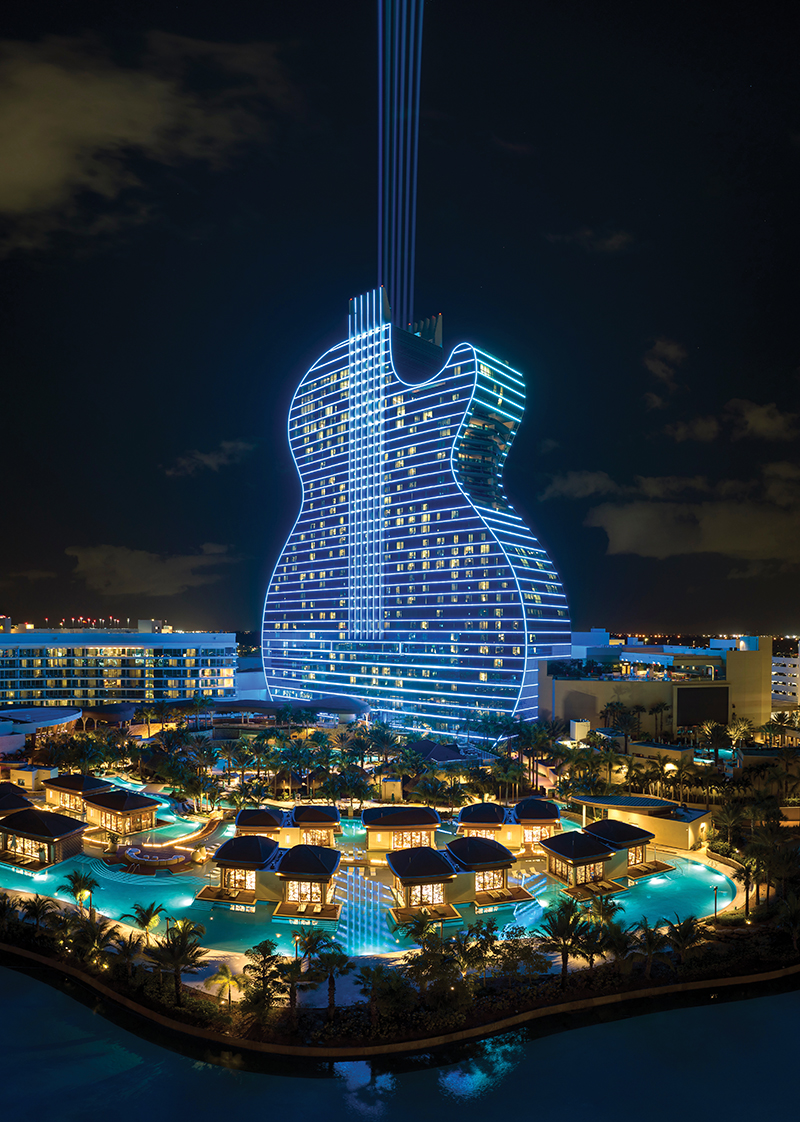
The new Guitar Tower Hard Rock International property
features an unusual shape and LED lighting that gives new
meaning to Las Vegas’ claim to fame as the City of Lights.
LED lights embedded in the building’s glass skin run horizontally. Every floor has an exterior lighting control panel for the outside lighting, and some floors have multiple control panels, Mitchell said. Bombard installed the power and data raceways from the inside of the glass to the electrical rooms.
LED room lighting mimics soft incandescent lighting at 2,700 lumens. Other areas require other, more specialized lighting.
“The live theater and podium in the guitar will feature unique rock memorabilia and special art lighting for wall scenes and display cases,” Mitchell said.
Main hallways that have no windows will be programmed to operate 24/7 at the same level of brightness, but stairwells will operate at lower lighting levels, with motion sensors to activate brighter lighting for safe egress.
During his 19 years with Bombard, Mitchell has seen many changes in Las Vegas venues, including the transition from neon and incandescent lighting to LED.
“Everything is LED now,” he said. “Because it creates less demand for power, there are more features and fixtures on a single circuit.”
For the guitar, Bombard is also installing the audiovisual and teledata distributed antenna system, all of which requires extra effort due to the building’s unusual shape. Forty-five different room types each required different constellations for lighting and power outlets.
“That’s been the challenging part,” Mitchell said. “Electricians typically get into a routine, but they can’t quite get into the flow because some rooms are shorter and some are longer.”
Also, due to the building’s unusual shape, the Bombard work crew count peaked early in the project, with 180 workers on-site when installing the wider lower stories. By June 2026, the crew count was at just 80 because there are fewer rooms on the top floors.
Bombard also installed surveillance and security systems.
“Casinos have to have lots of eyes on the gambling floor, at least one for each table,” Mitchell said. “But the tower and rooms are no different than any other hotel.”
The project called for 19,000 downlights; 128,000 feet of linear lighting fixtures, 1 million feet of wire, 1.5 million feet of MC cable and 430,000 feet of conduit.
The design of the guitar tower continues to evolve, with changes sometimes requiring reworking certain portions. Even so, Bombard employees have managed to stick to 40-hour work weeks.
As with other massive hotels, Bombard has coordinated closely with other trades.
“This project has lots of rooms and lots of bathrooms: one bathroom for every room, and multiple bathrooms for penthouse suites, making coordination necessary,” Mitchell said.
Thanks to Dynalectric Co. of Nevada, also based in Las Vegas, a 39,000 square-foot luxury health spa will occupy the Guitar Tower’s fourth floor. The $6 million stand-alone project is testament to a health-oriented luxury vacation trend taking hold in Nevada. In Las Vegas, that includes high-end shopping, live concerts, art exhibitions, sporting events and meals prepared by executive chefs.
“It’s the largest of any Las Vegas spa ever wired by Dynalectric,” said Jason C. Bosnos, vice president of operations. With custom-made, climate-controlled cedar saunas, treadmills and exercise machines, the spa offers an impressive south view of the strip as well as floor-to-ceiling views in other directions.
Fifteen to 20 Dynalectric electricians and techs are handling the inside wire and low-voltage work that includes the spa’s LED lighting, climate controls, audio-visual, voice/data, Wi-Fi, surveillance and an extensive lighting control system.
“The low-voltage work is unique and more concentrated than in the rest of the hotel,” Bosnos said. “It includes sensors that monitor humidity, temperature for air and water.”
To preserve the well-being of all FFE materials and equipment, the project will be well climatized prior to all finishes being installed to protect all spa facilities. Completion is expected in May 2027.
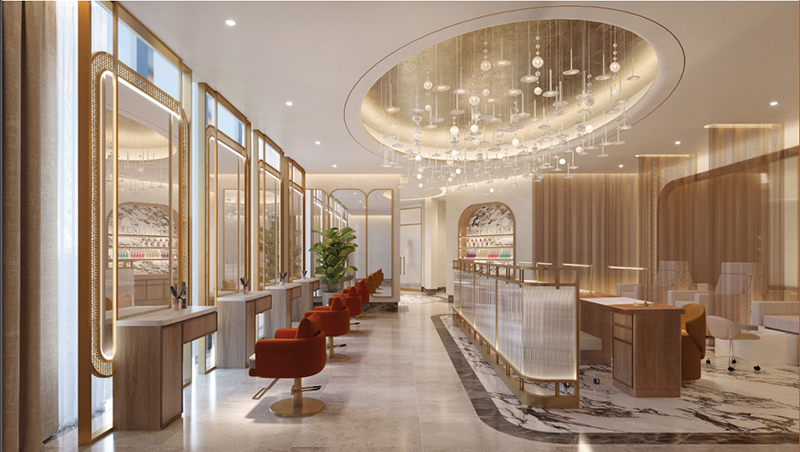
Rendering of the spa undergoing construction on the
fourth floor of the Hard Rock Hotel & Casino.
The Sphere
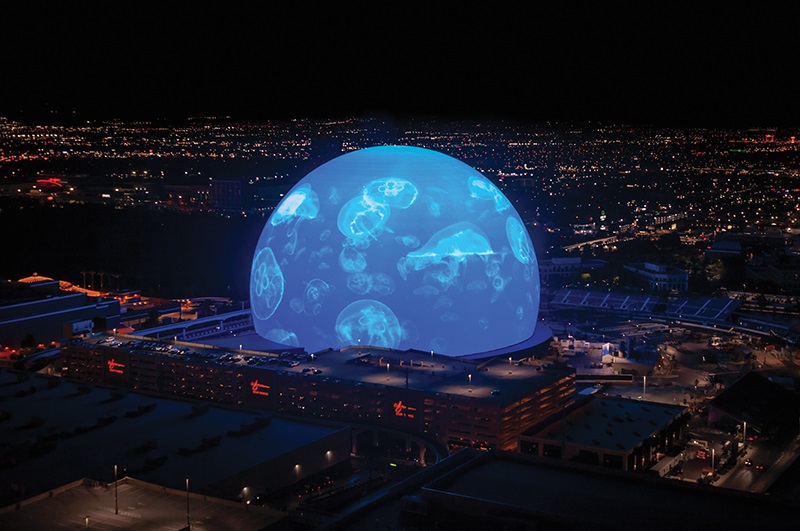
Another unique shape served by Bombard is the Sphere, completed in 2023. Also known as the Las Vegas Sphere, it is the largest spherical building in the world, with seating for 17,600 people and additional in standing room. It cost $2.3 billion to build.
The arena is 516 feet wide and 366 feet high, with an exterior that lights up the night with constantly shifting images. This all happens thanks to 1.2 million LED pucks spaced 8 inches apart and 64,000 circuit boards.
From a distance, the Sphere may look like a monolithic jack-o-lantern or sea anemone one moment and planet Earth the next.
“But up close, it just looks like a bunch of dots,” said Richard Pendleton, Bombard’s lead project manager for the Sphere.
Inside, larger-than-life moving images and correlating sounds engulf audiences. Haptic technology causes seats to vibrate in conjunction with what’s happening on screen, and the air becomes infused with fog and different scents.
Holoplot X1 speakers digitally aim sound at a consistent volume, sometimes in different languages, toward different audience locations. The immersive sound experience is supported by 167,000 speaker drivers, amplifiers and processing channels.
“The Sphere was by far the most complex project I’ve ever taken on, and that includes some of Las Vegas’ largest and most luxurious hotel-casinos,” Pendleton said. “There aren’t words to really describe the experience. You just have to go see it.”
A 160,000-square-foot concave LED screen lines the building’s interior and relies on 64,000 LED panels, each controlled by printed circuit boards. SACO Technologies, a Montreal-based company specializing in video displays and lighting, designed and manufactured the screen.
Starting in September 2018, Bombard installed all of the structure’s electrical wiring and performed some of the low-voltage work, Pendleton said.
“We did all electrical, a majority of AV, surveillance, the immersive video, fire alarm and sound system.”
Bombard also installed all control panels.
“We also did work we normally don’t perform,” Pendleton said. “We’re not a sign company, but we did set some of the controls. We also performed work for a couple of other low-voltage contractors, too.”
At peak, Bombard employed 350 electricians on the project, but including other electrical contractors, there were around 450, with a trade workforce of 1,500 due to so much steel and concrete work.
The project virtually stopped for approximately six months due to COVID, Pendleton said, adding that, “we kept a small crew of 20 going during that time.”
Bombard also wired power to the chairs and to the fog and temperature controls, but mechanical contractors handled the actual controls for those.
“We worked with ArchKey Solutions, [Fenton, Mo.], which did the voice data, and they subbed a lot of the install out to us,” Pendleton said. “They hired us because we had manpower.
“Because this was a one-of-a-kind project that had never been built before, the design was always evolving,” he said. “Whatever we did one day might change the next. We went through unlimited amounts of RFIs and drawing revisions.”
Even so, Bombard managed to meet strict deadlines and even accelerate completion.
“We were 80% done and the owners requested to light up the Sphere for Fourth of July,” Pendleton said. “We committed to make that happen and had components flown in from Canada that hadn’t been due to arrive for several months.”
Bombard’s contract totaled $260 million, but the project yielded additional value. Getting to work on a project that had never been done before and that involved many integral parts that needed to cohabitate together, “was an amazing experience,” Pendleton said.
Besides tourist attractions, Bombard has served the local community in other ways, performing work for Nellis Air Force Base, local water treatment and reclamation projects, and for public schools and libraries.
West Las Vegas Library
The new West Las Vegas Library opened in December 2025.
“Due to the level of technology, I do think this library can set a standard, and I imagine that elements of this library will be incorporated [into] other state-of-the-art libraries,” said Nicole Carpenter, Bombard Electric’s project manager for the $40 million dollar project.
The 41,178-square-foot structure doubles the size of previous branches and provides additional educational resources, programs for literacy, learning, heritage-based celebrations and experiences for all ages, according to a library system press release.
Some of the public library’s most intriguing features relate to its 750 lighting fixtures.
“The walls of the event center can change color with interactive controls [tied to sound],” Carpenter said. “The wall panels feature embedded linear lights.”
The successful tie-in with sound is all thanks to Bombard’s low-voltage team. Also, the ceiling in the reading area contains lengths of linear lights installed in elaborate patterns and controls that enable the lights to dim automatically to make use of daylight.
Getting power to the lights posed space challenges, but Bombard solved that by switching from 160 inverters to 30 uninterruptible power sources that connected more lights together on strands, Carpenter said.
The reading area does not occupy a large space, but the library more than makes up for that with innovation labs for adults and children, arts and crafts spaces, a sewing area, computer lab, digital memories preservation lab, podcast room and recording studio, meeting rooms, a teen zone, education resource center, 3D printers and more.
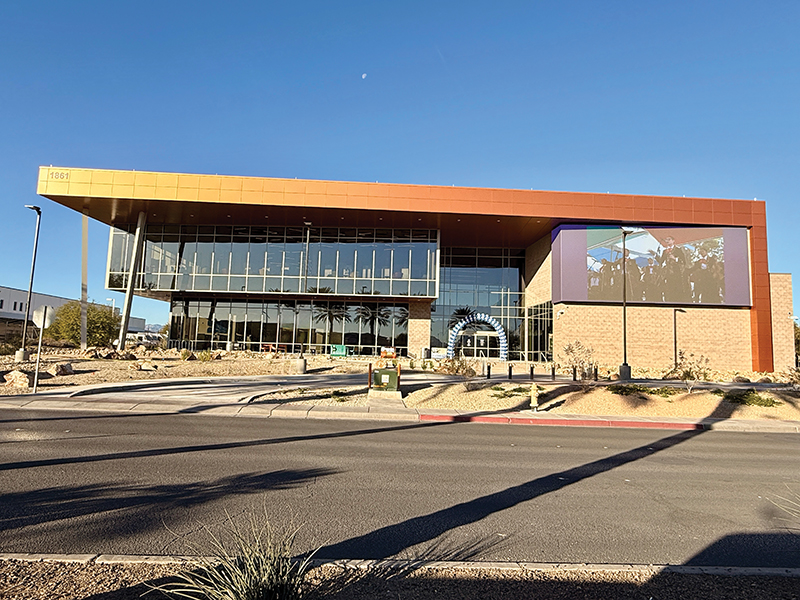
The new West Las Vegas Library features an events center with walls
that change color, podcast and computer rooms, craft rooms,
special LED lighting and numerous other amenities.
Each room required installation of key fob access to enable patrons to reserve time without interruption.
The library’s front exterior also features a programmable high-definition electronic sign. While Bombard did not install the sign, it did install the power for it, along with two EV charging stations.
“I’ve worked for Bombard for 26 years in various capacities, but this was my first project as project manager,” Carpenter said. “I’m really proud of this as a resource for the West Side community. This area is rich in local African-American history and culture, but this library is also for anyone in Clark County.”
The Fontainebleau Las Vegas
Lou Gentile started ANS Electric, Las Vegas, five years ago. ANS got its start on July 19, 2021, with six people and small projects, but quickly managed to take on larger projects.
“If a contractor is small, if they can work with a $100- to $200-million-dollar contractor, they will get better at what they do and will learn more faster than on their own,” Gentile said. “All our guys can handle this work, and we send them to classes so they can get certifications.”
ANS has worked on two hotel-casinos: Resorts World Las Vegas, which is 12 million square feet, and Fontainebleau, which is 9 million square feet. But, according to Gentile, project manager and one of the partner owners for ANS, Fontainebleau—the tallest luxury resort in Las Vegas at 737 feet—was the more complex of the two projects.
At peak, ANS employed 356 electricians and technicians to handle low-voltage work—systems integration, data, surveillance and audio-visual—on the $238 million project, which started in January 2022 and wrapped up in December 2024.
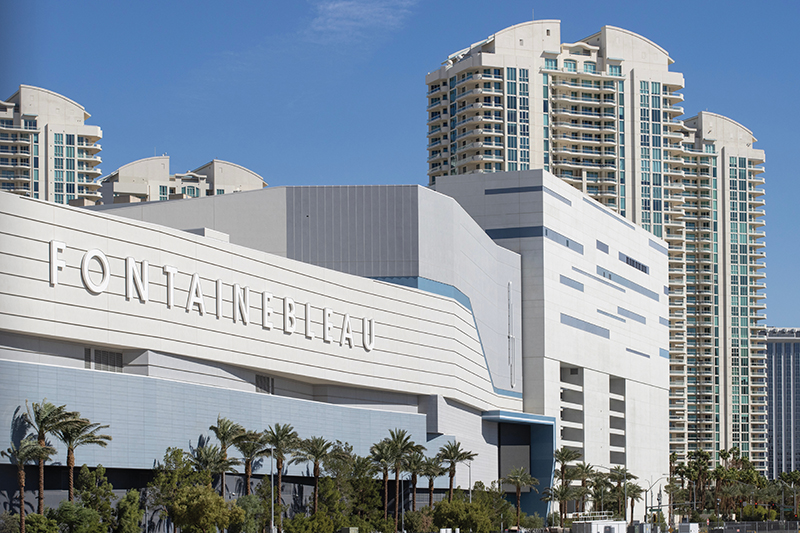
Las Vegas’ tallest luxury casino hotel, Fontainebleau, features the
latest in hotel technology to provide luxury and security.
As with all Las Vegas hotel-casinos, surveillance must follow strict regulations determined by the state gaming board, a main consideration being clear visibility for every move made at gambling tables, Gentile said.
Gentile got his start as an ADM driver, becoming an IBEW 3 journeyman and union steward in New York City.
“When my parents retired to Las Vegas, I saw the work going on here and decided I wanted to be a part of it,” he said. “I moved my family here in 1995.”
The actual construction of Fontainebleau spanned decades, starting in 2007, but paused at various times due to changes in ownership. It was once paused for seven years, after low-voltage wiring had already been installed.
“We ended up redoing all of that,” Gentile said. “The hotel wanted to future-proof the rooms, so we wired with fiber.”
Fiber supports IP-TV signals and Wi-Fi, as well as sensing devices used for automatic billing for streaming services and beverages taken from a refrigerator. Overall, Fontainebleau required more than 500 miles of single-strand fiber and more than 1.4 million feet of Cat 6A cable.
A typical room has four downlights, 16 devices and a fire alarm, but the largest suites, which measure around 5,000 square feet, have 300 downlights, 20–30 sound speakers and fire alarms, Gentile said. Bombard programmed the hotel’s lighting system. ANS set it up to have a handshake with the building’s control system and touch panels.
The most amazing part of the casino, according to Gentile, is the bar next to the main lobby escalators. Along with panic buttons for staff and surveillance cameras, it features a high-end Myers audio system that focuses music on the bar area, with tunes that change according to local events.
“If there’s a rodeo going on in town, there’s cowboy music,” Gentile said. “It depends on what’s going on—it’s mix and match.”
Header image: The Las Vegas Sphere is a unique structure inside and out, thanks to lighting, sound, scent and haptic technologies that deliver heightened sensory entertainment experiences.
stock.adobe.com/bilanol, stock.adobe.com/suzyanne16, Nicole Carpenter/Bombard Electric, stock.adobe.com/mashot stock.adobe.com/Tada Images, Dynalectric Co. of nevada
About The Author
.jpg?sfvrsn=a64b988b_1)
DeGrane is a Chicago-based freelance writer. She has covered electrical contracting, renewable energy, senior living and other industries with articles published in the Chicago Tribune, New York Times and trade publications. Reach her at [email protected].