A study published in the May 2025 issue of Environmental Science & Technology, “GUV Installations Demonstrate Effectiveness and Exposure Safety in Field Settings,” characterized the effectiveness, safety, energy consumption and user acceptance of germicidal ultraviolet (GUV) radiation based on field evaluations of 15 installations. Authored by researchers at the Pacific Northwest National Laboratory (PNNL), the study presents an informative real-world look at how these devices perform.
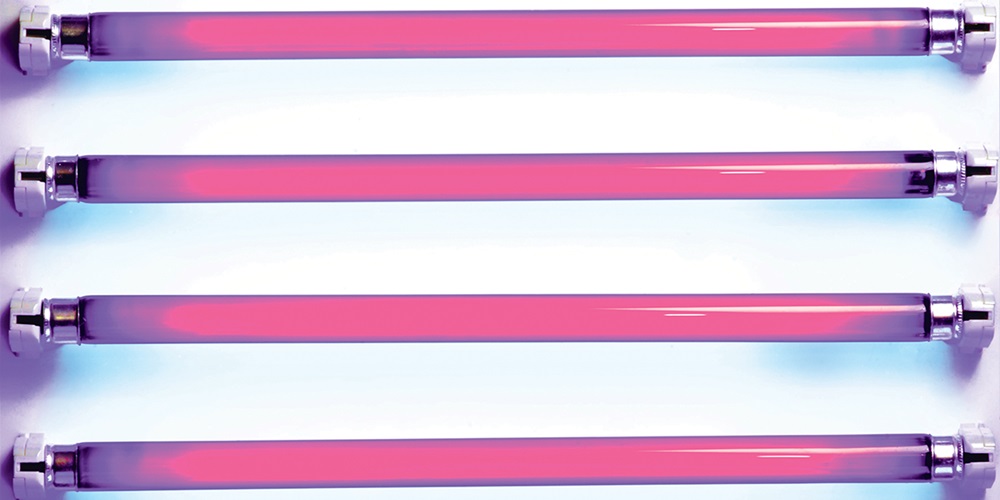
GUV devices emit ultraviolet (UV) radiation to neutralize pathogens. While this technology has been in use for decades in buildings, adoption increased during the pandemic. When deployed in rooms, these devices are commonly installed in an upper-room design, with low-pressure mercury lamps or UV LEDs irradiating the air above 7 feet. A more recent approach is whole-room irradiation using krypton-chloride excimer lamps that emit UV radiation at a wavelength considered safer for direct human exposure.
The installations included eight upper-room and seven whole-room spaces ranging from conference rooms to classrooms. In some of these installations, the GUV system had been in service for years. Based on a new protocol, the researchers conducted radiometric measurements to determine effectiveness and exposure, while electrical measurements were taken to characterize energy use. Questionnaires completed by facility managers and occupants provided feedback on their perceptions of GUV use.
Effectiveness
The researchers used a method of equating GUV air cleaning action to ventilation and inferring resulting effectiveness. The Centers for Disease Control and Prevention (CDC) recommend five equivalent air changes per hour for all space types except healthcare, which has more stringent clean air guidelines. ASHRAE Standard 241 sets a minimum equivalent clean airflow per person ranging from 20–90 cubic feet per minute, depending on space type.
To estimate the equivalent air changes per hour, the researchers used a metric called fluence rate. They calculated effectiveness for the given GUV system and space against the pathogens that cause tuberculosis, COVID-19 and MS2, which resemble noroviruses.
Based on the CDC guidelines, the GUV systems were generally effective at achieving equivalent airflow required to minimize infection due to SARS-CoV-2 and the bacteria that causes tuberculosis but far less effective with the more UV-C-resistant MS2. Smaller spaces tended to show higher effectiveness than larger ones; other factors included number of GUV devices, device type and number of occupants.
Regarding ASHRAE 241, two installations exceeded the targets for equivalent clean airflows, while one, in which devices cycled on and off, provided only 3% of the ASHRAE target. The remainder provided 7%–43% (upper-room) and 7%–44% (whole-room).
Exposure/safety
The researchers evaluated the installations based on the American Conference of Governmental Industrial Hygienists, which publishes recommended limits for eye and skin exposure to UV radiation. Again, generally the GUV systems performed well, within safety limits. Three of the upper-room installations and one of the whole-room installations exceeded the time-weighted average limits, however.
Energy
GUV device power ranged from 9.5W to 120W while in an active state. Relative to the cost of conditioning or moving air through an HVAC system, this is a smaller load, which suggests GUV as an energy-efficient alternative to upgrading building HVAC systems.
User perception
Facility managers were asked to rate their satisfaction with the GUV systems, occupant complaints or concerns, effects of GUV radiation on room surfaces, and how the systems were maintained. Those available to complete the questionnaires—seven facility managers and 31 occupants—reported being generally satisfied.
Three facility managers reported some occupant complaints about plants dying in addition to concerns about UV radiation as a cause of cancer. None reported any issues with degradation or discoloration of materials caused by the UV. Three reported that devices malfunctioned due to various causes such as driver failures, which they resolved by working with their vendors.
The majority of survey participants were satisfied and reported no negative experience with the GUV. Two were dissatisfied; one did not know the GUV devices were installed and operating, and the other voiced concerns about UV radiation and cancer.
Conclusions
GUV disinfection remains a viable option for building owners seeking to reduce infection due to airborne pathogens. Overall, the 15 GUV installations performed well in satisfying CDC guidelines. The PNNL field study indicates more research and guidelines for fluence rates for GUV to satisfy ASHRAE 241 and suggests more guidance would be helpful to ensure safety requirements are satisfied. Fewer concerns about UV safety were expressed than might be expected.
stock.adobe.com / Николай Зотов
About The Author

DiLouie, L.C. is a journalist and educator specializing in the lighting industry. Learn more at ZINGinc.com and LightNOWblog.com.