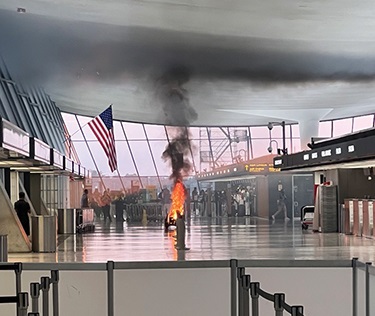
Airports come in a variety of forms, from large international passenger and cargo hubs to military bases and small, unmanned airfields in Alaska’s wilderness. In all, the United States is home to 20,031 aviation facilities, according to the Federal Aviation Administration (FAA). Many are regional or local, and many are private. Some are for seaplanes, gliders and ultralights. Thirteen serve balloon traffic.
Given their constant need for maintenance and technology upgrades, airports of all sizes represent a steady source of business for electrical contractors, including low-voltage and high-voltage specialists and systems integrators.
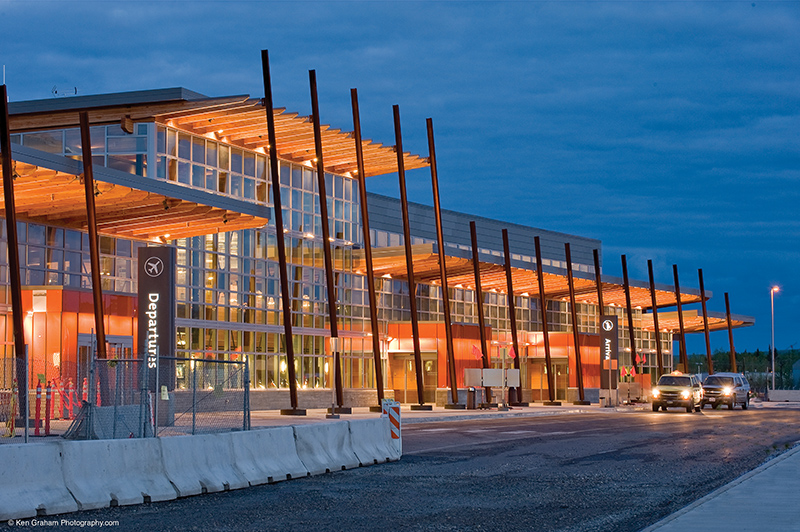 |  |
Alcan Electrical & Engineering has worked on Fairbanks International Airport.
The U.S. Department of Transportation’s goals for air transportation are to maintain safety, capacity, environmental performance, runway pavement condition, surface transportation accessibility and airport financial performance, according to the National Plan of Integrated Airport Systems (NPIAS). For 2025 through 2029, the United States committed $67.5 billion to NPIAS airport improvement projects.
Alaska
The FAA has designated Alaska as one of nine NPIAS regions. This may explain why it garnered the greatest number of NPIAS-supported projects of any state.
“On a per capita basis, we are the largest recipient of aviation infrastructure funding, but the width of our state, including the Aleutian Islands, is wider than the entire country,” said Larry Bell, executive manager for the Alaska NECA Chapter. The state has less than 740,000 residents but is heavy on military infrastructure. “The chapter’s aviation market share is normally a solid 10% of overall hours statewide, but if you figure in [Department of Defense] spending on a military basis, it easily gets up around 15% to 20%. There’s a large military presence, and construction is underway, with housing for squadrons, hangars, aprons and more.”
Almost as many airports in Alaska are receiving NPIAS funding as in the Eastern United States and New England regions combined. One reason is that roads only cover 20% of the state.
“Most Alaska residents live in or near Anchorage, Fairbanks and Juneau, but people definitely rely on smaller airports in the more remote villages,” Bell said. “Lots of smaller runways are for turbo prop planes and people living off the grid, and for emergency ambulatory services.”
In many places, mail arrives by pontoon planes or boats.
“In many rural communities, a home will serve as a pickup point for the community mail, and there may be less than 50 people in a community,” Bell said.
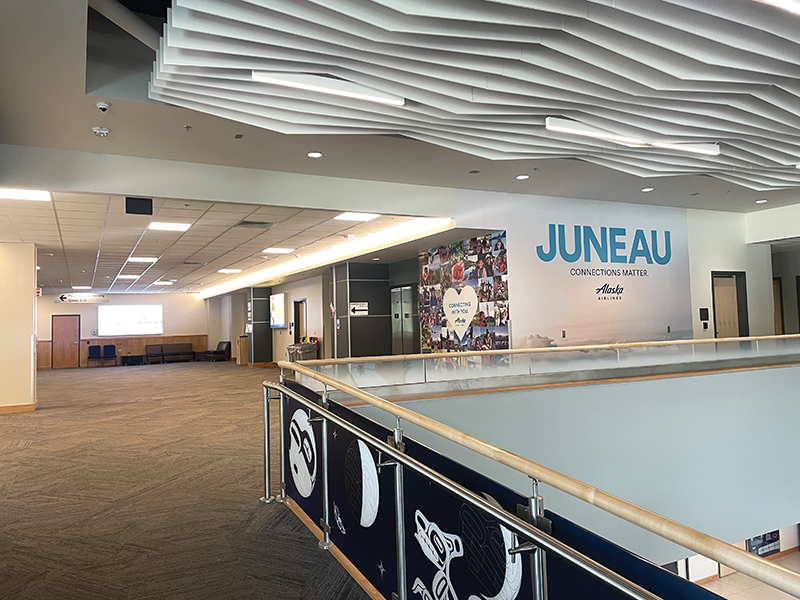
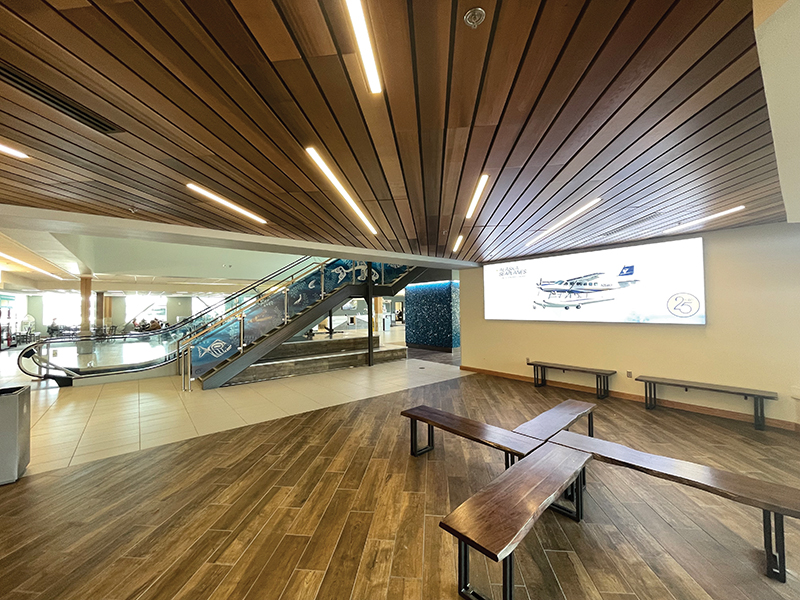
Juneau International Airport is among many in Alaska served by Alcan Electrical & Engineering.
One of Alaska’s largest electrical contractors is Alcan Electrical & Engineering Inc., headquartered in Anchorage, with additional offices in Fairbanks, Juneau and Wasilla. With 220 employees, Alcan serves Alaska’s Southcentral, Interior and Southeast regions, and remote communities statewide.
“Air travel is the lifeblood of Alaska—lots of villages only have access by small plane, and that goes for bringing in food and supplies, mail, transportation and emergency evacuation for medical care,” said Jesse Hale, vice president and partner owner at Alcan. “Those airports depend on regular maintenance of lights as well as air distribution systems that house panels that supply runways with power.”
Most of the smaller aviation facilities can be found from Fairbanks northward. They’re usually funded with state, federal and NPIAS money according to need, Hale said.
“The DOT relies on the same design and equipment [for smaller airports] you’d find outside of Alaska,” Hale said. “The main challenges are associated to the infrastructures in place not being designed to handle the extreme conditions such as flooding, extreme temps and storms. Most of the underground electrical pathways and fixtures supporting the runways repeatedly get destroyed by ground movement and flooding. That, in return, is never mitigated, causing line breaks once frozen in winter temps.”
Travel logistics to these remote sites become difficult, with maintenance needs occurring mostly in the coldest months. Electricians are challenged with making field repairs while relying on snowmobiles and ATVs. There’s also limited communication to outside support due to lack of reliable phone and Wi-Fi coverage.
“The airfields are not manned,” Hale said. “Somebody may keep an eye on them, but they have to be maintained.”
That maintenance process often involves traveling in by air as well.
On a larger local scale, Alcan maintains a steady presence at the Ted Stevens International Airport in Anchorage and its affiliated cargo airport. It recently completed an Americans with Disabilities Act accessibility design upgrade for the hearing impaired, which included installation of video monitors to display PA system messages.
“We have a robust tech department for handling AV voice over IP, fiber, structured cable, fiber, access control and security,” Hale said.
Air cargo routed through Anchorage flies over the North Pole to airports in the Eastern United States and international locations such as London and Frankfurt. FedEx and other air cargo carriers use the airport heavily, making it the second-largest U.S. air cargo hub.
“The ratio of cargo to passenger dollars spent there can be as high as 5:1 in cargo versus passenger dollars spent,” Bell said, adding that, “it’s because everyone wants their Alaskan seafood.”
Ted Stevens International Airport will eventually see construction of a new control tower to serve passenger and cargo traffic. The tower replaces an old one identified as inadequate by the FAA.
Aviation makes up 7% to 8% of Alcan’s business mix, Hale said, adding that this work could account for 25% when construction starts on the new tower.
That new project may take a while due to funding allocation delays, but regardless, Hale said, “We’re proud our trucks and hard hats at these locations serving the state and outlying communities. Air traffic is essential for survival here in Alaska, and safety and upkeep are key because our weather is unforgiving.”
Indiana
Aviation accounts for about 5% of the business for ERMCO Inc., Greenwood, Ind.
“It’s not a giant part of our portfolio, but it’s an important one, and one we plan to keep,” said Chris Fritzlen, ERMCO’s director of estimating.
ERMCO provides electrical services for airports in other states and municipal and metropolitan airports throughout Indiana.
“We also do work at reliever airports, where propeller planes and private jets must land so as not to disrupt other air traffic,” Fritzlen said. “We’re seeing an increase in private jets as a mode of travel.”
Those needs for reliever airports are not so different than for the smaller airports of Alaska—regular maintenance of lights, control panels and air distribution systems—but many have additional features.
ERMCO has updated runway and taxiway lighting to LED, and participated in construction of additional hanger structures, maintenance facilities and modernized fueling storage facilities.
“Several years ago, we completed a new hanger for the Indianapolis Colts team plane,” Fritzlen said.
ERMCO also has installed some small solar arrays at reliever airports, “but these facilities are not as ‘critical’ so they do not get some of the same backup power requirements. They always have upgraded backup generators, but little on-site storage (BESS), etc.,” Fritzlen said.
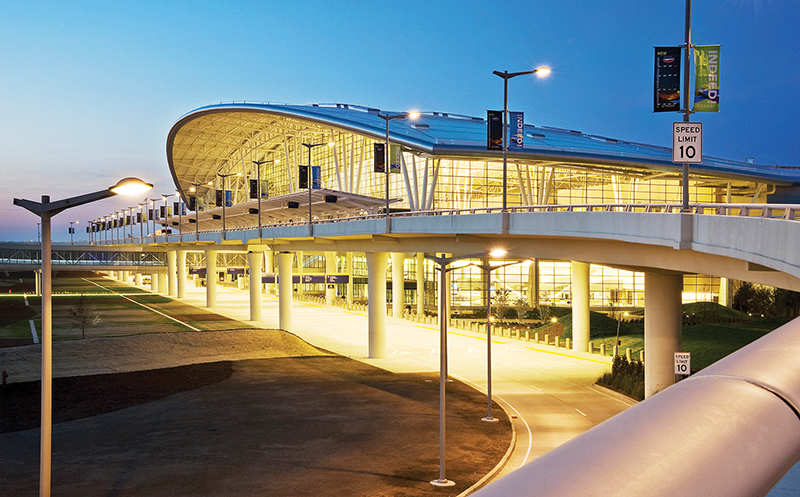 | 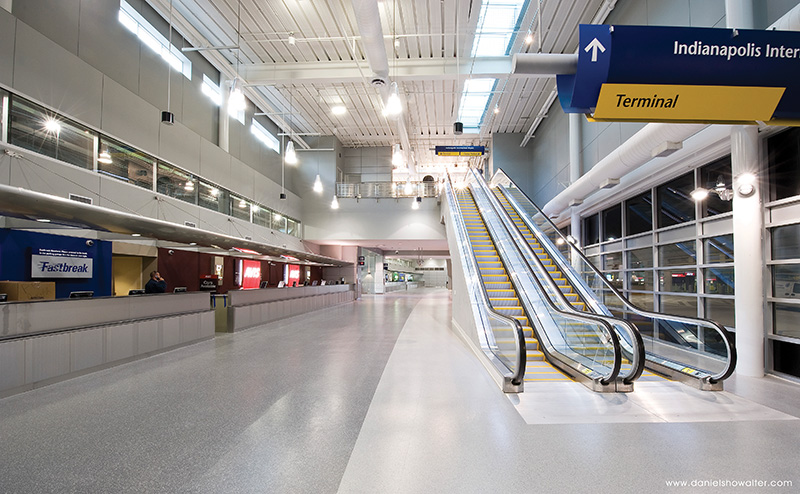 |  |
Indianapolis International Airport has a modern terminal and parking garage, solar farm and
EV charging stations. It has garnered recognition for easy maneuverability and customer satisfaction.
ERMCO is also a constant presence at Indianapolis International Airport (IND).
In 2008, the company participated in the building of a new terminal more strategically located between existing runways than the original constructed in 1931.
“It was the first airport fully designed and built post 9/11 with security measures not previously standard in airports,” Fritzlen said, adding that the project also included a control tower, new parking garage, new exit ramps and approach roads.
“We’ve had people there ever since,” Fritzlen said.
On most days, it’s a 10-person crew.
“We’ve benefited from continuous TSA screening improvements,” he said. “We switch out body and baggage scanners every couple of years.”
These days, ERMCO is installing more self-check-in stations and replacing kiosks.
ERMCO performs fiber and low-voltage work for the airport and the company benefits when carriers such as Verizon upgrade, Fritzlen said.
The FAA classifies IND as a medium-size hub. A robust convention business keeps it busy, Fritzlen said.
“IND is also FedEx’s second-largest hub,” Fritzlen said. “A crazy amount of planes land on that runway at night.”
ERMCO is currently carrying out the airport’s Energy Resilience project, setting up battery storage and power generation. They installed a solar field and, more recently, a solar canopy for a parking garage and related battery storage. Solar car ports are also being added to surface parking lots along with additional battery storage.
“Sustainability seems to be a huge factor, and the goal for the airport limit dependency on the grid and work toward net-zero,” Fritzlen said. “There’s a huge solar field at end of runway and solar arrays between runways and taxiways.”
ERMCO installed EV charging for electric shuttle buses and baggage handling tugs.
“We’ve installed a lot of EV charging stations throughout the airport,” Fritzlen said.
The airport also plans to enhance baggage handling screening area to make it more efficient, which is not surprising. The airport has gained traffic and expanded over the years but also ranked consistently high on customer satisfaction and being easy to navigate, Fritzlen said.
“We embrace that culture,” he said. “We’re part of the airport team when we’re out there. We’ve installed wayfinding signage with better technology, Wi-Fi bandwidth, better signals. The airport is constantly trying to improve customer experience, so we benefit from that effort.”
Another positive aspect of aviation projects is they can yield related work. IND recently broke ground for a 253-guestroom Westin hotel adjacent to the terminal and parking garage. ERMCO has also provided electrical services for car rental operations, eateries, hangars and housing for personnel, Fritzlen said.
Ken Graham Photography, ERMCO Inc, stock.adobe.com/Kiselov, ALCAN electrical & engineering inc./Ken Graham Photography/Eric brewer
About The Author
.jpg?sfvrsn=a64b988b_1)
DeGrane is a Chicago-based freelance writer. She has covered electrical contracting, renewable energy, senior living and other industries with articles published in the Chicago Tribune, New York Times and trade publications. Reach her at [email protected].