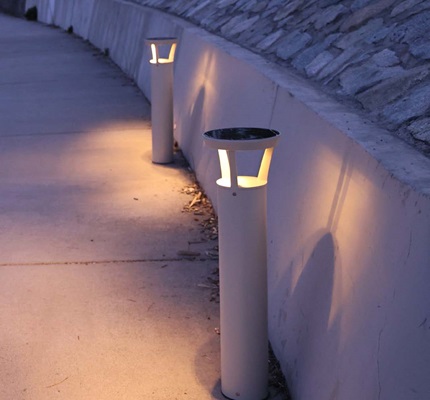
Humans and animals are sensitive to the timing and quality of light sources in their surroundings. According to the Epilepsy Foundation, flickering artificial light emitted by televisions, computer monitors, video games, fireworks and emergency vehicles can bring on seizures in about 3% of the world’s population. Responsible indoor and, particularly, outdoor lighting can benefit those who suffer from seizures as well as people and animals affected by disruption to their circadian rhythms and to the sky’s natural glow.
Contractors doing lighting work may want to consider DesignLights Consortium’s (DLC) seven strategies to minimize negative effects of outdoor light at night:
- Use dimmable and controls-ready light.
- Consult with local experts and community members to understand local impacts.
- Use the right amount of light and no more.
- Control light at night to reduce energy use and light pollution.
- Use lighting that can respond to seasonal changes in the environment, such as migration events, snowy periods and return of daylight hours.
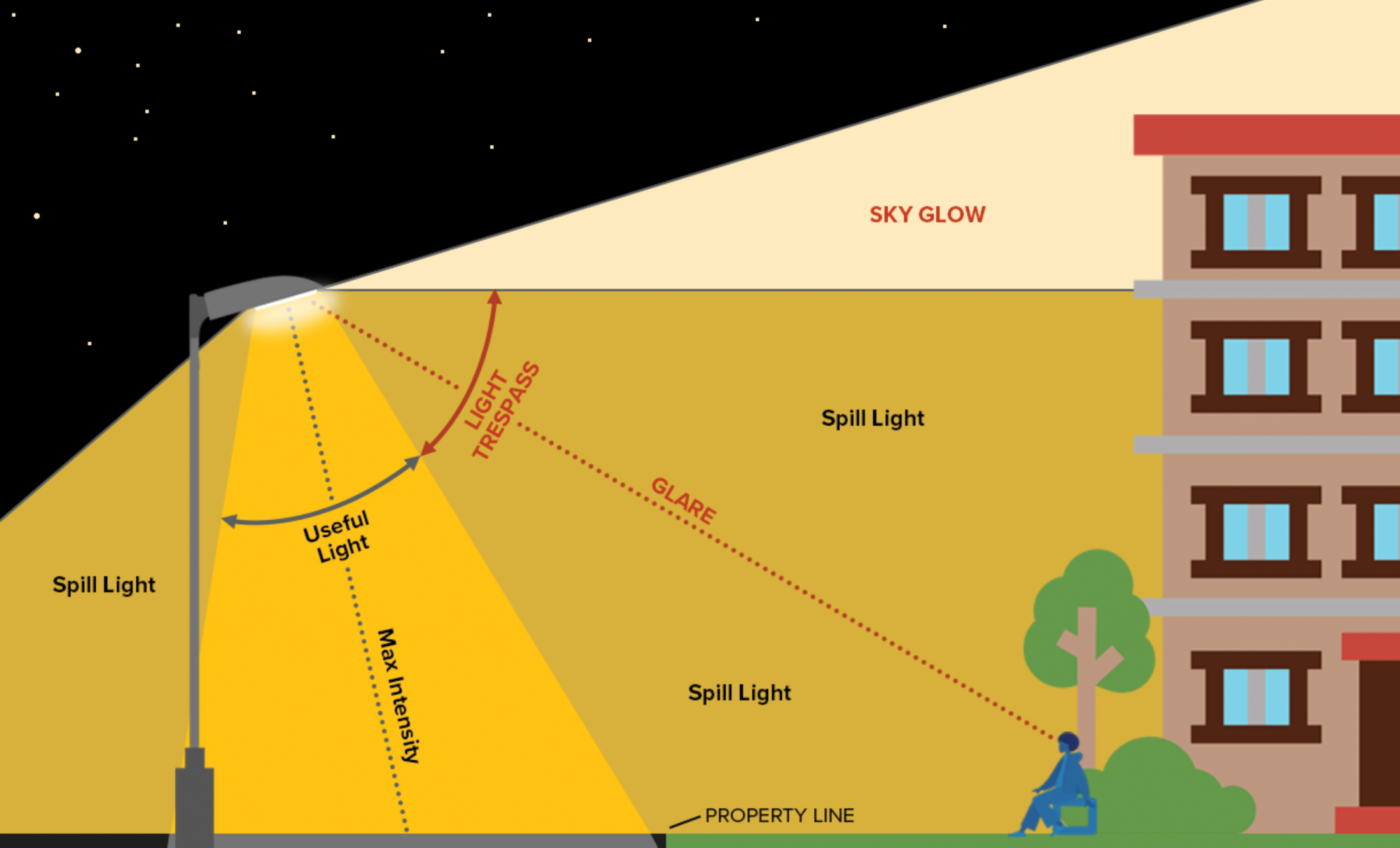
- Manage the distribution of light to minimize high-angle, upward light and light trespass.
- Minimize blue-violet light and choose products with a CCT of more than 3,000K.
DLC maintains a qualified products list of lighting fixtures and controls suitable for state-approved utility reimbursement programs and features the latest lighting standards. The consortium works with stakeholders on updating technical requirements.
DLC’s brochure listing these strategies, Seven Strategies to Minimize Negative Effects of Outdoor Light at Night, also explains the concept of light trespass, which equates to misdirected light that can cause blinding hazards, nuisance light or light spillover that affects animal habitats and plant growth.
Animals in the mix
Animals have a more pronounced response to light pollution than people in terms of sleep and waking cycles, directional orientation, feeding and mating cycles, and migratory movement.
“Many species are affected by light pollution, not just nocturnal species, and the impacts on behavior are broad,” said Leora Radetsky, senior scientist and director of DesignLights Consortium’s LUNA Program.
Two examples: Newly hatched sea turtles intending to head for the ocean become disoriented by beach restroom lights and head away from the ocean. Insects drawn to streetlights incite feeding frenzies for animals not normally inclined to overfeed on them.
All of this can destroy natural beauty in the form of local ecosystems and natural habitats as well as affect migratory behavior, which can disrupt additional habitats throughout the world, Radetsky said.
“We need biodiversity to support all life on Earth, and, beyond that, biodiversity provides enjoyment and economic benefits,” she said.
Commercial and industrial settings “are very large culprits” of light pollution, Radetsky said. “A lot of light is concentrated in a relatively small area, and systematic changes can have a large impact.”
Innovation
Fortunately, response to the unintended consequences of artificial light for humans and animals has prompted innovation.
“This is an exciting and evolving field, and we are learning how light at night is affecting ourselves and other species,” Radetsky said. “The good news is that lighting’s impact is acute, and dimming or switching off lighting has an immediate benefit.”
Changing color hue from cold bright blue to warmer yellow can also help.
With a process accredited by ANSI, the Illuminating Engineering Society (IES) publishes standards and booklets suggesting best applications and practices for outdoor and site applications, such as ANSI/IES RP-8-22, Design Of Roadway Facility Lighting, and ANSI/IES RP-43-22, Recommended Practice for Lighting Exterior Applications.
One factor delaying progress on curbing light pollution is that many people still don’t realize the capacity for light to spread.
“It’s important to consider that light pollution is not a local problem. Scattered light travels far from the original site,” she said.
Light from Las Vegas creates sky glow at Lake Mead more than 200 times brighter than the natural night sky, and Lake Mead is more than 30 miles away, she said.
“Even more surprisingly, perhaps, is that light pollution from Las Vegas is still detectable at the Grand Canyon—over 200 miles away from the Strip,” Radetsky said.
Responsible outdoor practices
Though progress could be faster, new lighting products and responsible practices are helping communities throughout the United States and commercial users of lighting products strike a fine balance between outdoor lighting needs for humans, curbing energy waste
and mitigating quality-of-life effects to people and wildlife.
Population movement away from urban areas to rural and suburban areas after the pandemic seems to be driving this in the United States. To stem increasing loss of healthier night sky settings, many states, counties and municipalities have enacted outdoor lighting ordinances intended to curb energy consumption and light pollution.
A nationwide map of light pollution ordinances, regularly updated by DLC, suggests just how wide the ordinance trend is. As of October 2025, 18 states—Arizona, Arkansas, California, Colorado, Connecticut, Delaware, Hawaii, Illinois, Maine, Maryland, Minnesota, Nevada, New Mexico, New York, Oregon, Texas, Virginia and Wyoming—all had mandates requiring responsible lighting practices that include taking measures to curb light pollution. In most states without ordinances, individual counties had enacted their own. Only two states were without responsible light ordinances of any kind.
Scott Mendelsohn is past president of the National Association of Lighting Management Companies (NALMCO) and one of the owners of Imperial Lighting Maintenance, Chicago. The family-owned business is known to partner with ECs on lighting projects.
In 2023, NALMCO and the IES forged a memorandum of understanding enabling collaboration on consensus-based guidelines as joint developers of the American National Standard titled ANSI/IES/NALMCO RP-36, Recommended Practice: Lighting Maintenance.
As a board member, Mendelsohn encourages electrical contractors to join NALMCO and obtain certifications aimed at supporting best lighting installation practices. The certifications range from basic certified apprentice lighting technician to certified lighting management consultant and more.
Improving indoor lighting
In indoor settings, simply installing a new LED light fixture without a compatible dimmer can cause performance issues such as flickering, ghosting or loss of dimming range. But on the positive side, new indoor lighting fixtures and controls facilitate light harvesting and can mimic natural daylight, which can reduce energy costs and cultivate healthier home and workplace settings.
Cost and customer satisfaction
It’s helpful to prevent unwanted outdoor light from shining into windows, which can disrupt sleep cycles. One sign of this need is an unusually robust demand for blackout curtains due to “increased urbanization and need to control light,” according to Growth Market Reports.
“We’re seeing control of light waste more from an energy-savings standpoint. But I do know there’s a shift to assist customers with human-centric lighting,” Mendelsohn said. “The flexibility offered by new products benefits these customers. It benefits us, too, because it enables us to deliver what they want.”
Mendelsohn is aware that light ordinances offer guidelines for customers within state, county and municipal boundaries to specify lighting features in RFPs and resulting contracts. The laws also affect permitting.
“It’s fairly seamless in areas mandating specific installation requirements and practices,” Mendelsohn said.
For the last several years, utilities throughout the nation have used incentives to drive the transition to more energyefficient LED lighting and networked lighting controls, he said. These incentives have helped customers save thousands on energy use and, in the process, realize better control for their own lighting needs.
“Features like occupancy sensors, daylight harvesting, dimming capabilities and being able to control color temperature all improve comfort levels and address customer needs more specifically,” Mendelsohn said. “These newer products are a vast improvement over earlier generation lights, where you basically ended up with a big blob of light. There was no dimming, no shutting on and off. Now, we can dim lights or shut them off altogether when they’re not needed, which extends the life of LED fixtures. Newer lighting fixtures are so precise they enable us to direct light to the edge of a property line and no further.”
Mendelsohn pointed out that lighting fixture selection is easier with new ones containing embedded controls for selecting color temperature and brightness. They also offer wider ranges and features for dimming. As far as lighting fixtures flickering or not performing properly due to pairing with incompatible dimmers, manufacturers are making solutions easier as well, suggesting compatible pairings for fixtures, dimmers and other controls, he said.
Better lighting control
Mendelsohn sees demand for better control of light growing as products continue to evolve. In Chicago, there’s plenty more room for LED saturation in outdoor lighting, and some areas with older generation LED lighting need upgrades and replacements.
DesignLights Consortium is in the process of updating its technical requirements and accepting applications for SSl V6.0 and Lumna V2.0 in January 2026. That process will also include DLC’s introduction of “turtle lighting,” which requires long-wavelength amber LEDs, special light distribution requirements and controls to accommodate local wildlife populations and ecosystems.
For more information, check out this webinar form the DLC.
stock.adobe.com / Rashevskyi Media
About The Author
.jpg?sfvrsn=a64b988b_1)
DeGrane is a Chicago-based freelance writer. She has covered electrical contracting, renewable energy, senior living and other industries with articles published in the Chicago Tribune, New York Times and trade publications. Reach her at [email protected].