When I started in fiber optics, Ph.D.s from Bell Labs were doing the first installations. They introduced me to the technology with help from experienced AT&T techs who had been installing copper telephone cables. Today, 40 years later, practically everybody is installing fiber, including many electricians. The period between has seen many changes in the fiber optic workforce.
The first commercial fiber optic networks were installed around 1980 by the big telephone companies, such as AT&T and GTE. AT&T built long-distance backbones on fiber on both coasts using the latest tech: multimode fiber and 850-nm lasers. While each were hundreds of miles long, they were really still experimental. They were used to test fiber optic cables and learn how to improve the products and installation.
The real beginning of fiber optic applications began in the mid-1980s when technology had improved by leaps and bounds. Single-mode fiber and 1,310-nm lasers became available, allowing much longer distances between repeaters and higher bit rates on every fiber. Telcos began installing long-distance trunks to replace copper and microwave links, which were now considered obsolete.
Multimode fiber did not disappear; it was adopted by the computer industry for local area networks (LANs) and links between computers and peripherals. These applications used cheaper LED sources because their speeds were much slower than telephone links with shorter distances.
The workforce divides
This marked the divergence of fiber optic applications into outside plant (OSP) and premises (indoors.) At the same time, the workforce diverged. Telcos needed techs to install OSP cables, while the computer industry was almost exclusively installing links indoors with premises cabling. Techs from both sectors were retrained, from installing copper cables to installing fiber.
The differences in OSP and premises installations were considerable and the techs learned very different skills. OSP techs learned how to install underground and aerial cables over long distances. Cables were mostly loose-tube designs with up to 144 fibers. Most underground cables were pulled into ducts where pulling tension and bend radius required careful monitoring. Aerial cables were usually lashed to a metal messenger.
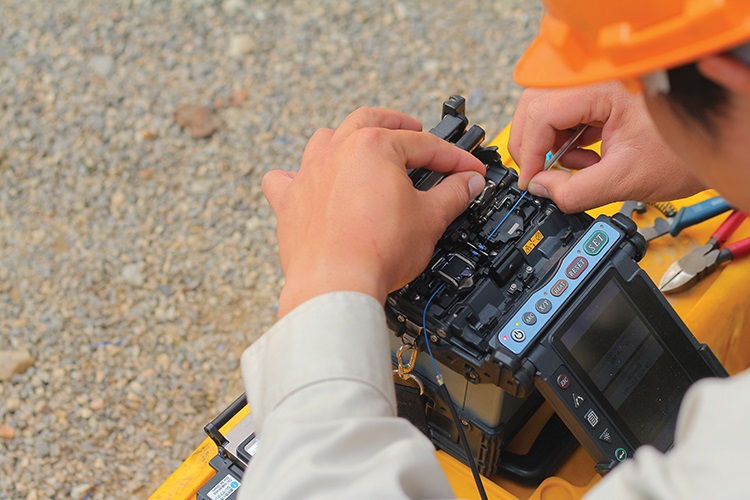
Because the longest cables that could be made were less than 5 km long due to factory machinery limits, cable weight and the amount of cable that could be wound on a spool, long-distance links required frequent splicing. Skillful OSP techs learned how to prepare cables for splicing, cleave and splice fibers efficiently, then place fibers and splices neatly in splice closures. When the fibers needed connectors, factory-made pigtails were fusion-spliced on to each fiber.
Every OSP cable was tested with an optical time-domain reflectometer (OTDR), an instrument that worked like radar in an optical fiber. The OTDR was invented in the late ´70s, but instruments in the ´80s were big, heavy and operated manually. Test techs had to learn to operate the instrument properly and visually analyze the trace from every fiber. If the OTDR offered a record of the test, it was a printed tape like from a cash register.
Different skills needed
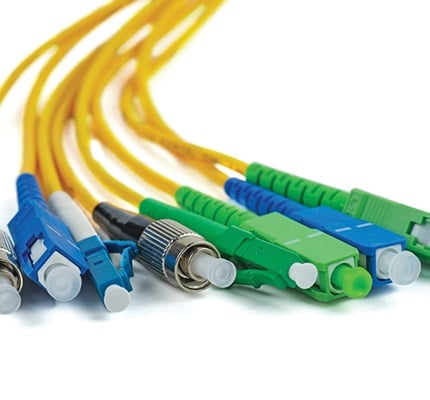
Premises techs needed different skills. Multimode fiber links were short and rarely needed splicing. Premises cables had only a few fibers and heavy flame-retardant plastic jackets. Techs learned how to terminate multimode fibers by gluing connectors on the fibers with epoxy and polishing every one by hand.
Testing these short links was different, too. A flashlight test checked continuity and polarity, connections from transmitter to receiver on a fiber pair. Fiber loss was tested with an LED light source and fiber optic power meter. Premises fibers were generally too short to be tested with OTDRs optimized for long-distance single-mode links.
In the mid-1980s, a new instrument was introduced that all fiber techs needed: the visual fault locator (VFL). While visiting the Hughes division that was developing fiber optic connectors for the military, I watched an engineer use a high-power, helium-neon laser to illuminate a fiber during an experiment.
I knew this would be a great tool for field techs troubleshooting fiber optic cable plants. The problem was that the laser was about 4 feet long, weighted 100 pounds and required a 2,500V power supply. The engineer told me that Hughes had another division that made the lasers, and they made some smaller ones.
That started a project that led to the introduction of the VFL to the fiber optic marketplace. You can read more about the development of the fiber optic VFL in my online column this month.
stock.adobe.com/baphit
About The Author

HAYES is a VDV writer and educator and the president of the Fiber Optic Association. Find him at www.JimHayes.com.