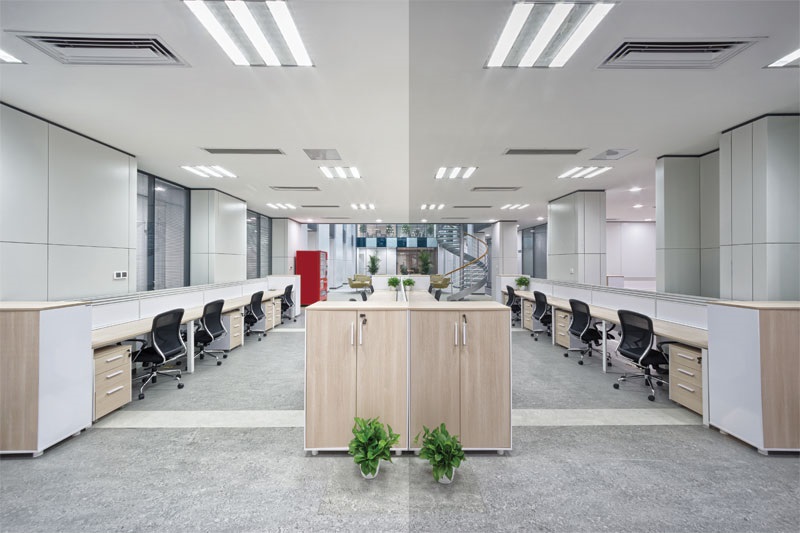
As many workers are called upon to return to the office after years of working remotely, one improvement is expected to make the day better and brighter for them. Company and building owners are replacing traditional, harsh fluorescent lights with new technology, such as faux skylights that mimic natural light, and adjustable illumination systems designed to sync with workers’ circadian rhythms. These systems can be tuned for brighter or dimmer light and for cooler or warmer light to mimic the phases of natural outdoor lighting.
“We’ve known for a long time that natural light is better and makes people feel better,” said Peter Capelli, professor of management at the University of Pennsylvania’s Wharton School.
It doesn’t just make people feel better; natural light helps them work better. Research has found that light has an effect on nonvisual brain function during cognitive tasks, especially when they involve sustained attention. Researchers in the early 2000s discovered photosensitive cells in the retina that detect light below our sense of awareness. These photoreceptors affect biology and behavior.
Adding some of these technologies can increase project costs 20%–30%. Nevertheless, requests for lighting upgrades have increased, said Jake Pack, an architectural lighting and materials specialist with SeaTac Lighting & Controls, Tukwila, Wash., where a mixture of tunable LED lights was installed. In theory, these lights will keep workers’ melatonin and serotonin levels in balance.
Other ways some companies are trying to make the office feel homier include flexible lighting in the form of cordless, rechargeable, portable lamps that can accompany workers from desk to conference room to breakroom, enabling them to always work under their preferred level of light.
Another increasingly popular idea is adjustable lighting for conference rooms, according to Jean Chandler, senior director of design at Industrious, New York. Dimming overhead lighting 20% during video calls reduces shadows on faces, for example.
Skanska USA, New York, developed a high-rise office building in Seattle featuring windows with a proprietary coating that adjusts the tint in response to a small electric charge. It’s controlled by an artificial intelligence app that provides input according to the amount of daylight available, modifying the tint accordingly.
Circadian Sky and Virtual Sun are examples of new technology in the form of faux lighted windows that project an image of a blue sky that fades to sunset by the end of the day and skylights that project a virtual sun and, at night, moon. Intended for offices without access to much, if any, natural light, they are manufactured by Innerscene, San Francisco, to mimic the changing natural light of the day.
About The Author

Lori Lovely is an award-winning writer and editor in central Indiana. She writes on technical topics, heavy equipment, automotive, motorsports, energy, water and wastewater, animals, real estate, home improvement, gardening and more. Reach her at: [email protected]