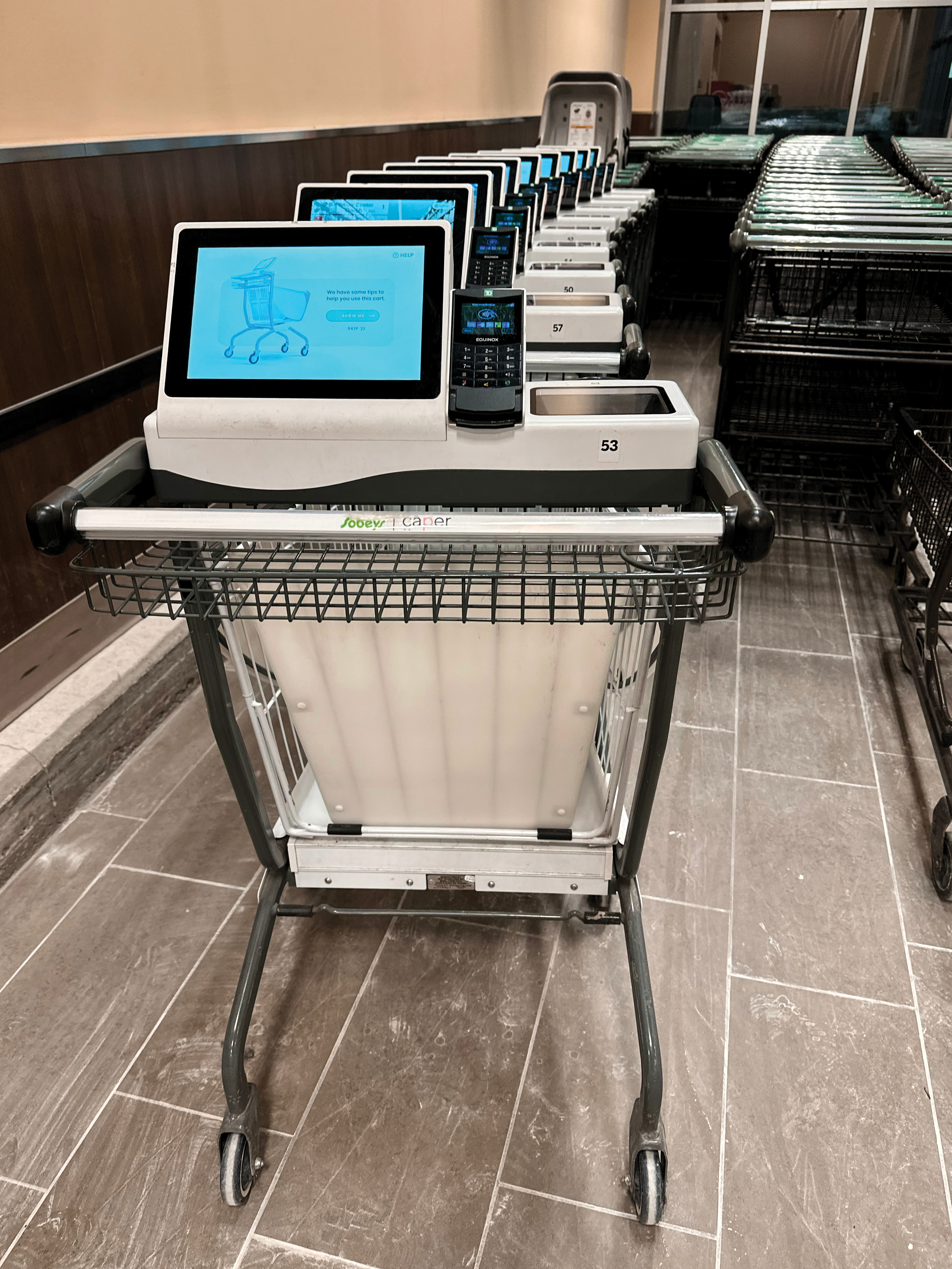
October is going to be a big month for Maurer’s Market in Wisconsin Dells, Wis. That’s when it will receive its Caper Carts from Instacart, San Francisco—“smart” shopping carts that let shoppers scan their items as they shop.
“As they are shopping, the Caper Cart is scanning the product and ‘ringing it up,’” said Kristie Maurer, co-owner of Maurer’s Market. “Customers bag as they go. This will enhance the customer experience in the store; [and for] customers on a budget, it allows them to know in real time as they are shopping how much they are spending.”
Here’s where an electrical contractor comes in. Caper Carts are powered through a corral that plugs into the wall, and the carts charge each other while nesting.
While such a setup sounds simple, there is plenty going on behind the curtain, according to Sarah Alqaysi, product manager for Siemens, Alpharetta, Ga.
“Smart cart charging systems function similarly to industrial EV charging applications,” Alqaysi said. “These setups require protected and managed power distribution to ensure both safety and system availability.”
To that end, contractors should be aware of the array of products that need to be installed. From Siemens, that includes the following:
- 3-volt-ampere molded-case circuit breakers for branch protection and fault isolation
- SIRIUS control relays to manage charging sequences
- TPS3 surge protection to safeguard the charging infrastructure from transients
- Power panels or switchboards that can be factory-configured for fast installation in back-of-store locations
Alqaysi added that, in some cases, her company’s low-voltage gear can integrate monitoring to track use patterns or detect overload conditions in real time.
In other words, smart carts are coming, and electrical contractors need to be ready. Kaitlyn Carl Ownby, director of retail communications for Instacart, said grocery retailers benefit from Caper Carts’ “integrated charging system, which streamlines operations with stacked charging and eliminates the need for individual cart charging or battery replacement.”
Ownby added that the carts are available at more than a dozen grocery retailers, including Aldi, Kroger, Schnucks and Wakefern as well as many regional and local independent grocers.
Robots at the market
Smart carts aren’t the only thing making for a new experience at your local grocery store. There is biometric checkout, e.g., palm-scanning systems, and an H-E-B grocery store in Austin, Texas, is piloting delivery robots the size of an ice cooler in the city’s Mueller District. These robots, made by Avride Inc., Austin, Texas, have a service radius of about a mile, and deliveries are limited to 10 small items.
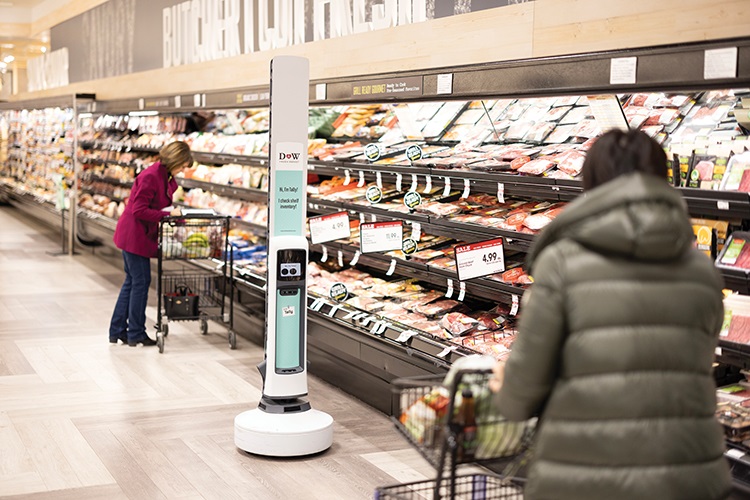
Here’s another one: robotic shelf stockers, which move from aisle to aisle checking inventory and restocking shelves. Burlingame, Calif.-based Simbe Robotics’ Tally shelf-scanning robots, which look a bit like a large, roving computer tower, use computer vision to identify precise product location, pricing information and stock levels.
Tally robots are used at grocers such as Schnucks, SpartanNash and Wakefern. The idea behind them is for retailers to get a view of store conditions in near-real time. Best of all, Simbe also has mobile apps where store managers and staff can interpret Tally data using their smartphones, further increasing efficiency.
Environmental performance meets public safety
That’s why Alqaysi said that like a lot of retail locations, grocery stores are becoming technology-rich environments. In addition to automation and robotics, the company is seeing innovation in three key areas:
- Energy efficiency and electrification through next-generation refrigeration systems using climate-conscious refrigerants and more efficient electrical equipment.
- Automated store logistics, such as on-site microfulfillment centers that handle online orders using conveyors and pick-and-pack robotics. A microfulfillment center’s inventory is separate from that of the retail floor.
- Smarter electrical infrastructure that ensures these systems run safely and efficiently with minimal downtime
But the refrigeration issue stands to have the greatest impact on contractors. Alqaysi said A2L refrigerants, which are a new class of refrigerants with low global warming potential, are being adopted in commercial refrigeration systems to meet environmental regulations. A2L refrigerants, named for their ASHRAE safety classification, are mildly flammable with low toxicity, incorporating hydrofluoroolefins.
“For grocery stores, this transition means electrical products used to control compressors and other refrigeration loads must meet strict UL safety standards,” she said, adding that Siemens’ contactors are tested according to UL 60335-2-40, Annexes JJ and NN, like the SIRIUS 3RT2 series, which are approved for use with A2L refrigerants. They are designed for motor-switching applications and tested for A2L use, along with DP contactors commonly used in HVAC and refrigeration systems.
“This represents a key shift that impacts both new construction and retrofit projects in the grocery space,” she said.
In a blog post, Schneider Electric, Boston, points out why all this is so important. Refrigeration equipment and cold rooms keep foods and beverages below 40°F for coolers and –4°F for freezers. Failing to meet those requirements, especially due to equipment failure, results in spoiled food. This can be a costly loss of partial—or even full—inventory.
But that’s not all. A store’s brand image can suffer, resulting in customers taking their business elsewhere. Once that happens, it can take a long time, if ever, to regain customers’ trust. This puts ECs on the front lines of ensuring public safety and benefiting a grocer’s brand and business prospects. It all ties together.
That attention to detail can also help a grocer attain certification through the Environmental Protection Agency’s GreenChill Program by achieving environmental performance beyond federal requirements.
Keep in mind, too, that grocery stores are loaded with sensitive electronics and equipment that operate in wet and cold environments. Surge protection is therefore essential for safeguarding refrigeration controls, self-checkout systems and smart shelving systems from voltage spikes and transients.
Alqaysi said that three-pole GFCI breakers provide critical ground-fault protection in refrigerated areas, prep kitchens and maintenance bays, where water exposure is a factor. They protect store personnel and equipment while helping stores stay code-compliant.
She also said that programmable logic controllers (PLCs) are essential to grocery store automation, managing everything from refrigeration cycling to conveyor systems used in an on-site microfulfillment center. Siemens offers the SIMATIC S7-1200 and S7-1500 PLCs, which are ideal for small- to mid-sized automation tasks within retail environments. These controllers integrate easily with SIRIUS ACT pushbuttons and sensors using the SIRIUS 3RC7 Intelligent Link Module, enabling decentralized control and condition monitoring from the panel.
But that’s the whole idea in the grocery store and beyond—to be prepared for what’s coming.
For electrical contractors, “servicing modern grocery stores means being prepared for highly electrified and compliance-focused environments,” Alqaysi said. “Contractors need to understand how to install and inspect components that are certified for use with A2L refrigerants.
“They should also be familiar with new digital tools that reduce wiring complexity and support diagnostics. Finally, working in grocery environments often means navigating NEC requirements for refrigeration, food prep and wet locations. Siemens products UL 489 2VA breakers with integrated GFCI help streamline compliance while reducing footprint and installation time.”
Alqaysi’s colleague, Javier Castaneda, added that “the technology built into the products make grocery stores smarter and safer. Each electrical contractor is going to have something there on their priority list.”
simbe robotics | Web Buttons Inc./stock.adobe.com, stock.adobe.com | Julia
About The Author

VOSS is a freelance writer based in the Chicago area and has worked extensively in the low- and high-voltage areas of the electrical industry. Contact him at [email protected].